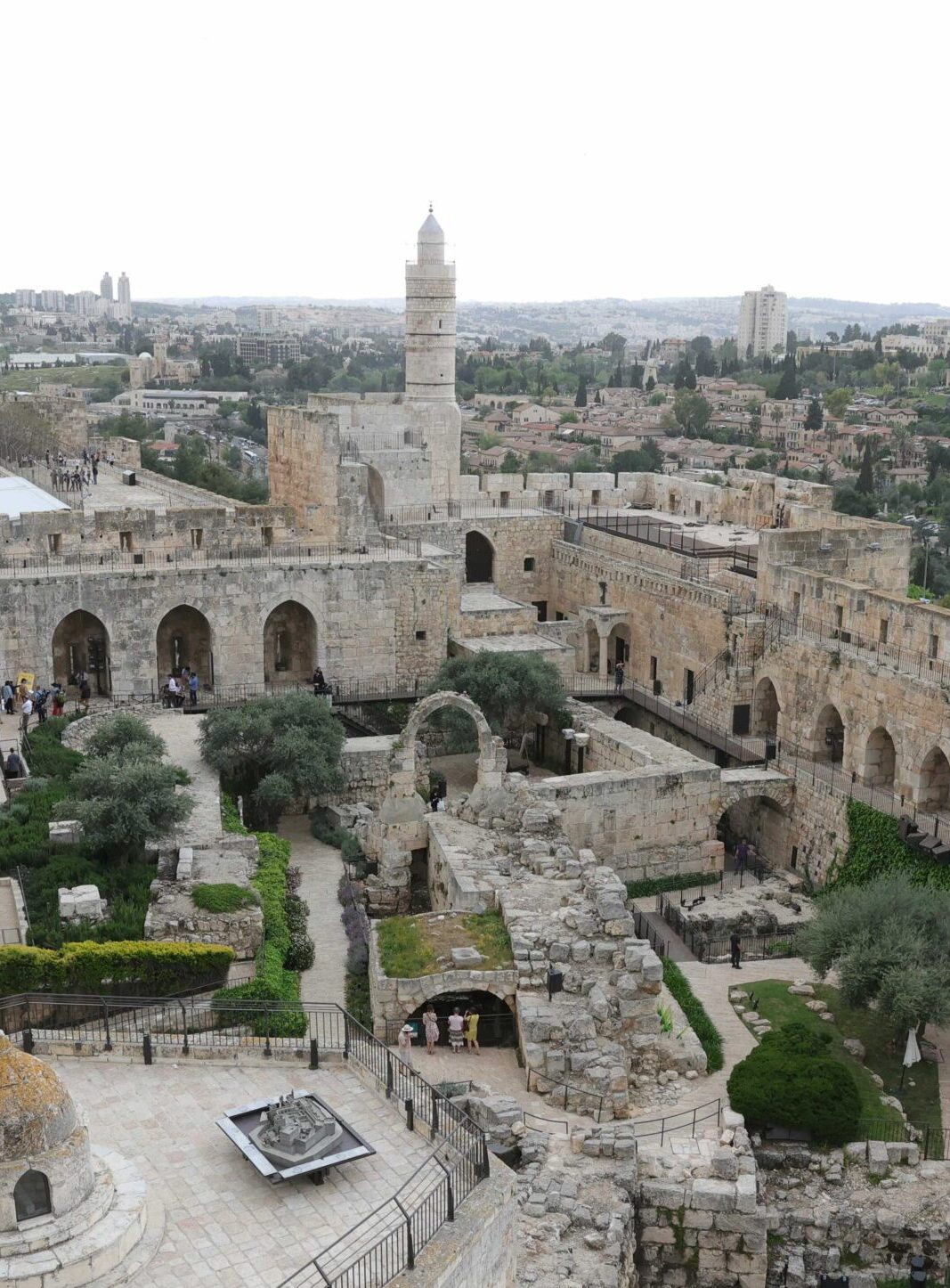
The accessibility project that has transformed Jerusalem’s Tower of David Museum over the past three years is no mere facelift. The fortress itself now takes center stage, serving as a gateway to the city of faiths

Tower of David Museum
Entry to the right of the plaza outside Jaffa Gate
Tel: *2884
Seasoned visitors to the Tower of David Museum may be surprised to discover that its entrance is no longer within the Old City but rather outside Jaffa Gate a few dozen meters away. The change isn’t just cosmetic. It reflects the entire philosophy behind the museum’s major, recently completed renovation: that the Tower of David should be the gateway through which tourists get their first taste of ancient Jerusalem, before touring the historical gems hidden within the Old City itself.
Navel of the World
As one opens the heavy, wooden door into the museum’s dark entrance hall, a freestanding wall of sophisticated touch screens introduces the history of Jerusalem. This state-of-the-art technology contrasts sharply with the sense of being inside an ancient fortress, its thick walls arching to a high ceiling against which dim lighting brackets create a torchlit effect. The tower itself is clearly now the main focus of the museum’s story, the inescapable prism through which Jerusalem is framed.
Some $50 million has been expended on this renovation, but much of it involves subtle changes that most visitors will never see. Every inch of every wall has been examined and treated for water and earthquake damage and erosion. (At one point in this exhaustive process, part of the ancient city wall was threatened with collapse.) All the cables powering the many multimedia installations have been concealed and plastered over in the cracks between the ancient stones.
Receding slightly from the uneven walls, the concrete floor essentially floats, resting on supports that raise it slightly above groundlevel. The resulting “crawlspace” houses heating and cooling systems and hides light fixtures and projectors at the base of the walls. Frameless, black glass screens hang almost like portraits in the exhibition rooms. Throughout, the medium serves the message, not the other way around.
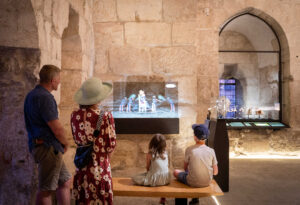
The visitor’s first brush with history is an animation projected on the wall right beside the entrance, schematically summarizing Jerusalem’s four-millennium story in under five minutes. The twelve interactive screens across the hall then invite museumgoers to dive deep into whichever era, religion, or ruler of the city they choose. In stark contrast with all this dazzling technology, the center of the room features a row of traditional display tables presenting artifacts of each period in the annals of Jerusalem.
Particularly informative is a changing outline of Jerusalem over the ages, projected onto a white topographic model of the city’s contours and noting the town’s size and population in each period.
Holy, Holy, Holy
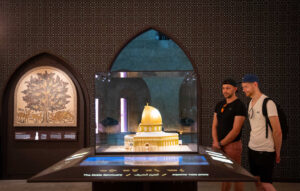
Three galleries lead visitors through Jerusalem’s journey from Canaanite town to capital sanctified by three world religions. The presentation of this potentially explosive narrative is remarkably evenhanded. Judaism, Christianity, and Islam each get their own rooms, centered on models of the Second Temple, the Church of the Holy Sepulchre, and the Dome of the Rock, respectively. As the first and last of these monumental structures occupy the same location, and the last was probably built in dialogue with and to compete with the second, these centerpieces are both intriguing and provocative. Furthermore, they grant members of all three faiths “access” to these buildings, even though the Second Temple is no longer, non-Muslims are barred from the Dome of the Rock, and many Jews won’t set foot in churches.
Each shrine gets a different treatment. Herod’s Temple is lit from within, detailing none of its contents. The Church of the Holy Sepulchre, situated where Jesus supposedly emerged from his tomb, reflects the complex built by Constantine in the fourth century. A digital display projects the building’s changes throughout its fifteen-hundred-year history, as necessitated by earthquake, fire, or conquest. The Dome of the Rock, site of the Holy of Holies and revered by Muslims as Muhammad’s point of departure in his night journey to Heaven, is cross-sectioned to provide both internal and external views. The digital dimension here shows the entire Temple Mount, enabling visitors to zoom in on any of the twenty or so structures located thereon.
Each room also reproduces a classic work of art central to the religion in question’s relationship with Jerusalem. Electronic effects allow interaction with each work, be it the Madaba Map, for example, which pinpoints the Holy Land’s Christian sites, or the Arch of Titus, depicting the Judean exiles’ march to Rome in chains, clutching the spoils of Jerusalem, including the Temple candelabra. The reproduction reflects Yeshiva University research into the arch’s original colors. Pigment slowly spreads across the relief’s white, marble figures, until they appear more or less as they did in ancient Rome. (The vivid, somewhat garish shades identified by scholars have been toned down for today’s sophisticated tourists).
Not yet a Segula subscriber?
Access our full archive online, have print issues delivered to your door, and moreFeel free to share