After the Old City of Jerusalem fell to the Jordanians, Dr. Shmuel Zanwil Kahane took charge of Israel’s few remaining holy sites. Pitching new pilgrimage destinations with boundless creativity and more than a little nerve, Kahane even added to their mystique with his own founding myths

In 1950, Jerusalem gained a new pilgrimage site: the Lion’s Cave, located in the Muslim graveyard of the city’s Mamilla neighborhood. The man responsible for this innovation was the director of Israel’s Ministry of Religious Affairs at the time, Shmuel Zanwil Kahane. This is his story.
As the armistice agreements following the War of Independence redrew the new state’s borders, Kahane faced a major challenge. Though Israel had survived, its Jewish population could no longer access most of the holy sites Jews had dreamed of for generations and visited before 1948. The Temple Mount, the Western Wall, in fact the entire Old City was beyond the border fence dividing West Jerusalem from the Hashemite Kingdom of Jordan. What pilgrimage destinations remained?
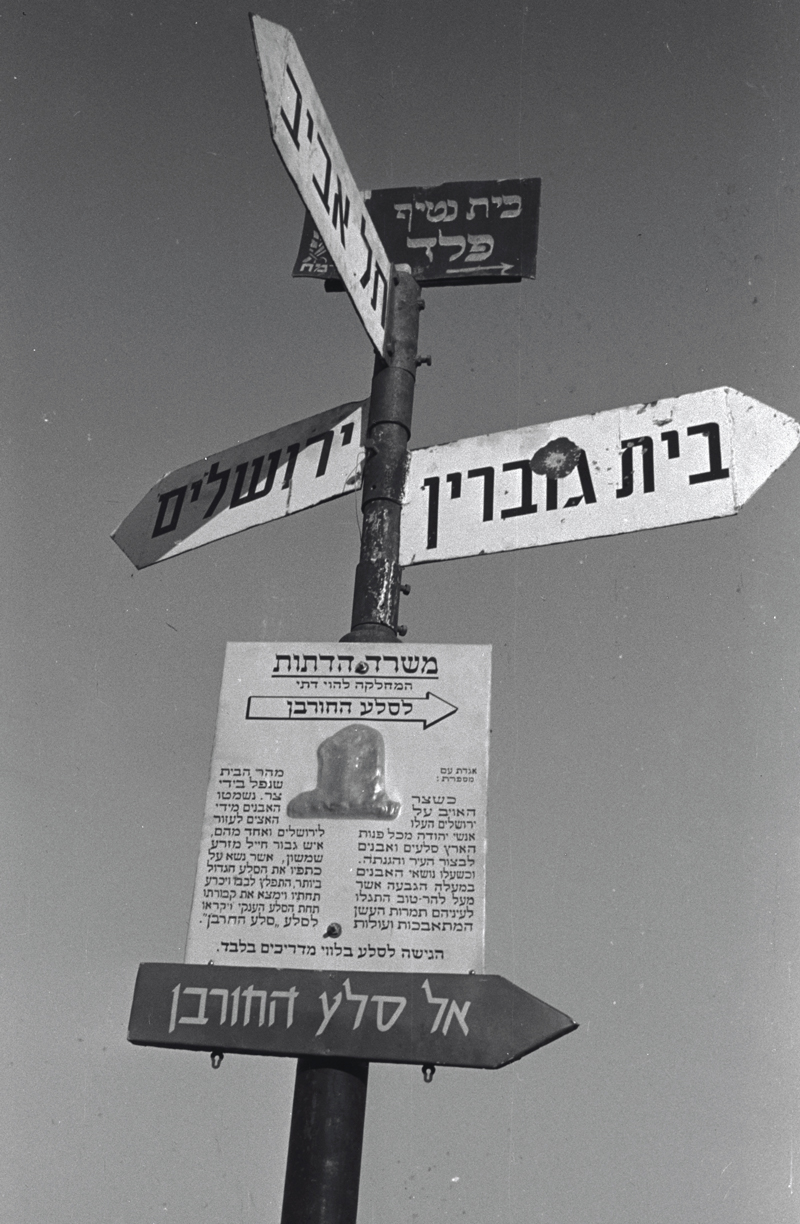
Unfazed, Kahane set about creatively filling the void, developing the Tombs of the Sanhedrin in Jerusalem, the Rock of Destruction in Eshtaol, near Beth Shemesh, and the graves of sundry Talmudic sages in the Galilee. His crowning achievement was David’s Tomb, on Mount Zion, which was primed to be the most important Jewish shrine in the country. Alongside it he established the Chamber of the Holocaust, among the first Holocaust commemoration sites in Israel, and ran what amounted to a one-man counseling service for survivors.
But Kahane’s efforts were not always well received. At the Lion’s Cave dedication, in September 1950, most of the attendees were Yemenite immigrants reciting Psalms. Maybe that’s because the site’s purported holiness was based mostly on ancient Jerusalemite traditions recorded in medieval travelogues. The sign at the entrance read:
Legend has it that the bodies of fallen Jewish warriors from the Hasmonean wars were brought to this cave. When the Hellenist [forces] came to defile [the corpses] the next morning, they found a lion guarding the cave entrance […]. Located on the basis of descriptions by disciples of Nahmanides and the Tosafists. (Israel State Archives, GL-13/6299)
Many criticized the cave’s “discovery” and development. Prof. Moshe Avneimelekh wondered:
If the cave has neither scientific nor religious value, and is distinguished only by an obscure tradition of dubious basis, possibly Jewish or Christian in origin, why should it be set aside for special [religious] events? […] There’s a grave danger that people could interpret the Religious Affairs Ministry’s stamp of approval as complete affirmation of the place’s sanctity. (Moshe Avneimelech, “Falsification of History,” Be-terem 17, no. 182 [1953], p. 20)
Though Kahane knew he was on shaky historical ground, he deemed the site worthy of preservation – and development.
I saw it as my duty as a researcher to present the suppositions that had been made, even if they were mere legends […]. These tales have their own beauty and educational value, and in my opinion there’s nothing to be gained by suppressing them or relegating them to some musty archive. (“Ministry of Religious Affairs’ Position on the Lion’s Cave,” Ha-zofe, 17 Tishrei 5715/October 14, 1954, p. 3)
In conjunction with the Jerusalem Municipality, plans were made to turn the cave and its environs into one of Jerusalem’s main Jewish pilgrimage sites. Together with other nearby caves – plus sculptures other symbolic decor – it was to serve as a memorial for historic heroes of Israel. Alongside a frieze of a lion, a large gate with five entrances would lead to the cave.
The project never materialized, and today the site is barely accessible. The cave entrance is blocked, and the whole area utterly neglected. It’s no longer marked on Jerusalem maps or even signposted.

Pilgrims’ Progress
Jewish pilgrimage dates back to the Bible and continued, though much diminished, after the destruction of the Second Temple in Jerusalem. Today, this custom has expanded exponentially, with thousands heading for Uman every year to pray at the tomb of Rabbi Nahman of Breslav in Ukraine. The Moroccan gravesites of famous rabbis are popular tourist destinations as well. Millions frequent Israel’s holy sites, in addition to the multitudes arriving for such special occasions as the anniversary of the death of Rabbi Shimon bar Yohai in Meron.
The Religious Affairs Ministry lists over 140 Jewish holy sites, including the House of the Shunamite Woman in Shunem (near Afula), the mikve of Rabbi Isaac Luria (known acronymically as the Ari) in Safed, Hebron’s Cave of Machpelah, and more. (Other spots have yet to gain official recognition, but they draw their own crowds. Among these meccas are the tomb of Grand Rabbi Gedalya Moshe Goldman of the Hasidic dynasty of Zvhil [d. 1950], located in Jerusalem’s Sheikh Badr cemetery; the Hasmonean tomb of Mattathias, outside Modi’in; and the shrine of the Moroccan rabbi David Ou-Moshe in Safed.) But seventy years ago, just after the founding of the State of Israel, the roster was much shorter: the tombs of several biblical kings, the graves of various Talmudic figures, and little else.
One of the earliest records regarding the few Jewish pilgrims to Jerusalem after its destruction by the Romans in 70 CE is the testimony of an anonymous Christian traveler from Bordeaux, France. Visiting Jerusalem in the fourth century, he observed Jews mourning among the ruins of the Temple Mount. In the sixth century, an Italian pilgrim from Piacenza recounted ceremonies performed by Jewish visitors at the Cave of the Patriarchs in Hebron. But we know almost nothing of other holy places – or the numbers they attracted – until the 11th–12th centuries, when the Crusades made pilgrimage a staple of Christian life. Descriptions by and of Jewish travelers multiply from then on, especially after the Muslims drove out the Crusaders, making holy sites more accessible to Jews.
With the rise of Zionism and the increasing ease of travel in the late 1800s, traditional destinations such as the Western Wall, Rachel’s Tomb, and the grave of the prophet Samuel (just north of Jerusalem) gained in importance and popularity. The 20th century added its own sites of Jewish and Zionist heroism, most notably the Judean Desert stronghold of Masada but also the graves of the Maccabees in Modi’in and Tel Hai, the Upper Galilee outpost where Joseph Trumpeldor was killed. Visits to these destinations became an integral part of Zionist education. The partition of Mandate Palestine into Jordan and Israel – with revisions following the 1948 War of Independence – left most of the Zionist pilgrimage spots intact. Yet the traditional holy places remained beyond the Jordanian border.

Not yet a Segula subscriber?
Access our full archive online, have print issues delivered to your door, and moreFeel free to share