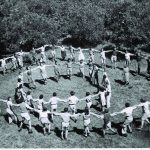
In 1928, the Soviets chose to establish an autonomous Jewish region east of Chinese Manchuria, with the city of Birobidzhan as its capital. As in the other Jewish homeland under construction at much the same time, Bauhaus architects played a major role in planning its urban center. What became of their efforts, both then and now?

Fascinated by the prospect of the world’s first socialist country, Western architects – particularly Germans – fixed their gaze on Russia’s new Bolshevik regime as it coalesced in the 1920s. Determined to modernize every aspect of life at almost any cost, the Soviets beckoned this cadre to what they presented as a land of unlimited opportunity. Giant projects, from dams and canals to cities and industrial complexes, were just waiting for the right drawing board.
The first architect to win a Soviet contract, though no great admirer of the USSR, was Erich Mendelsohn of Germany. A designer of numerous famous buildings in Jerusalem as well as the Weizmann Institute in Rehovot, Mendelsohn visited Leningrad (today’s St. Petersburg) twice between 1925 and 1926 and produced the blueprints for the Red Flag Textile Factory’s new buildings. Next came his colleague Le Corbusier, who planned the Centrosoyuz (Central Union of Consumer Societies) headquarters in Moscow in 1928. Many other architects followed, individually and in large groups. One highly influential collective, arriving in 1930, was headed by the Swiss Hannes Meyer.
Farthest East
Meyer, who ran the Bauhaus art school’s architecture department and later the entire institution (see “A Brief History of Bauhaus,” p. 14), first made contact with the Soviets when a delegation from Moscow’s Higher Art and Technical Institute arrived on campus in 1927. On his reciprocal visit in the spring of 1928, Meyer was accompanied by other Bauhaus faculty members: Arieh Sharon, who’d come from Mandate Palestine to join the staff, and Gunta Stölzl, a Swiss textile designer who taught weaving. Lodging in the Moscow University dormitories, the three participated in workshops and discussions exploring teaching methods as well as design and architecture issues. The program drew architects and their students from all over the USSR, and Meyer formed lasting ties with many. (A year later, Sharon and Stölzl married and moved to Tel Aviv, where Sharon’s long and celebrated career included his drafting of the State of Israel’s first architectural master plan. Stölzl later moved back to Switzerland to continue her own professional development.)

When Hannes Meyer was fired as director of Bauhaus due to a political disagreement with the Dessau municipality, Moscow became his next destination. More Bauhaus architectural alumni joined him in early 1931. Béla Scheffler, Konrad Püschel, Antonin Urban, and Philipp Tolziner had been part of the Red Bauhaus Brigade, a radical socialist faction within an institution already known for its revolutionary politics. In the USSR, they worked like any other Soviet architect – building schools, being paid in rubles, and refusing the benefits offered to foreign experts.
A devoted Socialist, Meyer fit into Soviet society more easily than the other foreigners recruited to work there. He planned grandiose projects in Moscow, Magnitogorsk, Nizne-Kur’insk (today Zakamsk, a suburb of the city of Perm), and Molotovo while teaching at the USSR Academy of Construction and Architecture (VASI). Interviewed in 1933, Meyer mentioned his interest in “the ethnic expression in socialist architecture,” apparently alluding to an even more grandiose enterprise – the world’s first Jewish socialist urban capital, in territory slated to become a Jewish homeland in one of Russia’s easternmost provinces. This Jewish Autonmous Region (JAR), situated in an area known as Birobidzhan, was intended to upgrade previous Soviet revolutionary schemes to settle Jewish farmers in southern Ukraine and on the northern Crimean Peninsula.
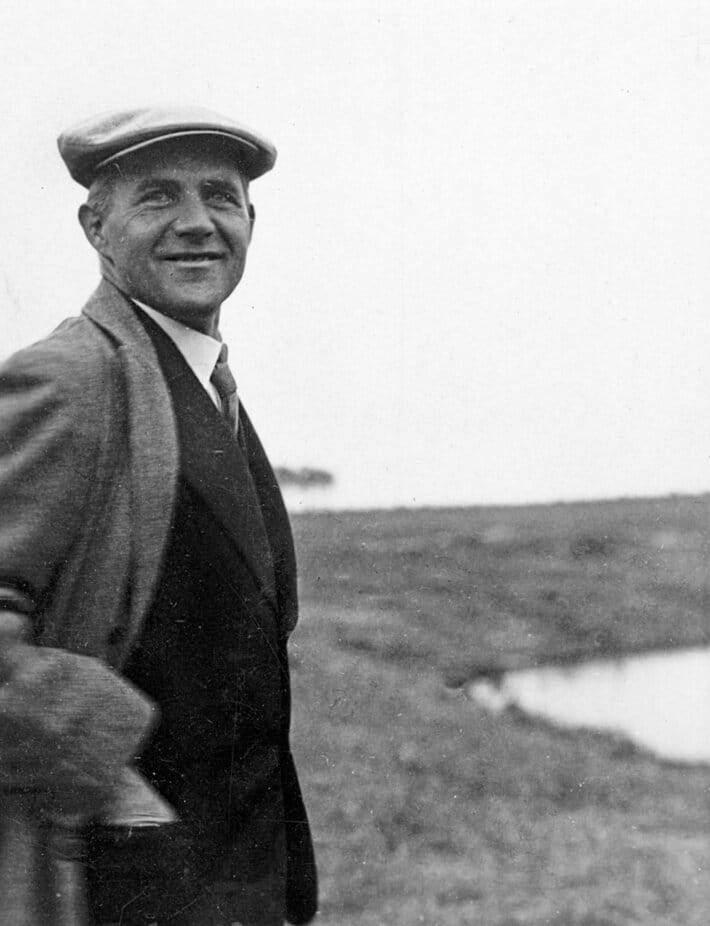
An ardent socialist, the Bauhaus school’s ex dean offered his services to the Soviet Union. Hannes Meyer, 1928 | Photo: Hermann Bunzel
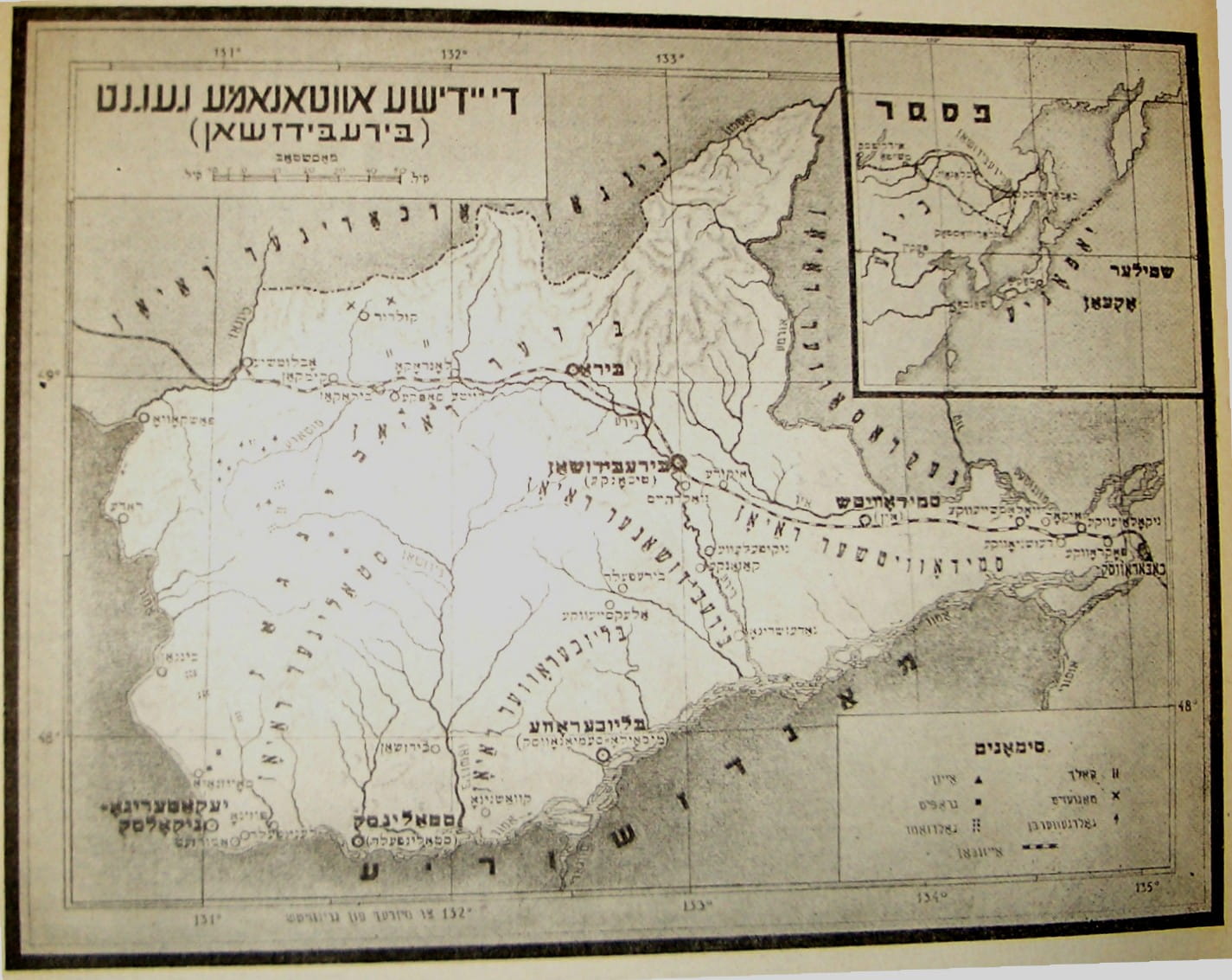
The Jewish region in the Far East. Map of Birobidzhan from the Yiddish daily Naylebn (New Life), January 1936
A “Yiddish Republic”
Birobidzhan is located north of the narrow strip of land dividing Chinese Manchuria in the west from the Pacific Ocean (and the Japanese islands) in the east. The rivers Bira and Bidzhan gave the region its name. Jewish settlement of the area was a unique experiment that developed under unusual political, economic, and cultural circumstances.
From the project’s beginning in 1928, the region boasted a Soviet Jewish education network in which Yiddish was the language of instruction. Along with nurseries and schools, colleges trained teachers and medics as well as metallurgical, mining, and railway engineers. The Birobidzhaner Shtern (Birobidzhan Star) newspaper launched in 1930 in Yiddish and is still produced today. A Yiddish publishing house distributed a wide range of other publications, and a Yiddish theater opened in 1934. An opera house, university, and other Yiddish-oriented institutions were in planning stages too.
The JAR marks an important chapter not only in the annals of Soviet Jewry but in modern Jewish history, Yiddish culture, and even Jewish politics. Though the project was a Soviet initiative, some fifty thousand Jews poured into the region of their own volition between 1928 and 1949 (largely because, after the Holocaust, they had nowhere else to go). The aim was to build a Jewish republic – a Yiddishspeaking Jewish cultural center – within the Soviet Union, attracting the finest creative talents.
Such ambitions dovetailed with the Soviet policy of granting every ethnic group its own region in which to develop its unique culture. The vision also served the USSR’s economic agenda of putting “unproductive” populations to work settling uncultivated land. And it secured Russia’s Far Eastern periphery from unfriendly Manchuria next door.
Land was designated in the spring of 1928, along with the resources necessary for industrial and agricultural development. Thirty-six thousand square kilometers, more than the entire area of Israel, was earmarked alongside the Trans-Siberian Railroad. Based mostly on agriculture, the future republic was to be less self-governing than Armenia or Uzbekistan but was awarded certain symbols of statehood. The place was to be built mostly by Jewish labor supervised by Mikhail Kalinin, titular Soviet head of state and president of the All-Russian Central Executive Committee.
Not yet a Segula subscriber?
Access our full archive online, have print issues delivered to your door, and moreFeel free to share