
Kfar Uriel was a source of pride for the young State of Israel, and Helen Keller’s visit was an excellent opportunity to show off this unique village where the blind live independent lives

In 1952, Helen Keller visited the blind-immigrant village of Kfar Uriel, near Gedera. There this famous American author and social activist, who became blind and deaf at a young age, declared:
This is not a village where blind persons are forced to depend upon the charity of others. It is a village where men and women who happen to be blind are self-respecting and productive people. (Intermountain Jewish News [Colorado] 39, no. 26 [June 26, 1952], p. 4)
With the founding of the Jewish state in 1948, the gates of immigration opened to all. The great waves of immigrants thus included the disabled and others with special needs. To assist them, the American Joint Distribution Committee (acronym JDC) created Malben, a Hebrew acronym for Institutions for the Care of Needy Immigrants. The goal was to find a solution for newcomers unsuited to government transit camps due to a variety of physical and emotional challenges. Since conventional wisdom had it that every disability required its own community, separate centers were created for each. Malben’s flagship project was the Village of the Blind or the Blind Moshav, founded in 1950 but renamed Kfar Uriel in 1951, at residents’ request.
Kfar Uriel numbered some seventy families – each of whose main breadwinner was blind – from fifteen countries, primarily Yemen and Iraq. Residents lived in wooden huts, while the clinic, grocery store, kindergartens, and other facilities were housed in concrete buildings connected by paved roads. Malben provided all supplies, including special accessories for the visually impaired, such as special watches.
A sheltered workshop enabled villagers to earn a living by manufacturing mattresses, brooms, baskets, lampshades, and raffia mats sold throughout Israel. Every department of this factory had guides who mentored the blind and lent support. Particularly industrious employees even took work home. The paths between the houses and the plant were equipped with a railing, enabling the blind to find their way relatively easily.
Public Relations
The JDC was funded by donations coaxed from American Jewry by the United Jewish Appeal, necessitating extensive public relations that included celebrity visits to Joint projects as well as press coverage, films, and photographs documenting such occasions.
In the spring of 1952, seventy-two-year-old Helen Keller embarked on a three-month tour organized by the American Foundation for the Overseas Blind to promote its goals and raise money. Keller’s inspiring personal story and the book she’d written had attracted global attention, which she leveraged to raise awareness of the needs of the blind and their integration into mainstream society. As soon as it became clear that her trip would include the Middle East, Malben lobbied to add its institutions to her itinerary.
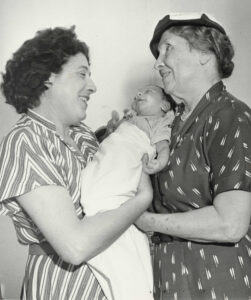
Keller traveled to Egypt, Lebanon, Syria, and Jordan, urging education for the blind and deaf as well as government efforts to ensure lives of dignity for these populations. She then spent some two weeks in Israel, hosted by Labor Minister Golda Meir. Aside from meeting with Prime Minister David Ben-Gurion and other politicians, Keller visited various residential and development enterprises as well as rehabilitation projects for the blind.
Sight Unseen
Keller’s stay in Kfar Uriel, the world’s only such community, was a highlight of her journey. Village director Dr. Nisan Hagel, a lawyer who’d lost his sight to illness and immigrated to Israel in 1949, showed her around with the help of his guide dog. In a stirring speech, Keller hailed the village’s embodiment of progress, culture, and peace, which would surely improve life for the blind. Residents then showered her with gifts.
Serenaded by kindergarten children, Keller “heard” the singing of these youngsters – new immigrants as well as native Israelis – by touching their throats and feeling their vocal cords. With one or even two blind parents, the kids were used to living with handicaps, so they were perfectly comfortable with this contact with their elderly visitor.
Locals described their campaign to rename the village, explaining that Uriel means “God’s Light.” Profoundly moved, Keller promised never to forget the place.
The Joint subsequently emphasized the personal connections Keller had managed to form in Kfar Uriel despite her seeing and hearing nothing.. “You’re not our guest,” director Hagel had told her, “you’re our sister.” Meeting with factory workers, Keller spoke in Hebrew she’d taught herself to pronounce: :
Dear people, by your fine work you will help the blind to gain a place in accordance with the dignity that their manhood and womanhood demand, and they will be led along a new way, where their feet will not stumble, nor their souls fade within them. (ibid.)
As she was leaving, however, Keller voiced a note of criticism. “I don’t approve of their being segregated,” she said. “In time perhaps they can go out and work with others” (ibid.)
Keller wasn’t the village’s only visitor. Busloads of tourists came to marvel at the spectacle of blind people working and supporting themselves. Even U.S. first lady Eleanor Roosevelt made an appearance. A good friend of Jewish women’s groups, Roosevelt maintained regular contact with the State of Israel.
Not yet a Segula subscriber?
Access our full archive online, have print issues delivered to your door, and moreFeel free to share