
In her short life, Grace Aguilar produced historical novels, theological works, and devotional texts whose psychological depths still reverberate for women today

There are moments in history when a woman’s clear voice transcends time, offering a gentle but piercing view of identity and faith. Grace Aguilar’s was one such voice, her writing illuminating ancient texts. Whereas most women dwelt silently in the shadows, she spoke out, and her quiet dignity couldn’t be ignored.
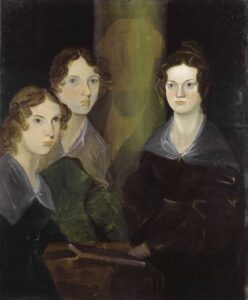
Aguilar lived when female authors were just coming into their own. Charlotte Brontë published Jane Eyre in 1847, the year Grace died, and Brontë’s sister Emily completed Wuthering Heights that same year. Mary Ann Evans – better known as George Eliot – authored Daniel Deronda (often considered the first Zionist novel) in 1876. Born in 1819, Eliot was just three years younger than Grace Aguilar.
Soul Food
Grace was the daughter of a wealthy, educated merchant family who’d fled the Portuguese Inquisition for the safety of London. Proud of being able to openly practice the faith of their fathers, her parents were deeply invested in their children’s Jewish education and identity. Like most girls of her time and station, Grace was educated at home, but – unlike them – her schooling was undertaken by her own mother and father.
Sarah Aguilar was a defining influence on her daughter’s character. Their deep connection was forged through Bible study, with Sarah reading to Grace. Recognizing her daughter’s literary talent, the mother encouraged its development.
The result was an accomplished author, poet, and Bible commentator. Although Grace Aguilar perished at thirty-one, her impressive literary legacy provided a foundation for Jewish feminism. She published twelve books, all translated and widely read in French, German, and Dutch, although only one – her Jewish historical novel, The Vale of Cedars (1850) – exists in Hebrew. Her profound appreciation for the Bible runs like a golden thread throughout her work. In the introduction to The Women of Israel (1845), her theological magnum opus, she described Scripture as a direct communication from God.
Sent as a message of love to our own souls, […] to elucidate [the Bible’s] glorious and consoling truths, to make manifest its simple lessons of character, as well as precept; to bring yet closer to the youthful and aspiring heart, the poetry, the beauty, the eloquence, the appealing tenderness of its sacred pages, […] to bring clearly before the women of Israel all that they owe to the word of God, […] the present task is undertaken. (The Women of Israel: Or, Characters and Sketches from the Holy Scriptures, and Jewish History [D. Appleton and Co., 1873], vol. 1, p. 7)
Aguilar believed that engaging directly with the Bible on an emotional and literary level was key to religious development.
To desert the Bible for its commentators; never to pursue its pages without notes of explanation; to regard it as a work which of itself is incomprehensible, is, indeed, a practice as hurtful as injudicious. (ibid.)
With Jewish women lacking direct access to Scripture, Women of Israel was devoted to righting this wrong. Though far from revolutionary, her unabashedly feminine voice legitimized women’s writing. She discoursed on history, biblical exegesis, and even the traditionally male domain of Jewish law.
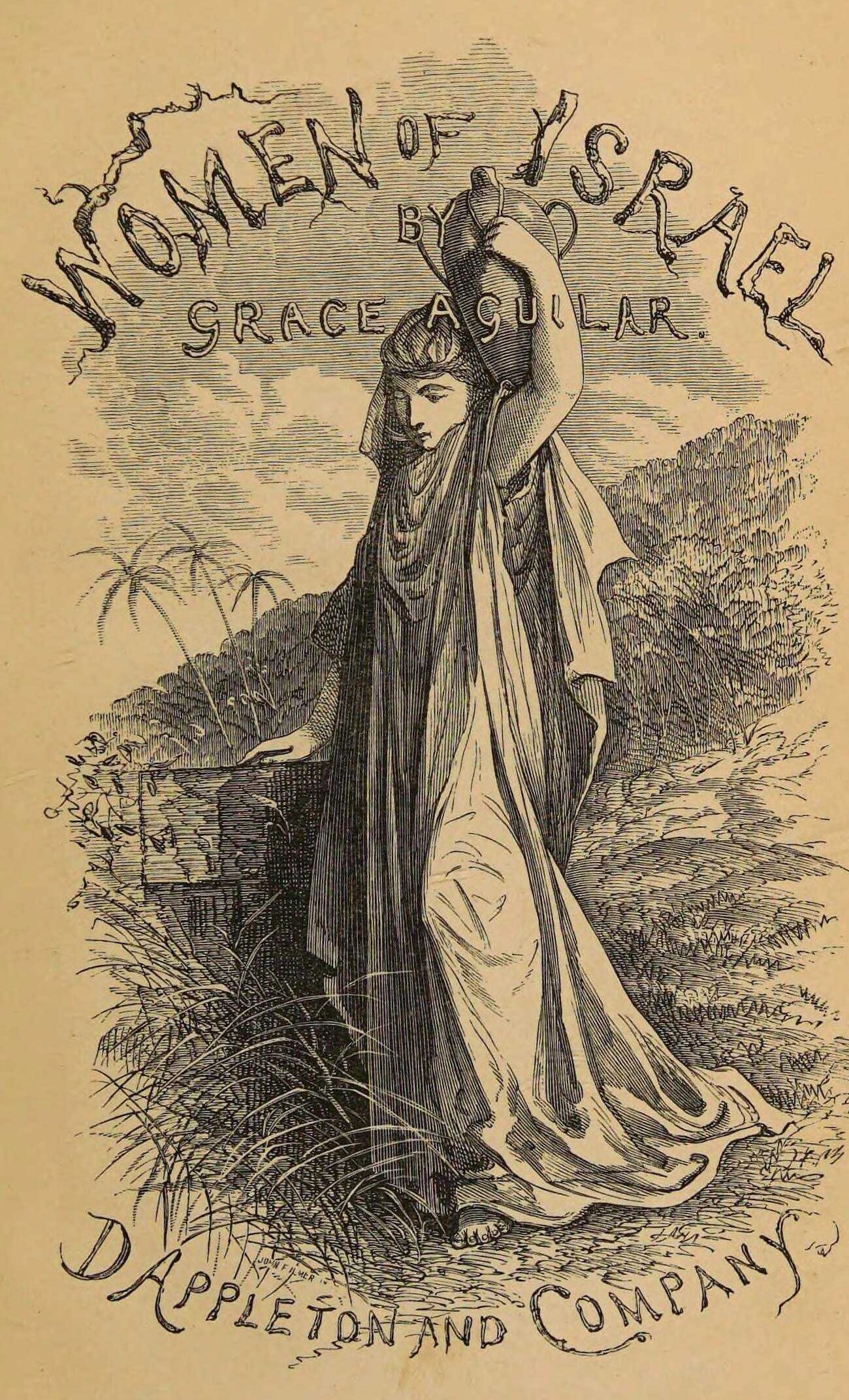
Flyleaf of Aguilar’s The Women of Israel, which traces Jewish history through its heroines
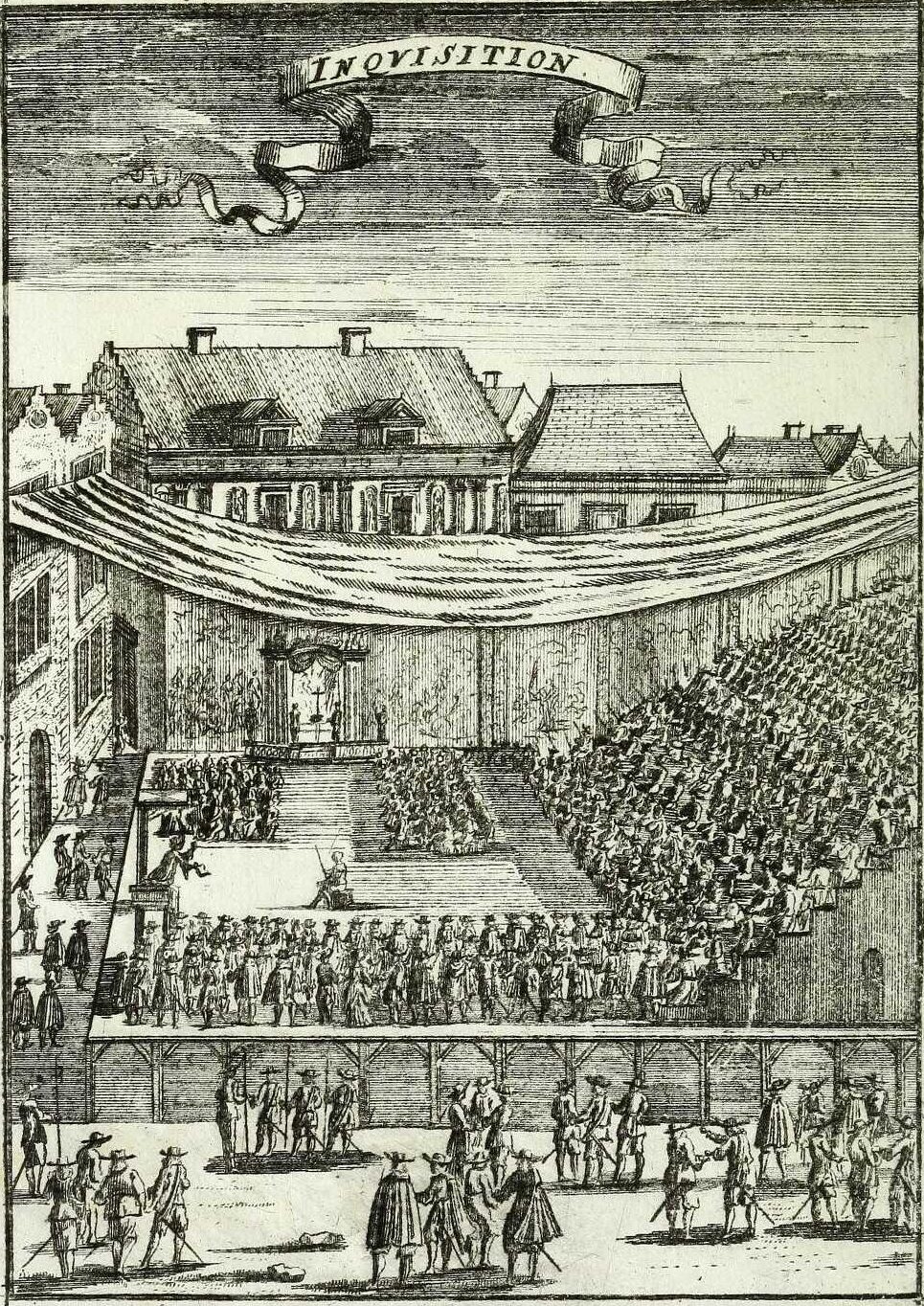
Grace Aguilar’s fascination with the question of loyalty to Judaism was probably rooted in her family history of persecution by the notorious Portuguese Inquisition, depicted below | Description de l’univers
A Woman’s Quill
We can imagine Grace Aguilar seated at her desk in London and setting to work, convinced that women could and should emerge from the same legal category as slaves, fools, and children to occupy the space God intended for them, as equal members of society.
How or whence originated the charge that the law of Moses sank the Hebrew female to the lowest state of degradation, placed her on a level with slaves or heathens, and denied her all mental and spiritual enjoyment, we know not; yet certain it is that this most extraordinary and unfounded idea obtains credence even in this enlightened age. The word of God at once proves its falsity; for it is impossible to read the Mosaic law without the true and touching conviction, that the female Hebrew was even more an object of the tender and soothing care of the Eternal than the male. (ibid., p. 11)
Aguilar claimed that anyone, man and woman alike, could understand and interpret the words of the law and the prophets. Here she followed in the footsteps of the Anglican Church, which was founded on the premise that the Bible should be accessible to all, and which had paid in the blood of martyrs for the right to read Scripture in English.
Addressing above all the women of Israel, Grace deemed them as vital to the Jewish community as their brothers, with the Jewish people’s very survival resting on their commitment. She wrestled valiantly with the widespread belief that Jewish law discriminated against women, arguing that any limitations placed upon them over the generations – and expressed in the Talmud and other texts – stemmed from the Jewish people’s dire circumstances rather than God’s will.
Grace was well aware of the relative ignorance of the average English Jewess and the pressure to abandon the despised chosen people. Many converted to Christianity, whether out of religious conviction or simply to improve their lot (such as by marriage). She was certain that if only they could see Judaism and its God as she did – as a faith more enlightened with regard to women and more protective of their welfare than any other, with God as a sheltering father comforting the widows, orphans, and oppressed rather than a stern master and judge – they would take a different path:
The women of Israel must themselves arise and prove the truth of what we urge – by their own conduct, their own belief, their own ever-acting and ever-influencing religion, prove without doubt or question that we need not Christianity to teach us our mission – prove that our duties, our privileges, were assigned us from the very beginning of the world, confirmed by that law to which we still adhere, and will adhere forever, and manifested by the whole history of the Bible. (ibid., p. 13)

Life of the Party
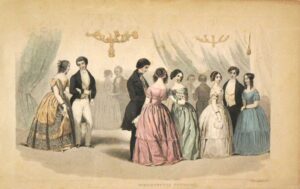
Yet Grace had her lighter side as well and could be a lively companion. Writer Caroline Bowles Southey recollected meeting her early on at a ball:
I was much struck by the appearance of a young girl, apparently in the first flush of girlhood (then in her seventeenth year) enjoying the dance with great zest. She was tall and graceful, her eye of rich blue, beaming with intelligence, shaded by long dark silken eyelashes, […] her hair of a brown cast […] hanging in clustering ringlets around her fair throat. (Beth-Zion Lask Abrahams, “Grace Aguilar: A Centenary Tribute,” in Transactions of the Jewish Historical Society of England [1945], p. 140)
Introducing a posthumous edition of one of her daughter’s works, Sarah Aguilar recalled Grace’s love of music and dancing but also her willingness to forgo the latter at her mother’s anxious urging:
A wish was once expressed by her mother that she should not waltz, and no solicitation could afterwards tempt her. (Grace Aguilar, Home Influence [1852], p. xiii)
From that moment, Grace accepted her mother’s understanding of her mission, embarking on a spiritual leadership that left no room for trivial pursuits.
Grace’s education was fairly typical of any middle-class British girl of her day; yet while she studied music and embroidery at home, her parents also schooled her in Judaism. Her diary describes how her mother sat with an open Bible on her lap, waiting for her daughter’s music lesson to be over, while her father shared Talmudic and rabbinic legends as she sewed. Tales of her family’s crypto-Jewish heritage were also handed down.
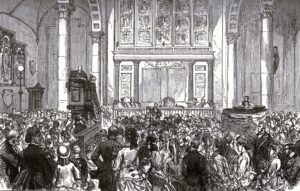
The young girl’s passion for music often took her to the church near her home in Teignmouth, Devon, where the family moved from London due to Emmanuel Aguilar’s failing health. Isolated from the Spanish and Portuguese congregation of London’s Bevis Marks Synagogue, where her father had been a lay leader, Grace relished not only the hymns and the organ. The pastor’s sermons, packed with biblical inspirational passages, were a particular delight. Distressed that no such experience was available to England’s young Jews, she started a weekly gazette with stories from the weekly Torah reading and other items of interest to the women around her. As she wrote in The Jewish Faith (1864), published in the last year of her life:
Our youth indeed need help and guidance, or they are likely to be lost in the fearful vortex of contending opinions around them. To rest indifferent and unenquiring, always unnatural to youth, would actually be impossible now; and more than ever, books are needed on which the mind and heart may rest – and more especially for our Female Youth. For them, there is literally no help in the way of vernacular religious literature. (Grace Aguilar, The Jewish Faith: Its Spiritual Consolation, Moral Guidance, and Immortal Hope, p. 14)
Protestant Jewess?
A passage from Grace’s posthumously published essay collection, Sabbath Thoughts, expresses the ease she felt listening to the church service:
There is nothing, in my opinion, that enlarges an unprejudiced mind more than joining with those of another faith in their religious ceremonies. […] I thank God He has in His mercy permitted me to be so firmly convinced of the truth and holiness of my own belief, that it is a pleasure to me to join with Christians in their religious forms. […] I am so firmly convinced that the Christian religion is that Kingdom of Iron prophesied by Daniel. When the Kingdom of Iron has extended over the whole world, then will our Messiah, the Saviour of the Jews appear, to cleanse the Christian nation from their impurities. (Grace Aguilar, Sabbath Thoughts and Sacred Communings, ed. S. Aguilar J. Wertheimer, 1853], p. 2)
Although this suggestion drew significant criticism for seemingly promoting assimilation, Aguilar saw the dissolution of barriers between Jews and Christians as a strength.
Yet in The Jewish Faith, Grace daringly exposed her deep alienation as a Jewess in a Protestant country town. In this exchange of letters between a young woman and an older one on the subject of immortality, the author defends Judaism while acknowledging Jews’ new circumstances in relatively liberal England.
Bearing the Torch
Sadly, Aguilar’s parents were both invalids, so much of the burden of raising and educating her younger brothers fell on her shoulders from an early age. Her longing to provide them with spiritual sustenance made her realize that many Jewish mothers must feel as inadequate as she. So she developed educational tools to strengthen Jewish women’s identity, enabling them to imbue their children with the basic tenets of faith.
Grace’s diary recounts how she woke early every morning to record the principal obligations and practices a mother had to teach her offspring. These short essays stemmed from her conviction that Jewish education begins at home. Eventually they became her first published prose work, The Spirit of Judaism, produced in the United States in 1842.
At times, Grace Aguilar differentiates between rabbinic precepts and interpretations and the Bible itself, attributing prejudice and discrimination to the former rather than the latter. Scripture, she wrote, is God’s word to man, whereas in Judaism:
There may be some observances which superstition and bigotry have introduced. (Spirit of Judaism, p. 178)
This critique earned her opposition. Even her publisher, Jewish Publication Society founder Isaac Leeser, had to comment. Although his introduction to The Spirit of Judaism lauded the depth and breadth of its young author’s erudition, this Philadelphia Jewish leader footnoted some of her more radical utterances.
Grace didn’t give up, however. Her dream was to give Jewish values wider exposure among both Jews and non-Jews. Only by spreading Judaism’s hope and optimism, she believed, could the religion be truly appreciated.
Biblical Role Models
Though Aguilar never became either, the Jewish wife and mother dominate her works. Her Women of Israel analyzes the heroines of biblical and later Jewish history from a female perspective, reading between the lines to express a deeply feminine voice. She places particular emphasis on women’s role in maintaining the Jewish home in times of trouble and on their full partnership in the making of the Jewish people.
The Women of Israel covers the entire Bible, the Second Temple period, destruction, and exile, yet it begins – somewhat surprisingly – with Eve.
As the mother of humanity, Aguilar sees Eve as a recipient of divine mercy from the moment of her creation. The author describes Eve’s pain at the death of her son Abel and her separation from Cain, her beloved firstborn, whose murder of his brother is punished by exile. Aguilar wonders how any woman could recover from such blows to bring more children into the world. Yet Eve somehow gives birth to Seth, continuing the human race. She’s thus the inspirational paradigm for suffering women.
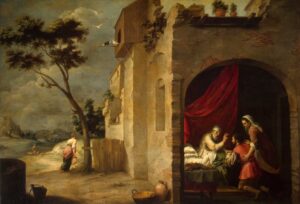
Rebecca, on the other hand, epitomizes the enterprising heroine. Leaving home as a young girl, she ventures into the unknown to meet her destiny. Taking responsibility, she pushes Jacob to obtain the paternal blessing she knows he deserves. Learning from Eve’s loss, Rebecca ensures that Jacob flees before Esau kills him, though aware she may never see her favorite son again. For Aguilar, Rebecca must choose between her sons, preferring the faithful one over the rebel. So too, the mothers of the Jewish people hold the nation’s fate in their hands.
The daughters of Zelophehad (Numbers 27), demanding their father’s inheritance in the absence of a male heir, represent women’s potential to take control of their lives and change society. Aguilar calls on her female readers to follow the daughters’ example and stand up for themselves in the face of male leadership, yet she also praises these five unmarried women for wisely preserving the integrity of their tribe. She views their very ability to step forward, and the fact that “God Himself deigned to reply” (Women of Israel, vol. 1, p. 182), as proof of the Jewish woman’s freedom and equality.
While aiming to provide Jewish women with role models, inspiration, and a sense of belonging, the book preaches dignity and love for all mankind as well.
Aguilar ends this volume by urging her contemporaries to take advantage of England’s rare atmosphere of tolerance and their own relative freedom from the economic burden of providing for a family to develop their spirituality, refine their characters, and teach those around them – above all their families – to recognize and proclaim God’s goodness in the world.
Resilient Heroines
Aguilar wrote novels and poems as well as intellectual works. Her Valley of the Cedars, begun when she was only fifteen, was published three years after her death. Set during the Spanish Inquisition, this fictional work tells the story of a young Jewish woman forced to choose between her love for a Christian nobleman and her Jewish faith; her decision expresses the fierce spirit of martyrdom among descendants of conversos. Intended to empower female Jewish readers targeted by Victorian missionaries, the protagonist opts for Judaism and family loyalty even at the cost of the love of her life. The narrative may well borrow from the Aguilar family history as recounted by Grace’s father.
Aguilar was frail from an early age, and a severe case of measles contracted at age nineteen left her largely homebound. Nevertheless, she was determined to help support her family by writing. Just over a decade later, two years after her father died in her arms, her health deteriorated. Although she traveled with her mother to Frankfurt in search of a cure, she died a few months after their arrival.
Even as many women’s spiritual needs were disregarded, Aguilar endeavored to be their voice. Despite the many handbooks for women in her day – on everything from manners to housekeeping – she lamented that none enabled the daughters of Israel to see themselves reflected in the heroines of the Bible. For them, Scripture was merely a manual of Jewish law, not a means of identification with their foremothers.
Grace Aguilar’s brief life and rich heritage serve as a vital reminder that women’s strength springs from inner conviction fed by profound study and independence of spirit. She called on her sisters to look to the Bible to strengthen their resolve and anchor their Jewish pride. In the ongoing struggle for women’s rights, her words are as relevant today as ever.
Feel free to share