
Six years before the port of Eilat opened in 1956, a dilapidated ship loaded with Yemenite Jewry’s cultural heritage anchored offshore. What happened to those priceless manuscripts?

Where To?
Eilat Port
Israel’s southernmost port

Traversing the rickety road from the Israeli port of Eilat to its Egyptian equivalent in Taba, past thousands of imported cars lined up in spectacular order, glinting in Eilat’s glaring sun, it’s hard not to feel a glimmer of pride. Somehow this pinch-waisted country, less than ninety kilometers across from Ein Gedi to Ashkelon, has become a maritime player in the Middle East. Nowhere else in the region offers a shore-to-shore experience that includes a dip in the freshwater Sea of Galilee, sailing on the Mediterranean, Dead Sea mud baths, and snorkeling in Eilat’s clear blue sea. No wonder the neighbors are a touch envious.
Egypt was incensed by Israel’s conquest of Eilat (then called Umm Rash Rash) in the War of Independence, and by the new state’s insistence on keeping the port. After Nasser came to power, he closed the Straits of Tiran to Israeli shipping in 1956, bringing about the disastrous (for Egypt) Sinai Campaign. He tried again in 1967, resulting in the Six-Day War, in which Egypt lost the entire Sinai Peninsula.
Israelis like Eilat, and we prefer it open to international trade, with the Egyptian army at a safe distance.

Gateway to the Far East
Though Eilat offers numerous tourist attractions, its port is its pride. The website of the government-owned Eilat Port Company boasts that it’s the “closest major port to the Far East.” But before you start dreaming of sushi and cherry blossoms, click on the website’s history page. There you’ll learn that by the early 1950s, ships were already sailing gaily toward Eilat’s shores, only to discover its complete lack of docking facilities. Freighters had to unload their cargo onto small boats in mid-ocean, until in 1955 work began on the first Eilat Port – now known as the “Old Port.” In 1965 it was replaced by the “New Port,” still used today.
Unfortunately, this overview makes no mention of the drama preceding the docking of the port’s very first ship, in 1950. Nor do these events appear on the Eilat municipal website, which also has a history section. The only online hint of this fantastic voyage lies in an upload of a quiz booklet produced by the municipality in honor of – for some reason – the town’s fifty-ninth anniversary, in 2006.
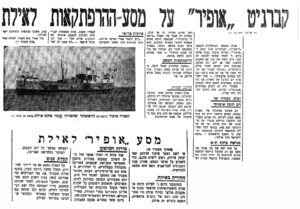
In July 1950, Israeli headlines breathlessly announced the arrival down south of an Italian ship, the Lucia, straight from the Yemenite beaches of Aden. Actually, the vessel was called the Luce, and it was renamed the Ofir upon docking in Eilat. In any case, it carried thousands of Jewish books – including hundreds of Torah scrolls – preserved for generations in the synagogues of Yemen. When the country’s Jews flew to Israel in Operation Magic Carpet that year, they weren’t about to leave their entire written heritage behind. But how did it end up on an Italian ship?
Not yet a Segula subscriber?
Access our full archive online, have print issues delivered to your door, and moreFeel free to share