How did the statue of Elijah in the Carmelite monastery on Keren Carmel lose its arm, then regain it? Of Scripture and sculpture

Where To?
Muhraka
Statue of Elijah at Keren Carmel Monastery

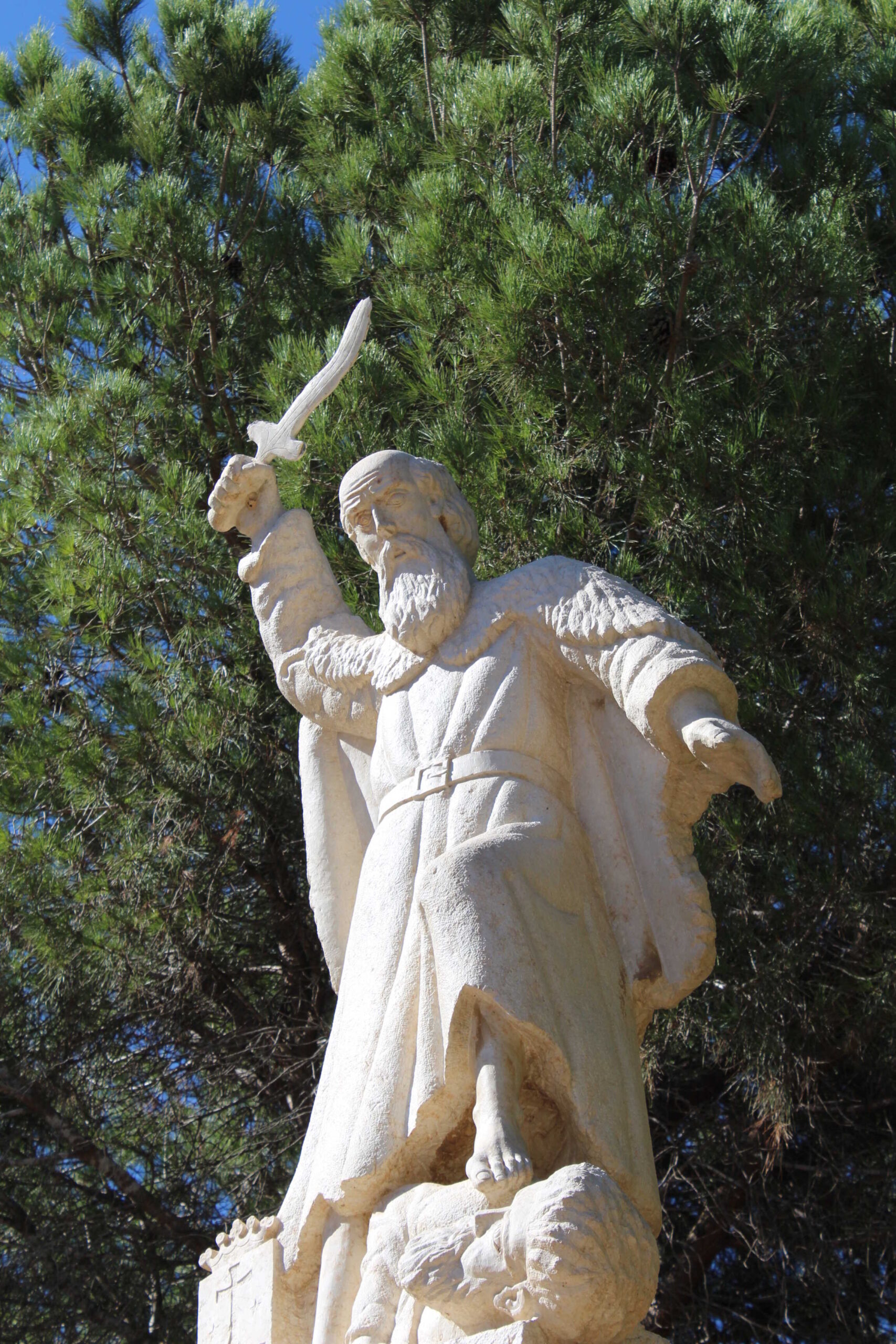
Starkly white against the surrounding green, an indignant Elijah the prophet, sword raised on high, gazes out from the grounds of a modest monastery on the southeastern slopes of Mount Carmel. The monastery belongs to the Catholic Carmelite order, which founded its headquarters elsewhere on the mountain in the late 12th century, attracted to the site of the showdown between Elijah and the prophets of Baal. The monks saw him as a role model – a religious zealot who slayed false prophets without batting an eyelid. That’s why the statue is here rather than at other Carmelite centers on the mountain: to mark the spot where Elijah is said to have summoned heavenly fire to consume his sacrifice. The Arabic name for the site is Dir-el-Muhraka, “place of fire.”
For anyone who missed the Bible class on that miraculous event, let’s recap. I Kings 18 describes the competition between Elijah and the prophets of Baal as to whose deity would be first to answer the call of his faithful and bring down fire on the altar each had built on the mountain, proving that he alone was the true god. The false prophets cried out to Baal for an entire day but failed to generate even a spark. Then Elijah soaked his sacrifice and altar to make the miracle more challenging, uttered a brief prayer, and – presto! – down came the fire, reducing the offering to ashes. And off came the heads of his rivals, whom he elegantly decapitated shortly afterward at the nearby Kishon Stream.
The Missing Hand
The statue in question captures this moment in all its glory: a heroic Elijah, bald but full-bearded, stomps on a defeated prophet of Baal, while his right hand brandishes a fearful sword bent out of shape by its recent bloody use. Naturally, the prophet is dressed as a Carmelite monk, with his waist girded and the cloak of the order draped about his shoulders. He’s even barefoot, as all medieval Carmelites were (today, they wear sandals – as do other barefoot monastic orders). And just to clinch his affiliation, a small shield at the foot of the statue bears a cross with a stella maris – a sea star, symbol of the Carmelites.
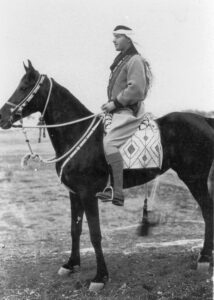
Yet this statue isn’t the original. Compare the photo at left, taken in the 1920s, which shows a pensive, passive prophet sans sword. Both his feet are firmly on the ground, with no prophet of Baal squirming beneath them. A sharper-resolution close-up from 1947, snapped by legendary researcher Yehuda Ziv, likewise features an uncharacteristically benign Elijah, looking as if he’d just downed a few cups of steaming Turkish coffee. And in both photos, while one hand rests serenely on his breast, the other appears to have been amputated, with the arm ending in a mere stump.
Who performed this sculptural surgery, and why?
Unraveling a Yarn
A Carmel legend claims Elijah’s fate was sealed when General Fawzi al-Qawuqji and his Arab Liberation Army invaded the Galilee in Israel’s War of Independence.
Although Qawuqji’s forces threatened the Jewish settlements in the area, he failed to conquer the Jezreel Valley as promised. Preventing Qawuqji’s frustrated army from advancing south into the country’s interior, Kibbutz Mishmar Ha-emek repulsed so many of the general’s attacks that he purportedly wondered aloud what supernatural force was protecting the Jews.
An elderly local Arab pointed out that a statue of a Jewish prophet stood on the hill just above the kibbutz, which is located below the Carmelite monastery. So long as the statue’s sword was raised in battle, Qawuqji didn’t stand a chance, for Allah would protect them just as He had in the wilderness, when Moses lifted his hands in prayer as Israel fought the Amalekites.
Qawuqji promptly dispatched a unit to the monastery courtyard to smash Elijah’s hand and sword to smithereens. He then redoubled his efforts to storm Mishmar Ha-emek and the other Jezreel Valley communities.
Yet, just as the sages attribute the biblical victory to the Hebrew fighters’ heartfelt prayers, not Moses’ hands, Elijah’s appendage made no difference. Qawuqji’s troops suffered one defeat after another, until finally he gave up.
It’s a great yarn, but for one fact: Qawuqji’s army crossed the Jordanian border into prestate Israel in January 1948, and Yehuda Ziv’s photo of Elijah’s amputated hand was taken in 1947.
So what’s the story? And where’s the hand today?
Picking Up the Pieces
Ziv himself discovered that the Carmelites had commissioned the statue from an unknown Bavarian sculptor, who carved it from pitted yellow sandstone (a common local material) and shipped it to the Holy Land. It arrived at the monastery in a heavy, wooden packing case in 1914 – just in time for World War I. Before even opening the box, the occupants of the Carmelite monasteries around Haifa were all put to flight by Turkish soldiers. (As far as the Ottoman Turks were concerned, all Catholics were under French protection and therefore fair game as enemy aliens.)
The monastery was commandeered by the army, plundered, and severely damaged. The troops then turned to the heavily padlocked, wooden crate, which presumably held something of immense value. But instead of gold ingots, all they found was a sleepy-looking, stone prophet. Not surprisingly, they vented their frustration by cutting off his head and smashing his right hand.
Following the war, the Carmelites returned to find their monastery in ruins and Elijah in pieces. After immediate first aid and a recovery period, which included finding the prophet’s discarded head at the bottom of a nearby cistern, the statue was proudly placed in the courtyard – minus a hand. We’ll never know whether it once held a sword, or a teacup, or was raised in blessing.
Not yet a Segula subscriber?
Access our full archive online, have print issues delivered to your door, and moreFeel free to share