
This article is dedicated in memory of Haim Stier, who passed away in the course of our combined efforts to transfer his extensive collection of New Year cards to the Israel Museum.
New Year cards have been popular for close to a hundred years, but today the Internet era has made them virtually obsolete. This now largely abandoned tradition has left us with a fascinating record of what has been perhaps the most tumultuous century in Jewish history

Thirty years ago, when sending out New Year’s cards was still a matter of course, who would have thought of making them the subject of an exhibition, let alone a museum exhibit. Progress, however, seems to have moved into fast forward in the last few years, and with the invention of social media, from fax to tweet, the Shana Tova card has rapidly become obsolete. At the same time, the historic, cultural and nostalgic value of what was once a common item, has increased enormously.
For close to a hundred years, Shana Tova cards have served as a heartwarming way of sending New Year greetings to family and friends. The custom originated at the end of the 19th century, with the invention of the postcard. These rapidly spawned greeting cards for Valentine’s Day, Christmas and New Years, a practice which the German Jewish community adapted , “converting” the greeting cards for Rosh Hashanah, the Jewish New Year. The custom spread throughout Europe, quickly reaching the growing concentrations of Jews in the United States and Palestine.
1910 – Kitsch and Tech
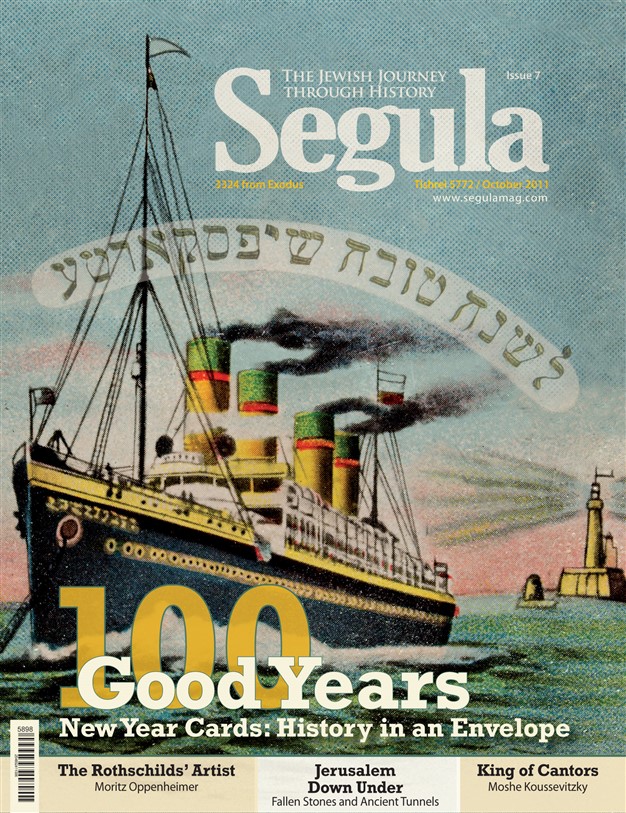
The motifs decorating a card bearing wishes for a successful year obviously had to reflect the similar sentiments. A wealth of such motifs included honey cake, flowers, birds, angels, or cornucopia, as well as images associated with the High Holyday prayers. One such card, illustrated here (Germany, circa 1910), combines a stylized ship, presumably symbolizing sailing into the future, flowers and a cantor complete with Torah scroll. Other cards from the first half of the twentieth century provide a fascinating record of the lifestyle of Jewish communities in Europe. Local artists painted or photographed figures from daily life, in addition to Jewish life cycle ceremonies and the festivals of the Jewish calendar. Contemporary technological innovations, such as the newly invented telephone, also featured prominently.
1920 – Propaganda
Somewhat surprisingly, many Shana Tova cards carry depictions of the historical events of the past hundred years, decidedly one of the stormiest periods in Jewish history. The personal New Year’s message sent in many such cards was accompanied by a nationalistic motto with which presumably both sender and receiver identified.. All the sender had to do to make an ideological statement was to sign his name beneath the slogan of his choice and address the envelope. The result is a veritable visual overview of the key events of contemporary Jewish history.
The massive migration of Eastern European Jewry to the United States is reflected in numerous Shana Tova cards from the early decades of the last century. A immigrant ship is a frequent motif on these cards, which are consequently referred to as shifskarte. The Statue of Liberty or some other female figure is often depicted welcoming the crushed, dejected newcomers with open arms. This warm, welcoming message, was in fact little more than wishful thinking on the part of American Jewry hoping to encourage their persecuted brethren in Poland and Russia to join them. In fact, opposition to this type of mass immigration was building up within the United States administration, and from the late 1920s severe restrictions were placed on Jewish immigration. From then on, many of the migrants turned eastward – in the direction of Israel.

“Liberty” greets Jewish immigrants arriving by steamship in New York harbor | Courtesy of the Israel Musuem Jerusalem, Haim Stier Collection

The “New Year” arriving to transport her people into a better future | Courtesy of the Israel Musuem Jerusalem, Haim Stier Collection
1940 – Personal Example
The Zionist movement used Shana Tova cards for its own propaganda purposes, and those produced for Zionist groups bore various Zionist symbols. Many Shana Tova cards had biblical motifs, to emphasize – in the spirit of the Zionist idea – the connection between the Jewish people and the Land of Israel, and the value of working the land. In place of “Miss America” in the Shana Tova cards, another female figure appears – Bat Zion, the daughter of Zion – who also carries the promise of an ideal life in the new homeland.
During the 1930s, residents of Tel Aviv would have themselves photographed, with vistas of the developing city behind them; these pictures would be sent to relatives abroad, with wishes for the New Year. Such pictures carried a message – sometimes overt and sometimes less so – calling for aliya to Eretz Israel.
The Second World War and the Shoah led to a cessation of the production and distribution of Shana Tova cards in Europe. A bitter memory from those years remains in the Shana Tova cards that depict the survivors in the DP camps in Europe.
Not yet a Segula subscriber?
Access our full archive online, have print issues delivered to your door, and moreFeel free to share