Jews relocating to Ottoman Palestine had their pick of holy cities, ports, Zionist colonies, and agricultural villages. Yet some settlers preferred to move to outlying Arab towns instead, founding Jewish communities like that of Beth She’an

On the second day of the week, on 14 Nisan of the year 5675 from creation, according to the calendar we use here in the holy city of Bisan (may it be established and rebuilt), which lies by brooks and is watered by their streams […].
So begins a Jewish marriage contract (ketubba) written and signed in Beth She’an (then better known by its Arabic name, Bisan) in 1915. The groom, Farj son of Binyamin Mizrahi, and his bride, Miriam, daughter of Yosef Mizrahi, had apparently both been living in this small town in the Lower Galilee. Bisan’s obscure Jewish community was mostly Kurdish, having relocated from Kurdistan and Tiberias a few years earlier.
In the rapidly diversifying Jewish population of Ottoman Palestine, where did the Jews of Bisan fit? Could their community be considered part of the Zionist settlement efforts of the late 19th century? If so – and even if not – why have these Jews been all but forgotten?
New in Town
From the end of the 18th century to the beginning of the 20th, the Jewish population of the Holy Land grew dramatically – and changed radically. Prior to this transformation, the local Jews were mainly Arabic-speaking Sephardim. They were now joined by Ashkenazic immigrants from Poland and Russia, the vast majority of whom were pious Jews. Next came small groups from elsewhere in the Middle East and North Africa, including Yemenites, Moroccans, and Tunisians. Zionism’s first wave of immigration began only in the 1880s, but these thousands of mainly Eastern European Jews quickly altered the Jewish demographics of Ottoman Palestine.
Far more numerous and diverse than the existing Jewish population, the new arrivals spread out in the second half of the 19th century, settling in the traditional centers of Jerusalem, Safed, Tiberias, and Hebron as well as where Jews had long been absent. These new locations were very different from the holy cities and included the ports of Haifa and Jaffa as well as something new: agricultural colonies. Communes and cooperative settlements, not necessarily agricultural, followed in the early 1900s.
While Zionist settlement has generated extensive research and public interest, few are aware of the Jews who made their homes within the urban Muslim sector. Taken together, these individuals, families, and even small communities constituted a not insignificant proportion of Ottoman Palestine’s Jewish population – about a thousand in all. The overleaf map shows that said pockets of Jews existed all over the country; most were established around the turn of the century. The remains of an ancient Jewish community in Nablus (Shekhem) and a larger one in Akko also continued functioning among the Muslims. There were a number of families spread over a few Arab villages in the Galilee as well, most notably in Peki’in and Shefar’am, whose Jewish communities dated several centuries back.
Very few of these clusters numbered more than a hundred. Some formed gradually as individuals and families moved in; in other cases, small groups relocated together. Some emulated the Ashkenazic communities in the holy cities, relying on charity. Others labored to support themselves or drew on savings. Some put down roots and remained for years, while others ebbed and flowed. Though most of these Jews had come to Palestine for ideological reasons, their choice of location was largely economic. Nevertheless, philanthropic or idealistic associations sometimes lent a hand – at least at first – in creating and maintaining a Jewish communal infrastructure.
Białystok and Gaza
Rabbi Azriel Hildesheimer’s For the Sake of Zion (Lema’an Ziyon) organization, founded in Berlin in 1888, backed the Jewish communities of Ramle, Jenin, Lydda, and Jericho. As widely publicized in the Hebrew journals of the period, the association encouraged self-supporting Jewish settlement in the Holy Land (though some funding went to scholarly communities as well). Any form of livelihood – trade, craftsmanship, or agriculture – qualified for aid. In addition, Hildesheimer’s group encouraged Jews to set up shop in Arab cities with no permanent Jewish presence.
Another such organization was Revival of Israel (Tehiyat Yisrael), cofounded by Nissim Bekhar and supporting mainly Ramle. Both Moses Montefiore and Baron Edmond de Rothschild assisted Jews in Arab towns, and after World War I, the Zionist establishment in Mandate Palestine followed suit.
Why settle Jews in Arab cities? First, this effort would allow Jews uninterested in agriculture to provide for themselves in the Holy Land by other means. Second, it would renew ancient Jewish communities in locations of historic or religious significance, such as Bethlehem, Jericho, and Beersheba. Finally, there was an urgent need to extend Jewish settlement beyond the holy cities and the Zionist population blocks of the coastal plain and the Galilee, to which immigrants naturally headed.
Leaders of the Lovers of Zion (Hovevei Ziyon) movement shared this last approach. As Russian tea manufacturer Kalonymus Ze’ev Wissotzky famously wrote in Ha-Melits (The Advocate) daily after visiting Ottoman Palestine in 1885:
In my opinion, Hovevei Zion should do nothing but open the eyes of our brethren and our people, the workers and laborers among us, and tell them: Dear brothers, there are still many towns in the Holy Land where no Jews live – such as Nablus, Nazareth, Lydda, Bethlehem, Gaza, Ashkelon, Tyre, Sidon, Acre, and more – and as people eat there and walk about clothed and shoed, there must be a need for all kinds of artisans and laborers […].Whoever has enough imagination to see that Gaza could be like Ponevezh […] will be able to earn his meager ration of daily bread in Ramle just as he did in Białystok, Vilna, or Minsk. (“Support for the Scribes,” Ha-Melits, 19 Adar II, 5646/March 26, 1886, p. 2)

Jews settling in Arab towns encountered financial, organizational, and security challenges, but even those who supported them offered little help. To make matters worse, many of these pioneers – at least until the British Mandate – didn’t particularly identify with political Zionism and its aspirations for a Jewish state.
As the 20th century progressed, the trickle of Jews into Arab towns dwindled, ending altogether amid the disease and famine brought by World War I, the Arab riots against the Jewish population in 1929, and the Arab Revolt of 1936.
Following the Train
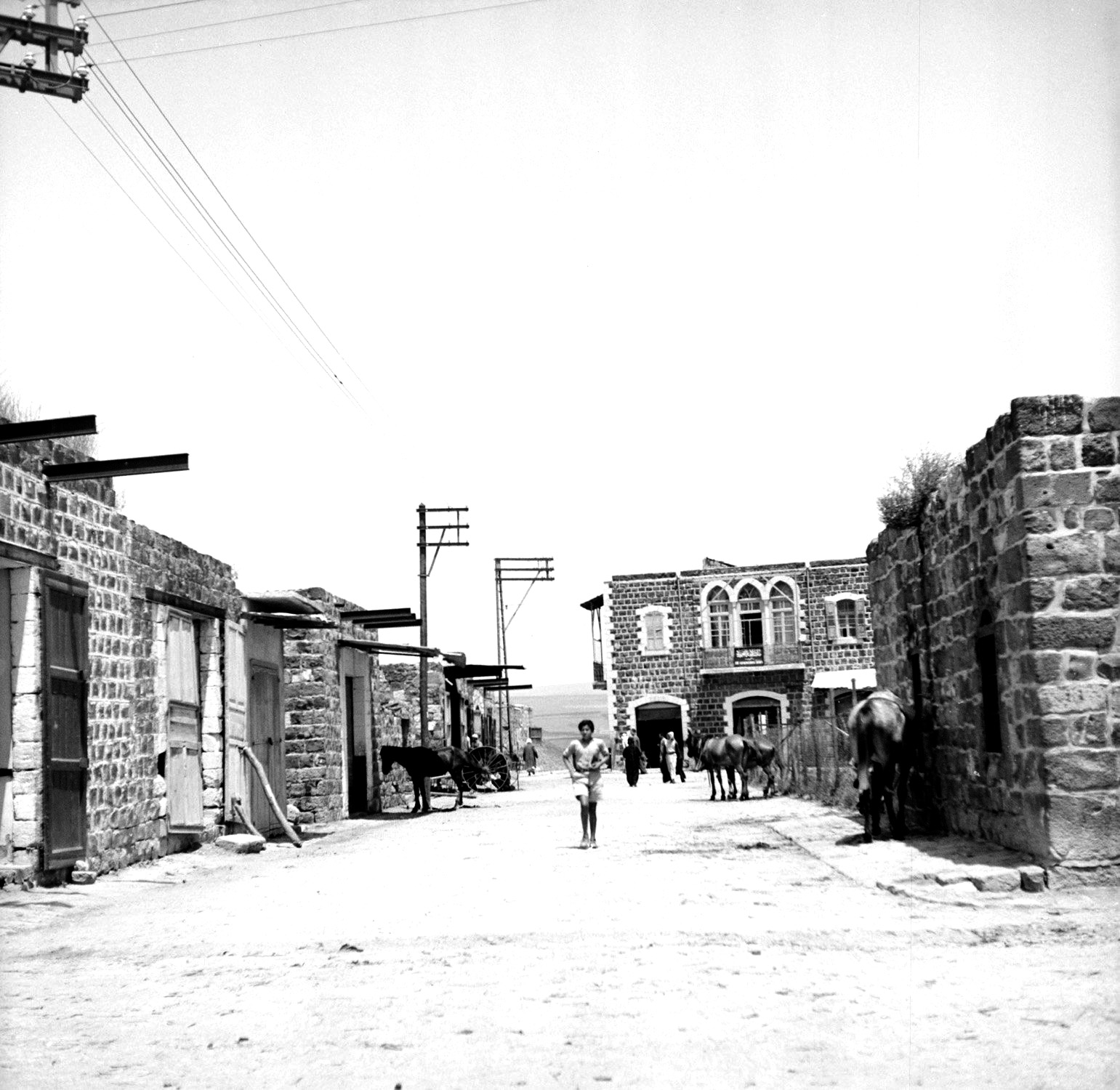
The story of Jewish Beth She’an is fairly representative of similar communities at the time, though few were as well established and organized. Recognizing the Beth She’an Valley’s agricultural potential, strategic value, and proximity to a well-used crossing point bridging the Jordan River, the Ottoman authorities invested heavily in the area in the late 19th century. Bisan became a regional capital, and steps were taken to spur its economic growth. Jews naturally followed. In 1905, Bisan’s importance increased with the opening of its train station, a branch of the Hijaz Railway (see “Trainspotting,” Segula 17).
The first Jewish residents of modern-day Beth She’an had no organizational backing. They arrived of their own volition, working as laborers, artisans, and small-scale traders in the town and surrounding Bedouin villages. There were several wealthy Jewish realtors and merchants as well, whose dealings took them as far as Damascus, at the end of the train line. Most Jews in Bisan hailed from the Erbil region of Kurdistan, but there were also Ashkenazim and North Africans.
By the turn of the century, there were only a few dozen Jews, not enough to create a communal infrastructure. During World War I, however, a Jewish council was formed, headed by Zaki Elhadif (later mayor of Tiberias, where he was killed by an Arab assassin in 1938). By 1929, the community numbered two hundred and boasted a synagogue and (thanks to the Mizrahi movement) a kosher butcher. In 1924, the Hadassah health organization had founded a clinic. Shortly afterward, a Jewish school opened its doors, run until 1934 by teachers sent by the World Zionist Organization’s Education Department.

Bisan’s new prosperity spawned a thriving community of Jewish merchants and artisans. Market scene | Photo: Moshe Schwartz, Bitmuna

The pre-state Jewish mayor of Tiberias spearheaded attempts to resettle Jews in Arab Bisan. Zaki Elhadif
Not yet a Segula subscriber?
Access our full archive online, have print issues delivered to your door, and moreFeel free to share