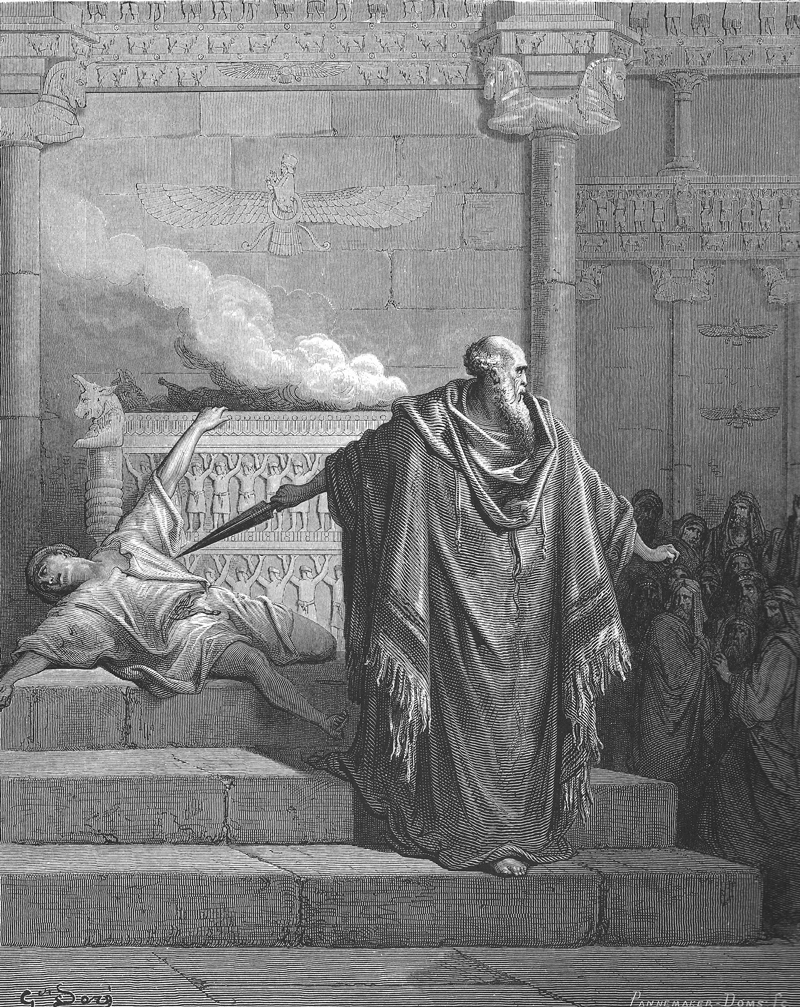
The war Mattathias and his sons fought against Hellenism was perhaps even more formidable than their armed conflict against the Greeks. The religious reforms the Maccabees enacted testify to their determination to prevent the cultural assimilation of the Jewish people, and to the proud, independent spirit of the kingdom they hoped to found

And Judah, and his brethren, and all the congregation of Israel decreed that the day of the dedication of the altar should be kept in its season from year to year for eight days, from the fifth and twentieth day of the month of Kislev, with joy and gladness (I Maccabees 4: 58).
Although today we tend to take the festive lights and seasonal atmosphere of Hanukkah for granted, the institution of the holiday as proclaimed in the first book of Maccabees was in fact no simple matter. A very clear prohibition exists against adding holidays – or any other additional commandments, for that matter – to those already appearing in the Torah. The Talmud in tractate Megilla debates the permissibility of the holiday of Purim with its mandated reading of the Book of Esther extensively. The ninth chapter of the Book of Esther itself hints at the tension between the hesitant attitude of the sages of the generation, on the one hand, and Mordechai and Esther’s insistence on making the one time celebrations an annual event, on the other. On whose authority were the days of Hanukkah instituted? By what license do we bless the Hanukkah candles in God’s name?
What is the blessing recited upon lighting Chanukah candles? One blesses, “Blessed are You God… Who has commanded us to light the Hanukkah candles.” Where in the Bible were we so commanded? … Rav Nehemiah said, From, “Ask your father and he will tell you, your elders and they will tell you” (Deut. 32: 7) (Shabbat 23a).
The Talmudic passage quoted above points to rabbinic authority as the source of the laws of Hanukkah. The Book of Maccabees seems to imply that the leaders of the Hasmonean revolt against Hellenism viewed their role as extending beyond the military sphere into the cultural and spiritual realm. The establishment of the festival was not their only or even their most significant contribution. Our sources for the following discussion are, in the main, the Books of Maccabees, with some additional illumination from Talmudic passages.
Rather than focusing on the wars of Judah Maccabee, and his military strategy, which have been widely discussed elsewhere, we will explore the spiritual heritage he created together with his father Mattathias, the priest-turned-warrior, through the activities of the legal body the Talmud calls the “Hasmonean rabbinical court.”
At the time when the events commemorated by the festival of Hanukkah took place, Judea was a minor province in the Seleucid Empire. The open, assimilative culture that characterized this Hellenistic regime posed a singular challenge which the Jews of Judea were ill-equipped to fight. Towns settled by the soldiers of the empire’s garrisons brought this culture into their midst, creating areas of economic co-operation and opportunities for social integration. The Olympic Games, with their emphasis on universal human values and the brotherhood of nations, sought even then to promote unity – under the umbrella of one global, international culture. It was this process of gradual encroachment on unique Jewish values that Mattathias and his sons sought to block, subtly shaping Jewish law to combat specific threats as they arose. Ostensibly, however, the main reason for the revolt was the new laws instituted by the Seleucid ruler, Antiochus IV in 167 BCE, outlawing the observance of Jewish customs and introducing idolatrous practices into the Temple service.

Reviving a Kingdom
We will start with a reform resulting from one of the first skirmishes in the Maccabees’ military struggle against the Seleucid authorities:
Then many that sought after judgment and justice went down into the desert to live there, they and their children, and their wives, and their cattle, because afflictions increased upon them. And it was told to the king’s men, and to the [Seleucid] army that was in Jerusalem in the city of David, that certain men who had broken the king’s commandment were gone away into the secret places in the wilderness, and that many were gone after them. And forthwith they went out towards them, and made war against them on Shabbat day. And they said to them: “Do you still resist? Come forth, and do according to the edict of King Antiochus, and you shall live.” And they said: “We will not come forth, neither will we obey the king’s edict, to profane the Sabbath day.” And they made haste to give them battle. But they answered them not, neither did they cast a stone at them, nor seal off the secret places, saying: “Let us all die in our innocence, and heaven and earth shall be witnesses for us, that you put us to death wrongfully.” So they gave them battle on the Sabbath: and they were slain with their wives, and their children, and their cattle, to the number of a thousand persons.
And Mattathias and his friends heard of it, and they mourned for them exceedingly. And every man said to his neighbor: “If we shall all do as our brethren have done, and not fight against the heathens for our lives, and our laws, they will now quickly wipe us off the face of the earth.” And they determined in that day, saying, “whosoever shall come up against us to fight on the Sabbath day, we will fight against him: and we will not all die, as our brethren that were slain in the secret places.” Then was assembled to them the congregation of the righteous, the valiant of Israel, every one that had a good will for the law (I Maccabees 2: 29-42).
Clearly, Mattathias permitted the Jews to fight on the Sabbath. Historians tended to understand the dispensation literally, as if until this point in time, Jewish law forbade any kind of fighting or self-defense on Shabbat. However, it is hardly possible that the Jews could have survived for over a thousand years in their homeland under such circumstances. Their hostile neighbors would have quickly discovered that they could exploit such a restriction, and dedicated their weekends to the destruction of the Jewish people. Nor can we imagine that such an existentially vital loophole could have been forgotten until it was renewed by Mattathias.
It would seem that the issue at hand was not whether or not the Sabbath could be desecrated for reasons of pikuah nefesh (saving a life) – when the decision could make the difference between life and death – because whether or not they chose to fight, the defenders of this desert stronghold were doomed. The besiegers were professional Seleucid soldiers, while the Jewish men fighting on the cliffs of the Judean Desert were poorly organized and ill-equipped, and were trying to protect not only themselves but their families. Any defense they could mount using stones, boiling water, or even the few swords or spears they may have been able to lay their hands on could only delay the inevitable. If the attack had come on a weekday rather than on the Sabbath, they would have gone down fighting, selling their lives as dearly as possible – but they would not have survived. Attacked on the Sabbath, with no way to save themselves, they chose to die without any show of resistance. Exacting a high price for their deaths did not, in their view, justify desecrating the Sabbath.
This is the logic dictated by the laws of survival or pikuah nefesh as they apply to individuals. When national considerations are taken into account, however, the picture – and the law – changes. Fighting on a national scale is governed by the laws of war, which apply regardless of the anticipated outcome of the battle. Considerations such as the deterrence of similar attacks come into play. Had the devout Jews sheltering among the cliffs desecrated the Sabbath by fighting, they would have contributed to the overall struggle against the Greeks, even though they could not have saved their own lives. According to the laws of war, they would have been permitted to fight on the Sabbath.
It seems that Mattathias’ halakhic innovation in the wake of that terrible, bloody Sabbath, was to rule that the Jews who chose to engage in guerilla warfare against the Seleucid authorities should no longer be considered as individuals, but as fighters in a national struggle governed by the laws of war. Suddenly, the followers of the Hasmonean priest were no longer oppressed subjects, bowed beneath the yoke of a Hellenist empire. They were proud citizens of the Kingdom of Israel, finally raising itself from the dust in which it had languished since the death of the last independent king of Judah, Josiah ben Amon, in the final years of the First Temple Period.
Not yet a Segula subscriber?
Access our full archive online, have print issues delivered to your door, and moreFeel free to share