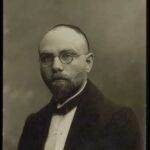

Autodidact Moshe Shapira emerged from Jerusalem’s ultra-Orthodox Me’a She’arim as an expert in both astronomy and sundials. Two of his sun clocks can still be seen in Jerusalem, but it was the one he refused to make that sent him into self-imposed exile

In early 1969, a very elderly man lay in a darkened hospice room in Jerusalem’s Katamon neighborhood. Almost nothing was left of him but skin and bones, but his eyes were ablaze, showing that he was still very much in touch with reality. None of his fellow patients dreamed that this withered figure was once a key player in one of the city’s greatest dramas in years.
Moshe Shapira was born in Jerusalem’s Old City in 1886. His maternal grandfather, Rabbi Mordechai, had arrived in the Holy Land in 1853. Euphemistically known all over Jerusalem as Big Rabbi Mordechai, this tiny man married his daughter off to Rabbi Yisrael Asher Shohat Shapira, who blew the shofar every Rosh Hashana for the renowned Rabbi Moshe Yehoshua Leib Diskin. (Previously the rabbi of Brisk, Diskin escaped Russia just before false accusations landed him in Siberian exile. Taking up residence in the Old City with his family, he became a bulwark in the Orthodox community’s resistance to secularism and modernization.)
Growing up in Jerusalem’s new Me’a She’arim district, outside the Old City walls, Shapira’s son Moshe attended the local heder – Yeshiva gedola v’Talmud Torah Me’a She’arim. There, at age thirteen, he met a teacher who changed his life.
Celestial Secrets
Ordained as a rabbi at twenty-one, Rabbi Arye Leib Gordon of Lithuania was strictly Orthodox but fascinated by science. He even studied chemical engineering at the University of Berlin. An autodidact in many areas, this young genius had published works on Hebrew grammar and was a compulsive book collector.
At some point Rabbi Gordon caught the Zionist bug, came to Ottoman Palestine as a pioneer, and taught Hebrew and arithmetic in Petah Tikva. Moving to Rishon Lezion, he worked as a chemist at the Rothschild vineyard, only to clash with Baron Edmond’s infamous clerks.
Gordon settled in Jerusalem in 1899. Despite Talmud Torah Me’a She’arim’s staunch opposition to secular studies, this complex character was hired as administrative director. In his two years in this capacity, he crossed paths with Moshe Shapira – a bright-eyed, intelligent youth who seized every opportunity to cut class and chat with Gordon about Hebrew, philosophy, and – above all – science.
The two were particularly taken with Hiya David Halevi Shpitzer’s Nivreshet Le-netz Ha-hama Be-Zion (Illumination of the Dawn in Zion), published in 1898 (5658). Though the West divides the day into twenty-four hours, regardless of sunrise and sunset, both Jewish and Muslim prayer times are calculated by dividing daylight and nighttime each into twelve “seasonal hours,” so called because their length varies throughout the year. Shpitzer had devoted his life to ascertaining the exact time frame for the recitation of the Shema (“Hear O Israel”) prayer in Jerusalem: from the moment the sun’s first rays pierce the morning sky until midnight. He’d spent day and night recording the precise time of sunrise in the few places where the city’s hills don’t block the rising sun; in the Old City, on the Mount of Olives, and wherever else he could.
Rejecting “modern astronomy” (i.e., Galileo’s heliocentric theory, placing the sun at the center of the solar system), Shpitzer preferred the Copernican geocentric model, in which the sun revolves around the earth. After all, according to the heliocentric model, it takes eight minutes for the sun’s light to reach the earth, so when exactly is sunrise – when we see the sun’s light, or eight minutes earlier?
Gordon and Shapira read Shpitzer’s book over and over, debating whether he was right. They were just as intrigued by his science as by the halakhic question of how to define sunrise, the ideal time for morning prayer.

Shapira became obsessed with the matter, especially when Shpitzer published a sequel in 1903 – Illumination II: Ascertaining the Time of Twilight around the World. The climax came in 1906, when Shapira was already twenty, in the shape of Shpitzer’s Tikkun Luah De-nivreshet (Revised Table of Illumination). This pamphlet listed sunrise times throughout the year, complete with diagrams.
By now, Shapira had spent years reading scientific articles as well as Talmudic works on astronomy and calendrical calculations, including the complex writings of the Gaon of Vilna. Armed with his own measurements, observations, and experiments, the young man embarked on a new profession: building sundials.
The Clockmaker’s Career
Shapira constructed his first such device atop his yeshiva in Me’a She’arim, enabling fellow students to recite “Hear O Israel” at the exact moment of sunrise-. He spent long months on the roof setting up a sundial made of two precisely angled marble slabs. These efforts paid off, and Shapira’s contraption worked as long as the weather wasn’t too cloudy. Sadly, his success was short-lived: the marble pieces suddenly collapsed one day, smashing to smithereens. Shapira was almost as shattered as his sundial.
Luckily, however, news of his expertise reached Shmuel Levy, a wealthy American tailor bankrolling a new “high-rise” on Jaffa Road, just outside the Mahane Yehuda market. The complex was to include a study hall, synagogue, and new immigrants’ shelter, and Levy dubbed it Zoharei Hama (Emanations of the Sun). Perched atop the local watershed, the ambitious project soared over four stories high and was topped by a small tower – a real skyscraper by Jerusalem standards in those days. Hashkafa, a local religious newspaper, couldn’t conceal its excitement:
And in Jerusalem the Jews rejoice, for yet another institution has been added to the previous ones: on Jaffa Road, at one of the city’s higher points, a new structure has been built, towering over the entire city. Three stone floors have already been erected, plus two wooden attics above them, and the construction workers are still hard at work raising the building yet higher.
From the shape of the attics, you can tell that [the structure] isn’t meant to be residential, and anyone who sees it says it must be an observatory. But what do Jews have to do with stellar observations? Is their calendar not fixed and accurate? What do they care about the paths of the stars?
Rather, this sage and understanding nation is unlike all others, and its lookout tower has been built not [to study] the stars, heaven forfend, but for a much nobler purpose.
A new society has lately been founded here, for those who pray as the sun peeks over the horizon. As Jerusalem is surrounded by hills, it’s extremely difficult to calculate [that precise] moment. So a certain gentleman, an American tailor prompted by generosity, has built this structure.
When the building is finished, a rooftop flagpole will be equipped with a thin, copper plate attached to it, so that when the sun’s first rays emerge, they’ll illuminate the plate so that it shines out, informing all Jerusalemites that it’s time to pray with the sunrise. Fortunate are you, O Israel! (L. P., “A Watchtower,” Hashkafa, 11 Tammuz 5666/July 4, 1906, p. 4 [Hebrew]).
Levy was far from satisfied with this primitive arrangement, however, so he was delighted to hear of Shapira the clockmaker. The tailor ordered a sundial for Zoharei Hama’s top floor – both for the benefit of those rising early to pray and to indicate when the Sabbath began on Friday evenings. Shapira happily set about measuring, checking, planning, and calibrating, and in just three years (!), he’d erected an enormous sundial spanning the entire five-meter width of the building. Shaped like an inverted rainbow, it was stunning and amazingly accurate – but its edges blocked the two side windows on the fourth floor, which served as a study hall and synagogue.

Not yet a Segula subscriber?
Access our full archive online, have print issues delivered to your door, and moreFeel free to share