


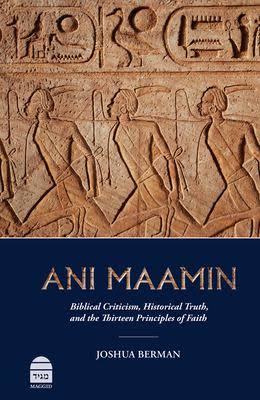
Ani Maamin: Biblical Criticism, Historical Truth, and the Thirteen Principles of Faith
Joshua Berman
Maggid Press, 2020, 334 pages
Not strictly speaking a history book, Joshua Berman’s collection of essays harnesses the tools of historic investigation to grapple with core issues challenging the Modern Orthodox believer today. Recasting some of his academic publications in a more popular form, Berman seeks to refute charges leveled at the Bible by its critics – its many inconsistencies, the lack of evidence for the Exodus in Egyptian inscriptions, repetitive yet conflicting narratives, and more. Citing rabbinic precedent in the writings of Maimonides and others, the author justifies his scholarly contextualization of the Bible within the ancient Near East.
Ani Maamin’s first section goes on to explore similarities between two Egyptian sources and two biblical passages: bas-reliefs showing the battle encampment and throne tent of Rameses II are compared with Scripture’s layout of the Tabernacle built by the Children of Israel in the wilderness, and Pharaoh’s widely publicized account of his youthful success in battle at Kadesh is stylistically analyzed alongside the Song of the Sea. Berman sees these parallels, previously noted by other scholars, as corroborating the authenticity of the biblical text. The cultural context of the book of Exodus is clearly Egyptian, and its closest Near Eastern likenesses date from a period at least within historical memory of its Israelite protagonists. These facts alone might not verify its events. Nonetheless, the author points out that unless applying the double standards common to biblical research, archaeological conclusions are often based on far less.
Pacts between dominant kings and their vassals in the ancient Levant are then compared to variations in the language of biblical covenants between God and Israel. Here too, the shifting relationship between the Lord and His nation is illuminated in the way political changes are expressed in the treaties discovered in the archives of the Hittite culture of Ugarit.
Berman warns readers not to impose modern distinctions on an ancient text. At the same time, he frequently offers modern illustrations of the concepts he seeks to describe. Both approaches are crucial when addressing the Bible, yet their juxtaposition is unsettling.
The second section of Ani Maamin, almost completely disconnected from the first, discusses since when and to what extent principles of faith – especially those delineated by Maimonides – have defined who is or isn’t within the pale of Jewish belief. By bringing two such seemingly diverse subjects together in one book, Berman may be attempting to bridge two of his own areas of activity, as a Bar-Ilan professor of Bible, on the one hand, and a leader of Modern Orthodoxy in Israel, on the other. Certainly, his investigations in the first section would be seen by many as pushing the boundaries discussed in the second section to their limits. That’s exactly why he titles this not-so-slim volume Ani Maamin – “I believe.”
Not yet a Segula subscriber?
Access our full archive online, have print issues delivered to your door, and moreFeel free to share