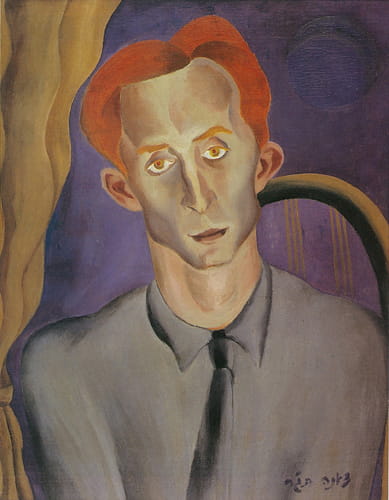
Few have been as versatile or lived lives as varied as Uri Zvi Greenberg. A revolutionary, anarchist poet who foresaw both the Arab massacre of Jews in 1929 and the Holocaust, Greenberg wandered between past, present, and future yet remained faithful to his own inner experience

In many years of wandering, my image dived into foreign rivers: As times changed, that image ichanged into several different images […]. Who can gather them into one living image of my existence Without gathering the banks of all rivers to the shore of the one Sea of Galilee? (Uri Zvi Greenberg, “Song of My Image in the River,” in Greenberg, Collected Writings, ed. Dan Miron, vol. 9 [Mossad Bialik, 1994], p. 196 [Hebrew])
As he declared in this poem, Uri Zvi Greenberg was one of the most multifaceted, complex Jews of the last hundred years: both poet and politician, public figure and recluse; revolutionary in some ways, conservative in others; a left-wing anarchist who moved to the far right; and a modernist with a classical bent.
Greenberg can’t be appreciated without understanding the events through which he lived, for his public and private selves are inseparable. The various episodes of his life reflect the upheavals of the Jewish people in the 20th century: from Hasidic village life to world wars to Zionism, the establishment of the State of Israel, and its struggle for survival. Each of these stages finds fierce expression in his poetry, the art of an iron-willed but sensitive soul whose experiences were so intense as to be almost uncontainable. His viewpoint is always challenging, unsettling – both for himself and for readers.
Rivers run through Uri Zvi Greenberg’s poetry in many contexts, forging deep connections in time and place. Each chapter of his life has its own river – and each river, as the Talmud says, has its own course.
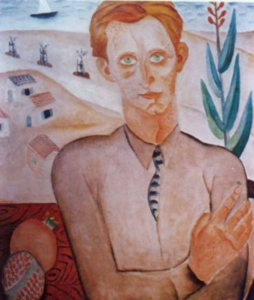
Greenberg’s poetry is itself a mighty river of language. For many years, his enormous literary output was inaccessible even to Israelis because of his difficult relationship with both his audience and his publishers, particularly toward the end of his life. For decades, his poetry was ignored by academia. Only in the 1990s did Prof. Dan Miron reintroduce Greenberg to the Israeli public by publishing seventeen volumes of his writings, followed by an autobiography, Introductions to Uri Zvi Greenberg (2004).
Reading Greenberg’s poetry is a wondrous experience; though deeply rooted in the politics of his day, his words still resonate.
On the Banks of the Bug
But my mother and I were born on the banks of the River Bug,
And our cradles stood not on the banks of the Jordan.
But in the water of the Bug, where we so loved to swim,
Taking desirous delight in the cool fragrance of its waters[,]My mother and I could taste the Jordan […]And close by the house, cooling its depths,
A well whose splash reached the tops
Of the trees, where birds chirped and stars twinkled.
The gurgle and sparkle of Miriam’s Well
Submerged in the Sea of Galilee and in Biały Kamień,
A Jewish village of the Jordan by the River Bug […].
(Greenberg, “Song of My Mother’s House,” in ibid., p. 30)
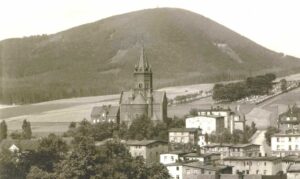
Uri Zvi Greenberg was born September 21, 1896, the day before Sukkot, in Biały Kamień, a small town in southeastern Galicia. Among his famous and influential Hasidic ancestors was Rabbi Uri of Strelisk (whom his followers dubbed “the Seraph”), for whom he was named.
“Song of My Mother’s House,” written many years after Greenberg had left Europe for Mandate Palestine, reveals a small piece of the exilic consciousness etched deep in his soul. Though later a fervent Zionist, he never lost his deep empathy for the shtetl, sensing a “land of Israel” embedded within the Diaspora. The River Jordan lay hidden in the fast-flowing Bug, and concealed within a European village well was the spring attributed to Miriam, sister of Moses, which sustained the Hebrews in the desert on their journey to the Promised Land. According to legend, that water source too is now in the land of Israel, submerged in the Sea of Galilee.
Greenberg was still an infant when his family moved to Lviv (today in Ukraine), where he grew up in poverty and privation. In this Jewish literary center, Uri Zvi was only sixteen when his first Hebrew and Yiddish poems were published. His early works were bland, romantic verse, usually lamenting unrequited love or describing scenic impressions.
In the summer of 1915, at age nineteen, Greenberg was drafted into the Austrian army and sent to the Serbian front. At first he took refuge in his pen, writing carefully metered stanzas that ignored his harsh reality. Then he witnessed a Serbian massacre of Austrian soldiers – from his own unit – as they crossed the Save River, a tributary of the Danube. Emerging unscathed, he found himself alone among the mutilated casualties of both armies.
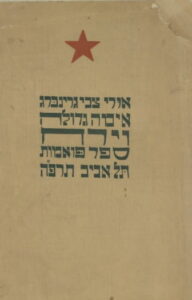
The trauma remained with him for the remainder of his long life, bursting out of his poetry again and again: the slain fallen absurdly upside-down along the electrified fence bordering the riverbank, the moonlight reflected in the metal soles of their boots. His first book of Hebrew poetry bore a title born of those moments: Great Terror and Moon (1924). During World War I, like many of his contemporaries, Uri Zvi lost faith in both God and human reason.
In the chaos following the war, pogroms swept Ukraine as Poles and Ukrainians battled for domination. Some eighty Jews were murdered in Lviv; Greenberg’s family was miraculously saved. Seeing no Jewish future in Europe – known as “the kingdom of the cross” in his poetry – he despaired of both his people and modern man.
Moving to Warsaw in 1921, Greenberg joined a circle of radical young Jewish writers, producing experimental, Expressionist poetry. He even launched a Yiddish periodical, Albatross, but after the Polish censor deemed some of its content blasphemous, he fled to Berlin.
Immersed in his poetry, Uri Zvi Greenberg opened himself up to the subversive modernism making waves across Europe. Expressionism, at the vanguard of this movement, demanded total authenticity, an all-encompassing, extreme self-consciousness. Greenberg therefore abandoned classic poetics – subtleties of rhyme and meter, romantic longings, and the like – in favor of a fiercely direct, penetrating tone. Whereas poetry had shielded him from both personal pain and the angst afflicting postwar Europe, now he wielded it to mold and shape raw emotions, expressing suffering in all its stark reality.
Greenberg’s last great Yiddish poem, “Mefisto,” written in Warsaw, was the culmination of this new direction. It described the collapse of Western culture and the appalling meaninglessness of modern existence. The work made him a name in Yiddish literary circles, drawing shocked opposition as well as admiration.
Not yet a Segula subscriber?
Access our full archive online, have print issues delivered to your door, and moreFeel free to share