
Though he saw the Jewish people as trapped in a fatal, dead-end existence, writer Hillel Zeitlin labored to bring redemption. Struggling with doubt, he kept hoping and praying, wrestling with contradictions to create a role model that – despite its lack of concrete success – resonates with Jewish intellectuals to this day


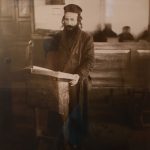
Wrapped in a prayer shawl, long hair flowing and brow crowned with tefillin, he walked to Warsaw’s deportation square, a volume of the Zohar tucked tightly under his arm. Upright and unswerving as a heavenly saint or a modern, monastical mystic going to meet his Maker, he was brutally cut down by the Nazis.
Such is the apocryphal description of kabbalist, journalist, and thinker Hillel Zeitlin’s death. He was the latest in a succession of Zionist martyrs such as Yosef Hayyim Brenner and Yosef Trumpeldor. His dramatic end shook the Jewish community in the distant land of Israel, awakening interest in and empathy for this enigmatic figure, even among his critics. No one knows if the aforementioned depiction is accurate or a new myth of Jewish self-sacrifice, adding Zeitlin’s religious fervor and resignation to a rich heritage of legendary rabbis and other righteous ones. Regardless, it’s a tale of an exalted death, the pinnacle of a life devoted to the very values it exemplified.
Three in Despair
Hillel Zeitlin was born in 1871 in Korma, a shtetl in the Mogilev governorate (today in Belarus). His parents belonged to the Kaposzt branch of Chabad Hasidim. An eager student, he possessed broad Jewish knowledge and an unquenchable thirst for religious depth and mysticism even in childhood. These set him early on the path of spiritual seeking, at first only within Jewish tradition but eventually encompassing the mystic heritage of many cultures and religions.

His father’s financial decline forced young Hillel to wander among the small Jewish towns of the Pale of Settlement, eking out a living as a teacher. Unmoored, Zeitlin roamed intellectually as well. Like many of his contemporaries, he was captivated by the great thinkers of his age, from Nietzsche’s compelling philosophy of doubt to Schopenhauer’s doctrine of blind will and fate and Lev Shestov’s grim subjectivism. Hillel married and moved to Gomel, where he found a group of like-minded and talented companions, all budding writers. Among them were Brenner (see “Nevertheless Zionism,” Segula 69) and Shalom Sander Baum. They were united by concern for the catastrophic state of the Jewish people, such that Zeitlin wrote, “Despair grew, and doubt, and with them [the call to] sacred poetry” (Hillel Zeitlin, Book of the Individuals: Collected Writings [Mossad Ha-rav Kook, 1979], p. 2 [Hebrew]).
Pessimism was popular in Europe at the turn of the 20th century, with many eastern European Jewish authors voicing such sentiments. Brenner and Zeitlin were among the most expressively urgent, describing the Jewish people as teetering on the edge of the abyss. In 1906, Brenner declared almost prophetically: “Six million are hanging by a scorched hair” (Yosef Hayyim Brenner, “He Sent Me a Long Letter” [London], p. 16 [Hebrew]).
The three young men felt isolated by their refusal to ignore this cruel reality. Fiercely individualist, they avoided the politics dividing Jewish society into parties and movements. For Zeitlin, Brenner, and Baum, both religion and ideology were just opiates of the masses, as likely to exacerbate the crisis enveloping Europe’s Jews as resolve it. Great schemes of emancipation or independence were mere delusions, and the politics driving them – Zionist or otherwise – were shallow and bourgeois.
Yet instead of being crushed by such a ruthless existence, the three were determined to act. Each went a different way, paying a different price. Sander Baum took his own life, having given up on finding a solution. Brenner put pragmatism before metaphysics, journeying to the land of Israel and devoting himself to the backbreaking task of building the land, vain as the hope of achieving anything substantial might be. His existential commitment to Jewish labor in the here and now took him far from religious tradition. Zeitlin chose yet a third path – mystic, Hasidic, messianic.

Facing the World’s Sorrow
In those years, Hillel Zeitlin was preoccupied with life’s inevitable pain and sorrow – both the internal, spiritual kind and the external, physical burden imposed by the pitiful conditions in which most Jews lived. His intellectual journey summoned Nietzsche, Spinoza, and Rabbi Nahman of Bratslav – whom he cast as a Jewish Faust – to his aid. Zeitlin’s writings chronicle his search for relief through many and varied means, and he composed many of his own prayers. He sought not just to ease his own melancholy, or even his fellow Jews’ suffering, but to heal a fractured world. In 1901 he averred:
When consciousness expands, man’s perspective on the essence of life expands accordingly, and he can understand all its sorrows. His empathy then extends to all of mankind, since in truth, all are suffering. […] He unites his life with theirs, becoming accustomed to placing their needs before his own. He begins loving his fellow man more and more. (Hillel Zeitlin, “Thoughts,” Ha-dor [The Generation] 10 [February 28, 1901/9 Adar 5661], p. 10)
Zeitlin attributed his Gomel circle’s resilience to its never-ending searching and its deep commitment to bettering the world. Both constituted a spiritual clarion call to fight to the bitter end:
By seeking and striving to correct the global evils of life and man, the iniquity of mankind’s eternal fall, some of us (i.e., Brenner, Sander Baum, and myself plus a few others) have arrived at the following thought: Life is full of tragedy and sin. Man would have been better off had he not been created. But since he has been, his task is to strive with all his might to improve and refine this life, imbuing it with heavenly sanctity. (Hillel Zeitlin, “Yosef Hayyim Brenner: Writings and Memoirs,” Ha-tekufa [The Times] 14–15 [Tevet–Sivan 5682], p. 635)
Did Zeitlin really live such lofty ideals? Yitzhak Sadeh, his student at the time of the Kishinev pogrom and later the first commander of the Hagana’s Palmah strike force, recorded the effect of these events on his teacher:
One summer evening is etched in my memory: a storm raged outside, and heavy rain pounded angrily on the roof and windows. Lightning flashed and thunder rolled. The roar of the storm woke me, and after the lightning I saw a scene I’ll never forget: Hillel Zeitlin was standing in the middle of the room in his white nightshirt, his face very pale, his eyes burning as he tore at the hair of his head, crying out in a choked voice, “Master of the Universe, Master of the Universe, see what You’ve done!” When he realized I was awake, he came over and sat by my side, stroking my hair for a long while in silence. Shivering with emotion, I understood that a great sorrow weighed on his heart. After a lengthy pause, in a faint, trembling voice, he began telling me about the riots and the disgraceful tragedy. He spoke very softly, and his eyes swam with tears. That night he mentioned [the need for] weapons, the concept of self-defense, and so on. Perhaps he never explicitly preached [violence], but the spirit of his words moved me to those conclusions. I decided I had to get hold of a revolver so as to defend myself and my family and friends, in order that such shame as had come upon the Jews of Kishinev would never befall me. (Yitzhak Sadeh, Writings, vol. 1, The Notebook Is Open: Various Autobiographical Notes [United Kibbutz Movement, 1980], pp. 189–90 [Hebrew])
At that time, Zeitlin still saw self-defense as an inevitable response to the pogroms. Although a Zionist, he favored any territorial antidote to his people’s suffering, however temporary. When the Uganda proposition was voted down, he renounced Zionism. His concern for Jewish survival, he commented, took precedence over a Zionist Utopia in the land of Israel.
Not yet a Segula subscriber?
Access our full archive online, have print issues delivered to your door, and moreFeel free to share