
Though most famous as the one-armed defender of Tel Hai, Yosef Trumpeldor was also a Russian patriot, dentist, and pre-kibbutz pioneer of agricultural collectives in the land of Israel. He also cofounded the Jewish Legion, which fought with the British army in World War I. The man behind the hero

Ten years before World War I, Yosef Trumpeldor fought in the Russo-Japanese War – essentially the first modern military conflict – and was captured in the fall of Port Arthur, in Manchuria. As a Russian patriot determined to prove that Jews were no cowards, this prisoner of war wrote an open letter (unsent due to political developments in Russia) to Tsar Nicholas II:
If we’d all had to give our lives in defense of (Port) Arthur, we would have done so without a second thought. For we knew very well that five million [Jews] were watching us from Russia, suffering all the pain together with us, supporting us with all their might, and hoping we’d truly do our duty. We knew they had no rights in Russia. We shouldered the full weight of that lack of rights […]. We’ve long sought an opportunity to throw ourselves at your feet, asking that you grant all Russian Jews [the same] rights as all the other peoples living in Russia. (Dov Ber Kotlerman, “Yosef Trumpeldor’s Experience as a Prisoner of War in Japan and Its Impact on His Zionist Vision,” in Tel Hai 1920–2020, Between History and Memory, ed. Yael Zerubavel and Amir Goldstein [Yad Ben Zvi, 2020], p. 69 [Hebrew])
Many of the sentiments expressed in this 1905 missive encapsulate the ideals for which Trumpeldor fought valiantly throughout his career: Jewish solidarity and unity, equality, and above all a sense that his life transcended its individual value and could inspire the Jewish people as a whole.
By the time he formed the British army’s Zion Mule Corps in World War I, Trumpeldor was already the most decorated Jewish soldier in history. His belief in Jewish defense galvanized youth all over Russia to focus on a new dream – a Jewish homeland in Zion.

Second Generation
Wolf (Ze’ev) Trumpeldor was a cantonist, one of countless Jewish boys conscripted into the tsar’s army. Snatched from his family at age thirteen, Trumpeldor was among the few who maintained their Jewish identity despite extensive pressure to conform. Eventually discharged, he was entitled to settle outside the Pale of Settlement (today’s Ukraine and Belarus) and chose Pyatigorsk, a resort town in the foothills of the Russian Caucasus.
Osip (or Osiya, as his friends called him) was born in November 1880 to Wolf Trumpeldor’s second wife, an assimilated Jew (although she subsequently became more traditional). The boy suffered through a few months of heder, but most of his schooling was in Russian institutions. He devoured Russian literature, particularly Tolstoy’s works, which shaped many of Osip’s later choices. The family relocated to the larger town of Rostov-on-Don, where he excelled at high school.
By 1902, young Trumpeldor was a dentist and Zionist. As a university graduate, he was exempt from the draft but enlisted anyway, despite the pacifism he’d absorbed while working at a Tolstoyan agricultural collective near his birthplace. Determined to disprove the Russian stereotype of Jewish cowardice, he fought at the Russo-Japanese front rather than simply serving his country through his profession.
What transformed the young Russian patriot into a Zionist leader?
Though legally defined a Jew in tsarist Russia, culturally Trumpeldor was more of a Russian philo-Semite than an assimilated Russian Jew. (Yohanan Petrovsky-Shtern, “Yosef Trumpeldor’s ‘War and Peace’: From Zionist Hagiography to Cultural History,” in ibid., p. 48)
Trumpeldor’s appreciation of the simple, stoic farmer and soldier, his admiration for the people of the book, and his devotion to the oppressed were all rooted in Tolstoy. Self-sacrifice in the line of duty was his guiding light in the battle for Port Arthur, in which he lost his lower left arm to shrapnel. Even after his injury, he demanded a pistol and sword and returned to the front, earning four medals for bravery, including the Cross of St. George. In addition, though never commissioned, he frequently filled in for wounded or absent officers.
Russia surrendered Port Arthur in January 1905, and its garrison was taken captive. The Japanese divided these prisoners of war by origin, placing Trumpeldor for the first time among Jews from the Pale of Settlement. Under his leadership, the group set up a synagogue and celebrated Jewish holidays. Beyond these religious activities, he organized classes in reading and basic arithmetic for any Russian captive interested and even founded a Zionist association, Bnei Zion in Captivity in Japan.


Cantonist’s progeny. Wolf Trumpeldor with his second wife, Fedosia, and six of their seven children. Osip, the fourth son, is seated in front of his father | courtesy of the Jabotinsky Institute
Demobbed
Trumpeldor and his fellow Jewish captives planned to establish an agricultural collective in the land of Israel, but after their release they scattered. Turning to politics, Osip fought for recognition as a disabled war veteran and studied law at St. Petersburg University. He wrote to his brother in 1906, deriding their joint efforts to secure him a pension, then added:
My thoughts tend toward founding a colony, and then if war breaks out in Eretz Yisrael, they’ll surely make me a deputy, though I’m perfectly ready to be just a rank-and-file soldier. There we’ll be at home, not with strangers. And you know what it means for one who’s spent his whole life knocking at strangers’ doors with no reply, who’s always known tough breaks and scorn instead of a soft touch and rest, to be “at home, not with strangers.”
And I believe a day will come when, tired and weary from a hard day’s work, I’ll joyfully survey my own fields in my own land. No man will tell me: “Go away, wretch – you’re a foreigner in this land!” But if anyone does, then by might and by sword will I defend my fields and my rights. […] And if I fall in battle, I shall be happy. I shall know why I have fallen.
Yet chances are we’ll neither fight nor fall. There’ll be no need. The need will be for labor, and labor we shall. (Menahem Poznansky, ed., The Life of Yosef Trumpeldor – A Collection of Notes and Letters [Am Oved, 1953], p. 33 [Hebrew])
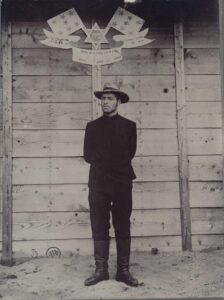
By 1910, Trumpeldor had returned to Zionist activism, directing younger would-be pioneers toward building a utopian commune in Ottoman Palestine. Nonetheless, he personally was in no hurry to relocate, having learned of the hardships of what’s known today as the second wave of Zionist immigration (the first being the colonists of the late 19th century). Forced to organize into labor battalions and accept whatever work came their way, these Jews eventually formed the first kibbutzim. Trumpeldor idealized these collectives along Tolstoyan lines, though his vision required much more manpower than their small group.
He-halutz
Trumpeldor advocated a large Russian agricultural collective where young pioneers could prepare professionally, socially, and ideologically for the Holy Land. At the same time, this “mother ship” could provide an organizational and financial bulwark for settlements in the land of Israel. This model would later be adopted by the third wave of Zionist immigration, youth movement graduates who began arriving after World War I.
In August 1911, at a conference they organized in Romny (now in northern Ukraine), Trumpeldor and six friends founded the He-halutz (The Pioneer) Zionist association. They held lectures, drafted a constitution, and even chose an anthem – the Yiddish “Oath,” sung by the Labor Zionist Workers’ Union. Their official language was Hebrew, though Trumpeldor didn’t speak it. This surrogate family’s first decision – with which he vehemently disagreed – was that members couldn’t preach Zionism without being in Zion. Trumpeldor was also determined that the group be financially independent, but with no time to raise funds before the first four pioneers set out, he accepted a loan from the Zionist Organization (today’s WZO).
Meanwhile, Trumpeldor took another law exam, recruited for He-halutz, and upgraded his prosthetic arm for agricultural work. In his native Pyatigorsk, he studied farming under a Tolstoyan landowner and tutored his children. Finally in 1912, Trumpeldor arrived in Ottoman Palestine with a group of He-halutz pioneers.
Their first stop was Migdal, in the Galilee, where a farm run by wealthy Jews prioritized Jewish labor. Yet the team soon began disintegrating, complaining of Arab competition for too little work and resenting Trumpeldor’s insistence on equal distribution of property despite unequal exertion. One pioneer even committed suicide, and Trumpeldor’s inflexibility was blamed. When he left for the Zionist Congress in Vienna in 1913, the group fell apart.
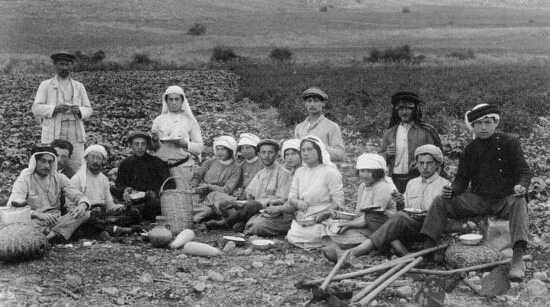
Members of the original He-halutz contingent in Ottoman Palestine break for lunch in the fields of Migdal, 1912 | Photo courtesy of Yaakov Ben Dov, Wikimedia
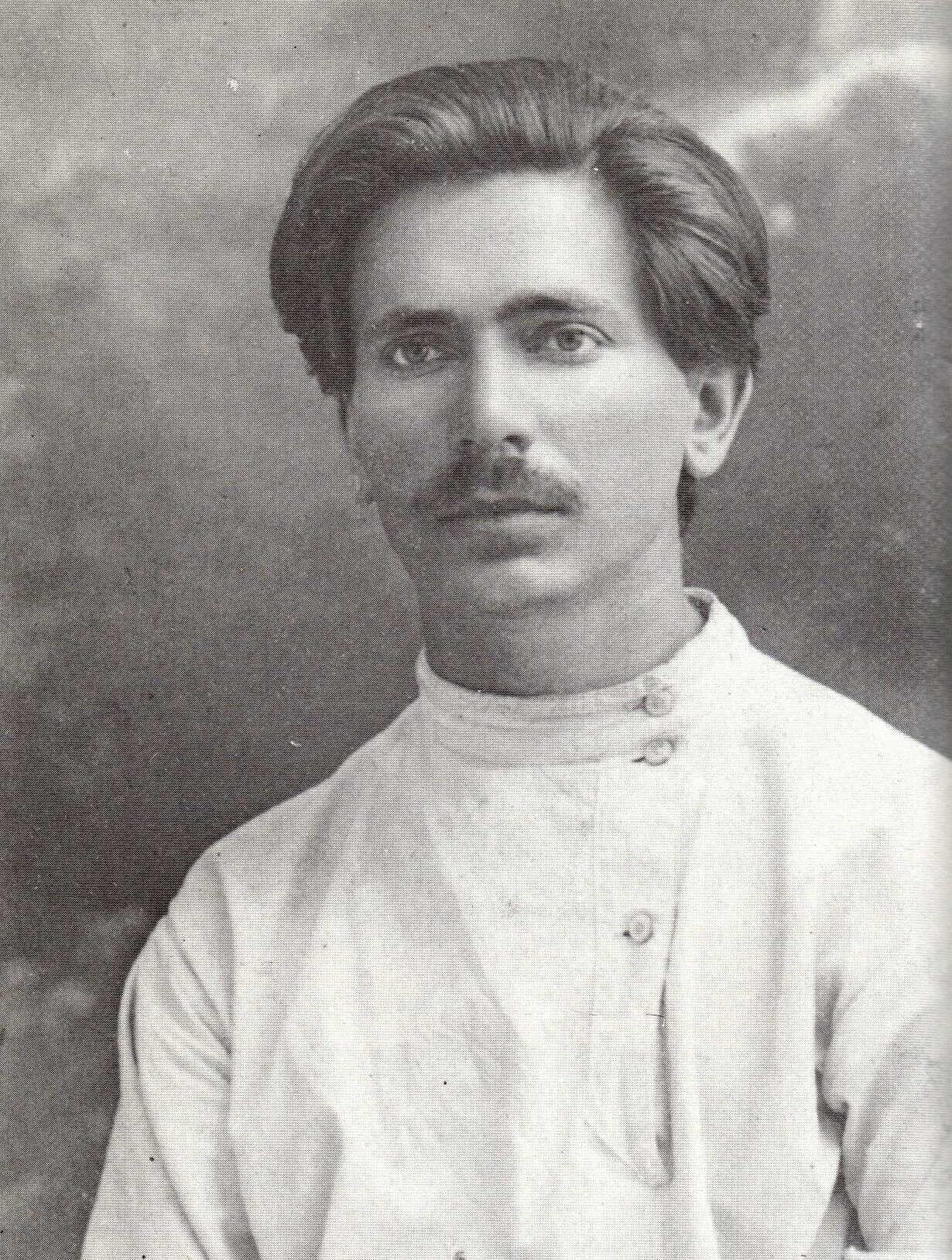
Zvi Shatz, Trumpeldor’s partner in creating He-halutz, was murdered in the 1921 Arab riots in Abu Kabir (in Jaffa) together with author Yosef Hayim Brenner | Courtesy of Brenner House
A Jewish Legion
Capitalizing on his European visit, Trumpeldor took another recruiting trip to Russia but was embarrassed to present himself as a resident of the land of Israel given his limited Hebrew. On his return, he hoped to spend time improving his language skills in Jaffa, but the murder of three Jewish watchmen from Ha-shomer – the first Zionist defense organization – put those plans on hold. The guards were all members of the Holy Land’s first agricultural collective, Degania (in the Galilee), and Trumpeldor decided to lend a hand in their place. Skillfully wielding plow and pitchfork despite his handicap, he was all set to remain on the kibbutz, even if no one there shared his grandiose dream of making Degania the model for a countrywide settlement movement.
Then World War I broke out. The Turks sided with Germany, and Europeans living in the Holy Land had to relinquish their nationality and become Ottoman subjects –or face exile. Most of Degania and much of the Zionist leadership preferred the first option, seeing it as a way of deepening their connection to the land of Israel. As a Russian patriot, however, Trumpeldor refused to align himself with the motherland’s enemies.
Donning all his medals, he handed himself over to the Turkish authorities, who imprisoned him in Damascus, then deported him to Alexandria along with thousands of other Jews in Palestine. Once again he planned to devote himself to language – this time French – and even began dating his French teacher, Firah (Esther) Rozov, to whom he later became engaged.
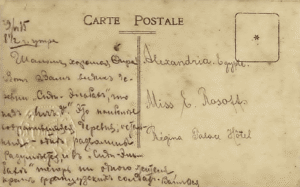
His plans changed after journalist Vladimir Ze’ev Jabotinsky arrived in Alexandria to cover the war. Seeking out the famous Trumpeldor, Jabotinsky explained his own vision of a Jewish brigade within the British army, which would help conquer the land of Israel. Together, they soon signed up a hundred volunteers, but the British high command in Egypt agreed only to an auxiliary regiment that wouldn’t necessarily fight in Palestine. Although Jabotinsky and others backed out, Trumpeldor recognized another opportunity to prove the bravery of Jewish soldiers, armed or otherwise.
Thus, under Lieutenant Colonel John Patterson, the “Zion Mule Corps” was sent to Gallipoli, with Trumpeldor serving as deputy commander. He and his volunteers swiftly earned a reputation for daring. As some joked:
The English like chocolate; the French, wine. Trumpeldor likes bombs. (Shulamit Laskov, Trumpeldor – A Life [Keter Publishing, 1982], p. 101 [Hebrew])
Despite Patterson’s disapproval of such reckless behavior, Trumpeldor cared deeply for his men, even bringing hot tea to their guard posts. The feeling wasn’t necessarily mutual, however.

The British had no interest in their Jewish recruits’ conquering the land of Israel, but much of the Zion Mule Corps realized as much only while sailing to Gallipoli, where the allies were vainly trying to break through to the Black Sea. These Jews felt deceived, especially upon discovering that their families wouldn’t be entitled to a soldier’s pension should anything befall them; they were regarded as mere auxiliaries, paid laborers’ wages. Trumpeldor was supposed to relay their grievances, but he was torn between remaining loyal to them and burnishing both his own good name and theirs.
There were signs of rebellion. Some men feigned sickness; others deserted. When Patterson fell ill, Trumpeldor had to discipline his own ranks, who were buying up cheap chocolate rations from the French and selling them to their British comrades at a profit. Nevertheless, the experiment was successful overall; frontline troops preferred the Jewish regiment’s services to those of the Indian auxiliary unit serving in Gallipoli.
By the end of 1915, the British had evacuated the Dardanelles, the Jewish soldiers returned to Alexandria, and Patterson disbanded the unit. Trumpeldor lost popularity by resisting this measure.
Becoming less useful in Egypt, he joined Jabotinsky in London, building on the Mule Corps’ sterling record to lobby for a Jewish regiment that would actually bear arms in the struggle to conquer Ottoman Palestine. Even here, the two Zionist giants’ success was limited. Trumpeldor couldn’t inspire potential recruits, as their meetings were held in Yiddish, and his English was too poor to negotiate with British army officials. Furthermore, some Zionists feared that openly siding with the British could endanger Jews living under Ottoman rule.
In the end, the 38th Regiment of His Majesty’s Fusiliers contained Jews alone but was formed only once massive casualties forced the British to extend conscription, enlisting the masses of young Russian-Jewish immigrants. After training in Egypt, the unit – including Jabotinsky – fought in the Jordan Valley, capturing the ford of Umm esh Shert. Another regiment, the 39th Fusiliers, was mostly American Jews, and the 40th came almost entirely from the Jewish community in Mandate Palestine.
Mother Russia
There was little interest in drafting Yosef Trumpeldor himself, however. He was still knocking on closed British doors when the October Revolution threw Russia into disarray. Ever the patriot, he pursued his dreams of a Jewish fighting force under the patronage of the new, pro-Jewish Russian regime. The British Jewish battalions arrived in the Holy Land without him.
In Russia, oppressed minorities were receiving better treatment. Jews were finally freed from the bounds of the Pale of Settlement, and Russian officers’ courses were open to all. Trumpeldor’s hopes of recruiting a hundred thousand Jewish fighters to face the Ottomans in the Caucasus mountain range and then conquer the land of Israel from the north suddenly seemed viable. In June 1917, he wrote to Firah:
Perhaps in a month we’ll have a license, and in another two or three we’ll be at the front, with the red Russian revolutionary flags and the blue and white flags of the Jewish revival flying overhead. I’ve spoken to a few ministers. They’re very satisfied with the idea. (ibid., p. 304)
Yet one Russian revolution followed another, and Jewish soldiers joined the ranks of other minorities wherever they happened to be. Trumpeldor struggled in vain to unite the Jews, sowing fear by means of what many saw as needless provocation.
He was soon occupied raising a much smaller force to protect the Jewish population from expected pogroms at the hands of Cossack bands loosed by the Bolsheviks. That corps too was disbanded by the authorities – and Trumpeldor himself briefly arrested – lest it expose the growing Jewish persecution under the new regime.
Yosef spent time in Pyatigorsk, staying with Firah’s parents, but his ardor toward her had cooled. Relationships didn’t come easily to him; friends described him as dependable but distant. He was too devoted to national and ideological issues to prioritize his private life, and he rarely even laughed.
Molding a Movement
Forced to abandon his military schemes, Trumpeldor found another outlet. The Zionist movement had transformed since he’d left Russia, and a large, young audience awaited his leadership. While supporting himself as a bookkeeper, he set about unifying the many He-halutz branches all over Russia into a cohesive organization. His original vision of groups training and then departing from the Russian “mother ship” to settle in the land of Israel, backed by He-halutz, began taking shape.
Trumpeldor dreamed of agricultural collectives nationwide, from the Hauran region in the north (today in Syria) to the Bedouin periphery in the south. Similar groups would provide the labor required for both defense and other national projects as the Yishuv, the Jewish community in the land of Israel, developed. Instead of military battalions, his trainees would form labor battalions, beating swords into plowshares.
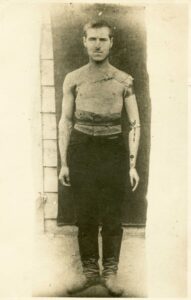
Trumpeldor launched a large training program near St. Petersburg, then in Minsk. He visited the many He-halutz branches, incorporating them into the umbrella organization he was creating. Although Yosef was approaching forty, his charisma and reputation remained captivating.
After a stint in Crimea, he returned to what was by then Mandate Palestine, stopping in Constantinople to help 150 He-halutz members detained there on their way from postwar Europe. The British wouldn’t allow Russian citizens into their new territory, suspecting them of Bolshevik aspirations of world domination. Trumpeldor’s British military credentials lent him the clout to vouch for the group.
Arriving in Mandate Palestine, Trumpeldor finally ended his relationship with the long-suffering Firah, focusing instead on putting his many young followers to work despite severe unemployment.
The Jewish workers, he realized, were divided into the socialists of Ahdut Ha-avoda (United Labor) and the socialist Zionists of Ha-poel Ha-tza’ir (Young Workers’ Union). Though the Jewish labor force was tiny, each union had its own employment bureau, mutual benefit fund, and health insurance. Given this waste of resources, Trumpeldor tabled the large projects he’d envisaged and desperately called for unity:
Jewry stands poised on the brink of critical events. In the next few months or years, the fate of the people of Israel will be decided – to be or not to be in the land of Israel. Our leaders [there] are unprepared for this great enterprise; they have no plan. On the other side [of the void], pursued to the skin of their teeth by pogroms more severe than any ever known, quite literally being slaughtered, Russian Jewry stands at the threshold of [Zion] and begs for admittance.
What’s needed is a united effort on the part of all workers. Every minute is precious. Each person entering the land is saved from certain death or a life of oppression. Every moment’s delay on our part will [one day] be considered sinful. Please make an effort; extricate yourselves from the vicious cycle of political division. For the sake of the work we have to do together, draw close to one another with a wide-open, brotherly heart. (Yosef Trumpeldor, “To the Workers of the Land of Israel,” Ha-poel Ha-tza’ir, 26 Kislev 5680/December 18, 1919, p. 30)
Yosef Trumpeldor’s appeal moved hearts and minds, coming as it did from an outsider to both rival parties who was admired throughout the Jewish world. Ahdut Ha-avoda immediately and publicly agreed to the proposed union; Ha-poel Ha-tza’ir requested clarification and specifics.
Trumpeldor was about to go back to his followers in Constantinople (soon to be Istanbul) but acceded to a request by Ha-shomer founder Israel Shohat to evaluate the military readiness of the isolated settlements of the Galilee Panhandle. This mission would prove to be Yosef’s last.
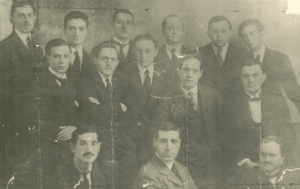
Last Stand
Trumpeldor’s ultimate sacrifice in defense of Tel Hai is legendary. One of a group of settlements cut off from the rest of the Zionist endeavor in an area governed by French as opposed to British Mandate, Tel Hai was ill-equipped to defend itself against the armed Arab bands gathering in the wake of lax French rule. Trumpeldor wrote of the growing danger. Jabotinsky and others suggested evacuation, but the labor unions feared the repercussions of abandoning Jewish land.
In the final assault, on March 1 (11 Adar), 1920, attackers entered Tel Hai ostensibly to search for French soldiers suspected of using it as a base. In the ensuing gunfight, Trumpeldor was mortally wounded, and five of the thirty defenders were killed. Although the onslaught was repelled, the survivors retreated to Kfar Giladi, taking Trumpeldor with them. His last words have become an indelible part of the Israeli military ethos: “Never mind, it’s good to die for our country.”
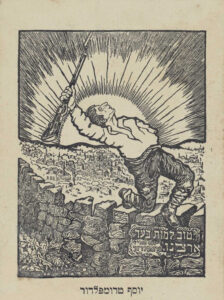
Although Trumpeldor is remembered chiefly as a military hero, his successful model of collective training and settlement linking the Diaspora with the Yishuv was perhaps his most essential contribution to the Zionist effort. The Trumpeldor Labor Battalion, founded on the anniversary of his death, used this template to provide employment and community for young pioneers in the form of large-scale construction projects. And the two labor unions he’d urged to amalgamate did just that only months after his demise.
Yosef Trumpeldor’s defense of Tel Hai taught the Jewish community in the land of Israel that in a power vacuum, Jews must fight for independence, not rely on foreign protection. In that, as in so many other aspects of his life, Trumpeldor was ahead of his time.
Feel free to share