
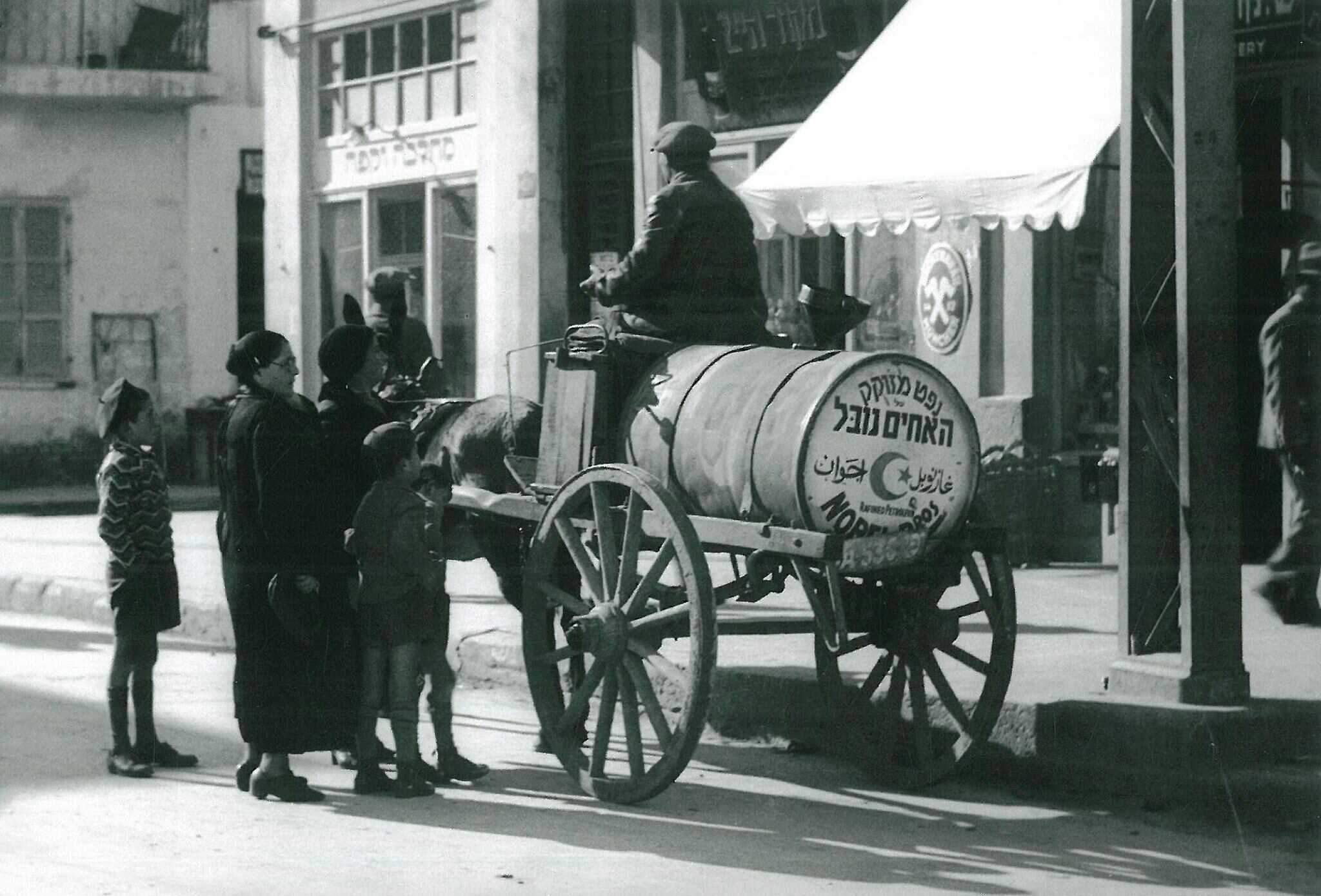
The city that never sleeps might now epitomize secular Israel, but for decades it was the country’s Hasidic capital – and Zionist too!

Shoppers on Tel Aviv’s fashionable Shenkin Street and high-tech workers on their way to the city’s Ramat Ha-hayal district still sometimes come across the odd bearded, black-hatted, and black-clad Hasidim striding along, eyes downcast, perhaps accompanied by a young son, with sidecurls, shaven head, and black, velvet skullcap. Out of place as he may seem, this Hasid is a remnant of Tel Aviv’s forgotten past – as the Hasidic center of the young State of Israel.

The Hasidim Are Coming!
Hasidic Jews began arriving in the land of Israel in the mid-18th century, including a particularly large group in 1777. Influenced by the growing opposition to Hasidism in eastern Europe – spearheaded by the Vilna Gaon – the Holy Land’s Ashkenazic communities turned a cold shoulder to these transplants, which forced them to settle in outlying Tiberias and Hebron.
Throughout the 19th century, Hasidic leaders generally discouraged emigration to Ottoman Palestine, and the percentage of Hasidim among Jews there consequently dropped. Prominent Hasidic masters were ambivalent about Hovevei Zion’s activities toward the late 1800s – as its small colonies couldn’t cater to Hasidic strictures regarding education, shehita, and mikva’ot – so few Hasidim joined the early Zionist villages.
The first Hasidim to organize a return to the Holy Land at this point were descendants of the master of Ruzhin, Rabbi Yisrael Friedman. In 1882, thirty Romanian families connected to the Bohush Hasidic dynasty (founded by Friedman’s grandson) bought the land abandoned by the failed colony of Gei Oni, renaming it Rosh Pina.
Individual Hasidim came even earlier. In 1866, Chabadnik Hayyim Shmuel Shmerling arrived in Jaffa and served as the port’s first customs broker. Shmerling was among the first to build a home outside the walls of Old Jaffa, on the seashore. A Chabad community developed around him, which built a house of worship, Ohel Yitzhak, in 1903. Today the derelict, frescoed structure is undergoing preservation and restoration.
In 1910, another Hasidic group arrived from Poland and Galicia, building their own synagogue – Kehal Hasidim – in Neve Zedek, then a new neighborhood of Jaffa. A prayer house (shtibl) in nearby Neve Shalom, founded soon after Neve Zedek, is still active today.
Mandating Growth
Hasidic attitudes toward Jewish settlement in the land of Israel changed after the Balfour Declaration, the end of World War I, and the beginning of the British Mandate. The turnaround was led by the master of Ger, Rabbi Avraham Mordechai Alter, who was then the most influential Hasid in Poland, where Hasidism was strongest. The Imrei Emet, as he was known, visited the land of Israel no fewer than five times, and after his first trip (in 1921) he wrote:
I set to work at once so as to be prepared. Together with the group accompanying me and some distinguished individuals from Jerusalem, we incorporated a share company […] and bought some twenty thousand cubits in Jaffa, to be developed for buildings and shops. (Digleinu, Sivan 5681, p. 86 [Hebrew])
Despairing of the bitter rivalries among ultra-Orthodox leaders in Jerusalem, the rebbe of Ger invested elsewhere.
Unlike Ger and Bohush, most Hasidic leaders kept their followers close to home. Mandate Palestine still lacked Hasidic educational institutions, and it was difficult to maintain the vital connection to the rebbe and his court from such a distance.
Nevertheless, a number of Warsaw Hasidim formed a company called Bayit Ve-nahala (Home and Heritage) to buy land for group purchase, and in 1923 they founded Bnei Brak near the site of the Second Temple town of that name. Around the same time, two young Hasidic rabbis – Yisrael Elazar Hopstein of Kozhenits and Yehezkel Taub of Jabłonna (both in Poland) – arrived with a shipload of followers to found agricultural colonies in the Jezreel Valley. In the end, difficulties forced them to merge, and with two colleagues they set up a unique village in the Galilee – Kfar Hasidim. (See “It Takes a (Hasidic) Village,” Segula 47.)
In the 1920s, Hasidim began building their own institutions in Tel Aviv, soon dividing up into separate shtiblekh for Chabad, Ger, Strykow, and Skierniewice. In 1924, the city welcomed its first Hasidic master, Rabbi Shaul Moshe Zilberman of Wieruszow, who established himself as the leader of the local Ger Hasidim. More rebbes followed, and in 1931 Hasidic businessmen built the Central Hasidic Synagogue on Yavne Street.
In the Shadow of Death
With anti-Semitism on the rise in Europe during the 1930s, thousands of ultra-Orthodox Jews fled Poland for Mandate Palestine. Many, including numerous Hasidim, settled in Tel Aviv. It was the natural choice for them, coming as they did from large, bourgeois towns. They bought apartments in the city’s expanding neighborhoods, finding employment and opening businesses in this almost all-Jewish environment.
Other branches of Hasidism joined those already established in Tel Aviv, with Sokolow, Kotsk, Sochaczew, Karlin, and Stolin all creating their own communities, synagogues, and study halls. Hasidic masters – of Lubavitch, Munkacs, Dej, and Carei (whose grand rabbi later became the rebbe of Satmar) – made pilot trips. Some of these leaders actually immigrated before World War II prevented that, most notably Rabbi Shmuel Eliyahu Taub of Modzits (one of the Hasidic rebbes most closely identified with Tel Aviv). The other newcomers were descendants and/or disciples of the Ruzhiner Rebbe, whose survival in large numbers and concentration in the land of Israel made them a force to be reckoned with after the Holocaust.
Yet the largest and most influential Hasidic sect in the White City was Ger, which opened a Beit Yaakov girls’ school and separate teachers’ seminaries for young men and women. By 1937 the Ger Hasidim had set up a branch of Jerusalem’s Sefat Emet Yeshiva, Tel Aviv’s first Talmudic academy with a Hasidic orientation. A year later, the place had competition from Chabad.
In 1940, the master of Ger escaped Nazi-occupied Poland and settled in Jerusalem. Nevertheless, he devoted much effort to developing the sizable Ger community in Tel Aviv. This period saw the institution of the custom of reading the biblical Song of the Sea on the seventh day of Pesach on the Tel Aviv seashore, an event that attracted thousands of Hasidim – and curious onlookers.
Hasidic leaders continued arriving in Tel Aviv during the 1940s. In early 1944, Rabbi Aharon Rokeah of Belz was smuggled out of Hungary and joined their ranks. A small community soon formed around him, which grew into one of the largest Hasidic courts in Israel. That same year a son of the master of Vizhnitz, Rabbi Eliezer Hager, escaped from his hometown and eventually settled in Tel Aviv. Shortly after his arrival, Hager founded a yeshiva that became Vizhnitz’s base of Israeli operations. Following his death in 1946, he was succeeded by his brother, Rabbi Hayim Meir, who built a neighborhood for his followers in Bnei Brak.
Not yet a Segula subscriber?
Access our full archive online, have print issues delivered to your door, and moreFeel free to share