
Bitter and bloody, the battle for Jerusalem’s San Simon Monastery in 1948 was etched deeply into the memories of all who fought there. Their bravery and self-sacrifice forged the founding ethos of the Israel Defense Forces

In 2003, about a year before Reserves General Rafael Eitan drowned off the coast of Ashdod, he spoke to a group of tour guides on the lawn by San Simon Monastery, in the Jerusalem neighborhood of Katamon. As children played in the background, Raful, as he was affectionately known, explained why future generations had to know the story of the battle he’d fought here during Israel’s War of Independence. “I was shot in the head,” he said, “but half an hour later I was fighting again.”
Speaking at the president of Israel’s residence soon after becoming commander in chief of the Israel Defense Forces in 1978, Raful famously referred to the same episode:
Not far from here, the future of Jerusalem as Israel’s eternal capital was determined in a fierce battle thirty years ago. I was privileged to be part of it, and it’s my privilege to stand here today, in this place, and accept the post of commander in chief. (Tzvika Dror, Harel: The Battle for Jerusalem [Ha-kibbutz Ha-me’uhad, 2005], p. 139 [Hebrew])
Though Eitan was never one to talk, one might have expected that when sworn in to his new post after thirty years’ army service, he would have drawn on a more crucial point in his military career than a minor skirmish predating his officers’ training course. Yet the battle for San Simon was the one he chose.
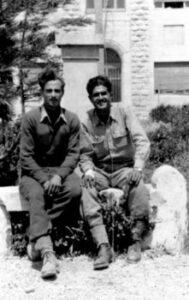
Raful’s comrades, many later highly influential in the IDF and Israeli life, also saw this battle as a defining event in their careers. Why was it so special? How did San Simon differ from other engagements waged in and around Jerusalem in the War of Independence, and why is it indelibly inscribed in the hearts and minds of those who fought there?
In April 1948, rumors circulated in Mandate Palestine that the British were planning to evacuate their personnel from Jerusalem earlier than expected. Leaders of the Hagana, the civil reserve guard and the largest underground Jewish defense organization, suspected that strategic British positions would then be occupied by Arab forces. Jerusalem commander David Shaltiel resolved to prevent that by bringing reinforcements to the city. He chose a unit from the Palmah, the Hagana’s fighting arm.
The Harel Brigade, headed by the young Yitzhak Rabin, had been stationed in the Jerusalem Corridor to protect convoys approaching the city. Rabin would have preferred to consolidate Palmah control of the road, Jerusalem’s lifeline, but instead his fighters were organized into the ill-fated Harel convoy. They were ambushed as the road passed through the narrow ravine at Sha’ar Hagai, and fifteen were killed.
The brigade arrived in Jerusalem only to find that the rumors had been false; the British were leaving only at the end of the Mandate, on May 15. Yet Jerusalem was under siege, and Harel’s arrival brought the city’s anxious residents much needed relief and a sense of security.
Shaltiel pondered whether to send the brigade back to the Jerusalem Corridor or keep it in the city for a military operation that had been postponed for lack of manpower. Operation Jebusite, as this contingency plan was called, was a bold series of attacks to prevent Jerusalem’s outlying Jewish neighborhoods from being cut off. The aim was to conquer Sheikh Jarrah, an area dividing the Old City from the Hebrew University on Mount Scopus, as well as the strategic heights of Beit Ikhsa and Nebi Samuel to the north of the city, and San Simon Monastery and Katamon in its south.
The attack on San Simon was the third phase of the operation, after the brigade failed to capture the hill of Nebi Samuel. More than forty Palmah fighters fell in that offensive – on April 22–3, the first day of Pesach – including commander Haim Poznansky and other officers. Overlooking Katamon, San Simon was a wealthy Greek Orthodox monastery of Arab Christians. Whoever controlled it commanded the southern Jewish residential areas of Talpiyot, Mekor Haim, Arnona, and Kibbutz Ramat Rachel, and could easily snipe at nearby Kiryat Shemuel and Rehavia. This whole section of Jewish Jerusalem was liable to be isolated from the central and western parts of the city, leaving its residents vulnerable. The hilltop monastery had to be captured before the rest of the attack could succeed.

Courtesy of the Palmah photo archive

Photo: Dr. Avishai Teicher
The Greek Orthodox monastery of San Simon was built in the 19th century on the ruins of a much earlier monastery. In 1948 it dominated the few houses in the area, while today it’s largely hidden by the apartment buildings, high-rises, and park that have sprung up around it
Not yet a Segula subscriber?
Access our full archive online, have print issues delivered to your door, and moreFeel free to share