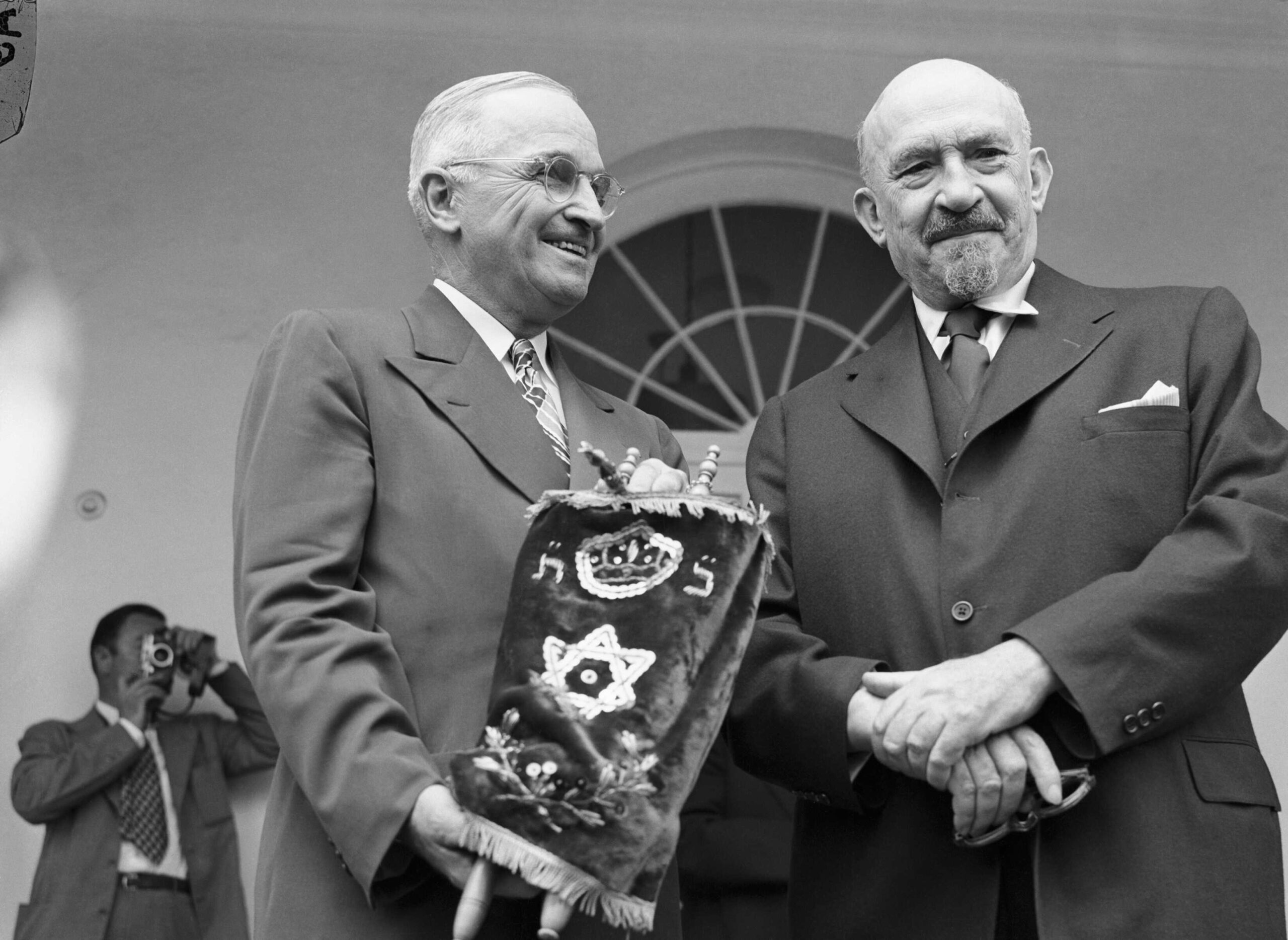
A Torah scroll sounds like a superlative gift for the first world statesman to recognize the State of Israel. But what exactly made the Torah scroll presented by Chaim Weizmann to Harry S. Truman so special?

On May 14 (5 Iyar), 1948, the Jewish National Council, the official representative of the Jewish community in the land of Israel to the British government, gathered in Dizengoff House, in Tel Aviv. David Ben-Gurion, the head of the Jewish Agency and future first prime minister of Israel, proclaimed the establishment of the State of Israel at 4 pm on Friday to avoid Sabbath desecration. The Mandate was set to end at midnight on May 15, corresponding to 6 pm on May 14 in Washington. Against the recommendation of Secretary of State George C. Marshall and many others in both the State and Defense Departments, Harry S. Truman, thirty-third U. S. president, recorded his recognition of the State of Israel in a press release timed at 6:11 Washington time, only eleven minutes after the Mandate expired:
This government has been informed that a Jewish state has been proclaimed in Palestine and recognition has been requested by the provisional government thereof. The United States recognizes the provisional government as the de facto authority of the new State of Israel. (draft of press release, May 14, 1948, United States National Archives)
Truman was thus the first head of state to recognize the State of Israel.
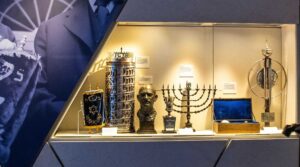
In the Harry S. Truman Presidential Library and Museum, in Independence, Missouri, an entire room is dedicated to Truman’s role in recognizing the Jewish state. A small Torah scroll (fifteen inches high) is displayed along with a silver Torah case and other Judaica gifted to the president at various times.
Such gifts grace many presidential libraries. There are very few Torah scrolls, however, and the Truman Torah stands out not only in size but for its fascinating history. The Torah’s original commission, its travels, how it came to be presented to President Truman, and its many exhibitions all make it a unique part of Truman presidential history.
Friend of the Jews
Born in 1884, Harry Truman grew up well versed in the Bible, including the story of the Jewish people. When he entered politics, many of his speeches referred to G-d, Scripture, and religion. He felt that the foundation of American law was given to Moses on Mount Sinai.
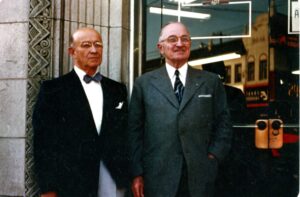
While young Truman had minimal exposure to Jews, he partnered with Eddie Jacobson in running a haberdashery in Kansas City, Missouri. The two had served together in World War I, and although their business failed during the Depression, Jacobson remained Truman’s best friend for life and played a pivotal role in his recognizing the State of Israel.
As World War II raged, Truman repeatedly expressed concern about the disastrous state of the Jews of Europe. In 1943, Senator Truman spoke at a large Chicago rally addressing Nazi atrocities. And in August 1945, as president, he received a report detailing the dismal conditions of Holocaust survivors in European DP camps. Writing to British prime minister Clement Attlee, Truman urged the immediate admission of 100,000 Jewish refugees to Palestine.
It is suggested that the granting of an additional one hundred thousand of such certificates would contribute greatly to a sound solution for the future of Jews still in Germany and Austria, and for other Jewish refugees who do not wish to remain where they are or who for understandable reasons do not desire to return to their countries of origin.
On the basis of this and other information which has come to me I concur in the belief that no other single matter is so important for those who have known the horrors of concentration camps for over a decade as is the future of immigration possibilities into Palestine. […]
The main solution appears to lie in the quick evacuation of as many as possible of the non-repatriable Jews, who wish it, to Palestine. If it is to be effective, such action should not be long delayed.
Very sincerely yours,
Harry S. Truman (Public Papers of the Presidents of the United States, Harry S. Truman, 1945 [Washington, 1961], p. 470)
The request went unanswered, but it reflected Truman’s ongoing commitment to Holocaust survivors.
Not yet a Segula subscriber?
Access our full archive online, have print issues delivered to your door, and moreFeel free to share