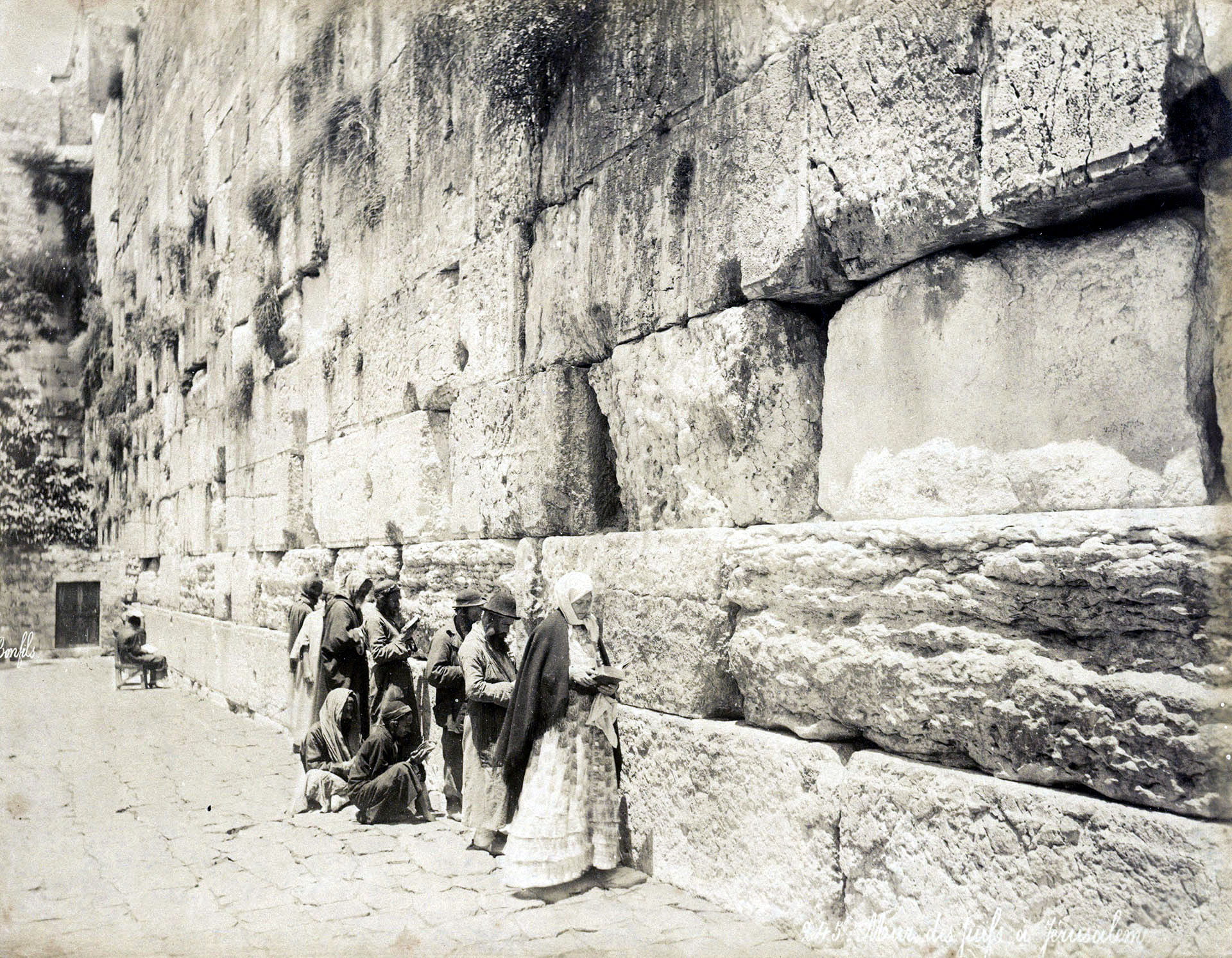
Today most Jews visiting the Temple Mount are religious and of a certain stripe, but when the site opened to non-Muslims in the mid-19th century, it was generally secular Jewish tourists who seized the opportunity to connect with their national roots. What has changed?

The Temple Mount is Judaism’s holiest site, Islam’s third-holiest, and sacred to Christianity as well. For Jews, it’s not just about what happened here in the past; Jewish law regards this spot as God’s eternal dwelling place on earth. Ever since the destruction of the Second Temple, however, all Jews have been ritually impure and therefore forbidden to enter certain areas of the Temple Mount. The exact location of these sections has been disputed since at least the 13th century. Thus, as Jerusalem’s Jewish population began growing substantially in the 1800s, most rabbinic authorities barred Jews from the mount.
Muslims, who have essentially controlled the Temple Mount for centuries, revere it as the site of the “furthest mosque,” mentioned in the Quran as the place where the prophet Muhammad and his winged horse, al-Buraq, landed at the end of his night flight from Mecca. Muslim tradition claims that Muhammad touched down in the southern part of the Temple Mount plateau, then ascended to heaven from a rock. The Rashidun caliphs who succeeded Muhammad commemorated this mystical event by erecting Al-Aqsa Mosque and the Dome of the Rock. In Arabic, the mount is called Haram a-Sharif (the Noble Sanctuary).
Islam later identified the Western Wall’s southern corner as the precise point where Muhammad tethered his horse, and this spot is thus known in Arabic as al-Buraq. Extending the Muslim holy site to include the Western Wall may have been intended to counter Jewish efforts to control this area, where Jews had prayed since Islamic rulers banned non-Muslims from the Temple Mount. Arab attempts to gain dominion over these few meters intensified from the second half of the 19th century onward.
Pressured by the European powers that had come to their aid in the Crimean War, the Ottoman authorities began admitting Christians and other nonbelievers to the site in 1856, although entry was reserved for Muslims on Fridays and during the month of Ramadan. Tourists had only to obtain a permit from Jerusalem’s Ottoman governor – and bribe the guard at the entrance. Yet Jews were still rabbinically forbidden to enter, so the observant contented themselves with gazing upon the mount from the Mount of Olives or tall buildings. As one visitor to the city noted:
As we neared the steps leading up to the Temple, my host halted and said: “Stop here, for we’re forbidden to go even a step further, since we’re ritually impure and must not enter the site where our Temple stood, which remains holy even in ruins […].” From afar, I beheld the city’s splendor. (Akavia, “Letters from the Land of Israel,” Ha-zefira, 9 Tevet 5659/December 22, 1898, p. 2)
Honored Guests
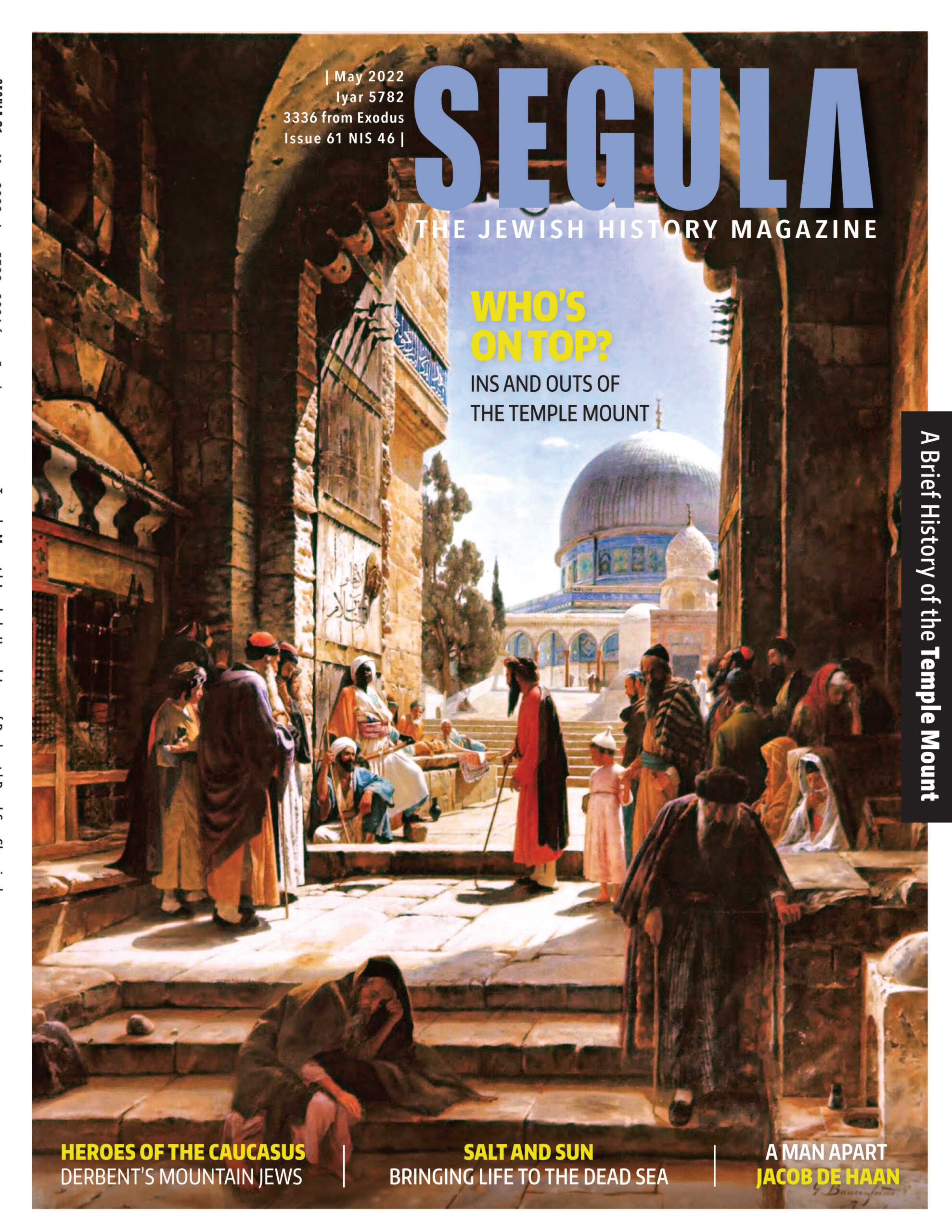
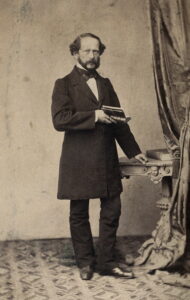
Nonetheless, certain European Jewish philanthropists flouted the rabbinic ban, incensing Jerusalem’s traditional community. Montefiore visited the Temple Mount in 1855 (albeit in a litter), and a year later, Dr. Ludwig August von Frankl, secretary of the Viennese Jewish community, took advantage of the dedication ceremony of Jerusalem’s Laemel School to fulfill a longstanding personal dream and see where the Temple once stood. Since the school was already controversial for teaching secular studies, Frankl kept his tour a secret by ascending on the Sabbath, thereby avoiding clashes with the city’s Jewish population. He was particularly struck by the architecture inside both mosques, as detailed in his book, The Jews in the East (1859).
Yet another Jew who couldn’t resist the holy site was Baron Edmond de Rothschild. Arriving in Jerusalem in 1887, the Baron went sightseeing with Nissim Behar, his representative in the land of Israel and headmaster of the city’s Alliance Israélite Universelle school. Though warned of the halakhic prohibition, Rothschild trod the sacred ground anyway – but without Behar.
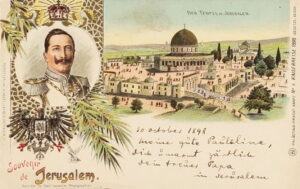
Theodor Herzl led a delegation to Jerusalem in the autumn of 1898, hoping to engage fellow visitor Kaiser Wilhelm II’s sympathies for the Zionist cause. Herzl’s diary mentions Orthodox Jerusalem’s ban on Montefiore after his trip to the Temple Mount. Accordingly, rather than doom relations between the city’s new Zionist residents and its Orthodox establishment by defying the rabbis’ prohibition himself, Herzl merely gazed out over the holy site from the balcony of the Tiferet Israel Synagogue. Nevertheless, Havazelet (Lily), a traditionalist Jerusalem daily, listed the iconic Zionist among the dignitaries accompanying the kaiser around the Temple Mount. The editor likened Herzl to false messiahs who’d transgressed biblical commandments just to show that redemption would soon make them irrelevant:
[Herzl endeavored] to violate a prohibition […] inviolable anywhere in the world except Jerusalem, by entering the Temple – [a crime] punishable, according to most halakhic authorities, by divine excision even today. And he succeeded […]. (“Jerusalem,” Havazelet, 21 Marheshvan 5659/November 6, 1898, p. 35)
As the 20th century progressed, respect for this prohibition eroded. Less observant and even secular Jews settled in Jerusalem’s new neighborhoods, international tourism to the city increased, and visiting the Temple Mount no longer required a permit. Consequently, more Jews than ever entered the sacred precincts.
At the same time, although the Western Wall remained the main Jewish prayer area, many steered clear of the narrow space at the foot of the wall, fearing that it too was halakhically off limits. Jerusalem scholar Avraham Moshe Luntz dismissed such qualms from the pages of Hashkafa (Outlook), Eliezer Ben-Yehuda’s newspaper:
In truth, many sages and rabbis have erred in this both in our own generation and in previous ones […]. This opinion has no basis, and this error has occurred only because our brothers are forbidden to enter the Temple Mount and measure it. The Western Wall is [merely a] wall of the Temple Mount. Any of us may approach the Western Wall and pour out his heart, and the Lord will hearken to his prayer as if to the prayer of King Solomon, may he rest in peace. (Luntz, “Reply to the Query concerning the Western Wall,” Hashkafa, 25 Kislev 5667/ December 12, 1906, pp. 3–4)
Strictly Forbidden
In the spring of 1912, the editorial board of Warsaw’s popular Yiddish daily Haynt (Today) arrived in Ottoman Palestine. The local rabbinical court failed to keep these journalists off the Temple Mount, and they found the site profoundly moving. A year later, pioneers from Kibbutz Degania organized a tour of Jerusalem, including the Western Wall and the mount.
That same year, Rabbi Abraham Isaac Hakohen Kook, then rabbi of Jaffa and the Jewish colonies, urged Tel Aviv’s Herzliya Hebrew Gymnasium to exclude the Temple Mount from the high school’s trip to Jerusalem. Similarly, in a 1914 letter to a colleague, Rabbi Kook complained about a visit by Baron Rothschild:
My heart shrinks at the profanation caused by his presence at the site of the Temple, and even more that no one told him it was forbidden. A single blow to the sanctity of the site of our Eternal Home is more significant than millions of settlements, though it doesn’t detract from his value as the founder of the community [in the land of Israel], as his action occurred either in error or as that of one whose transgressions are all unintentional, and the good Lord will atone [for him] and take [only] the good. (Rabbi Kook to Rabbi Yonatan Binyamin Halevi Horowitz, in Kook, Letters, vol. 2, letter 677, p. 285 [Hebrew])
Shortly afterward, a correspondent for the Moriah daily lamented that secular Jewish Jerusalemites and tourists were traipsing around the Temple Mount bareheaded and entering its mosques. Citing widespread ignorance of the rabbinic prohibition, the reporter suggested that the ban be publicized in various languages.
The complaint apparently struck a chord, since the same newspaper announced less than a week later:
Notices have been posted by the Sephardic and Ashkenazic rabbinic courts, warning of the prohibition of entering the Temple Mount, site of the Temple, which has been violated of late by many visitors among our Jewish brethren. The rabbis herewith declare that there is no leeway whatsoever in this matter and that [violators] incur the divine punishment of excision. (“Jerusalem – the Prohibition of Visiting the Temple Mount,” Moriah, 12 Nisan 5674/April 7, 1914, p. 2)
Not yet a Segula subscriber?
Access our full archive online, have print issues delivered to your door, and moreFeel free to share