
A converso who returned to his roots, Uriel da Costa found the Judaism practiced in Amsterdam a far cry from the faith he’d encountered in the Bible. The Jewish community’s response to his puzzled objections forced him back into hiding, this time among Jews

Amsterdam, Holland’s greatest city, epitomizes liberalism and freedom. The famous coffee shops of the De Wallen neighborhood, the red-light district, the free-flowing alcohol at the many breweries, and the general “anything goes” atmosphere attract millions of tourists in their twenties – and even younger – to this canal-riven city annually.
Tolerance has characterized Amsterdam ever since its golden age in the 16th and 17th centuries. Though its fervent Calvinists condemned all manner of luxury and frivolity, the city gained a reputation for open-mindedness verging on lawlessness. That ideology was rooted not in the puritan Calvinist population but rather in the town’s growing community of Portuguese conversos.
Dutch Independence
Throughout the 16th and 17th centuries, Amsterdam was the prosperous capital of a global empire. For close to a hundred years, it was also the world’s financial center.
Originating as a federation of seven provinces in 1581, the Dutch republic had no official religion or absolute ruler. Its only unifying factor was the urge to shake off Spain’s despotic rule, adopting a relatively liberal constitution that later inspired the U.S. Constitution.
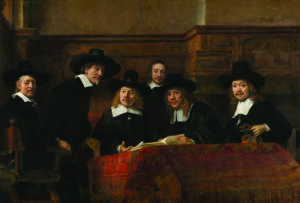
With no inherited aristocracy to speak of, Dutch society rested on its middle classes and wealthy merchants, residents of its fast-developing port cities. The Dutch East India Company, founded in 1602, became the world’s first public company by issuing bonds and stock options to the Dutch people. The firm was also the first global conglomerate, with its peak market value matching that of today’s Apple, Amazon, and Google combined. As for culture, Dutch masters such as Rembrandt, Vermeer, and Peter de Hogh were the brightest stars in an artistic pantheon whose workshops depicted the everyday, bourgeois life of the upper middle class.
Much of the Netherlands’ success stemmed from its liberalism and religious tolerance. After the revolt of the United Provinces in 1568, Spain invaded the southern Low Countries – modern-day Belgium and Luxembourg – conquering the vital western European port of Antwerp and launching hostilities that continued on and off for over half a century. Protestant England helped block the Spaniards’ advance northward. Non-Catholics under Spanish rule were subjected to heavy taxation and religious persecution, resulting in a mass exodus of wealthy Calvinist merchants, who abandoned the southern ports for those of the freer north. Many settled in Amsterdam, then a sleepy seaside town. They were followed by more waves of religious refugees: French Huguenots, English Puritans, and the well-endowed offspring of New Christians – conversos – from Portugal.
Simultaneously, the Netherlands became a colonial power, conquering much of the East Indies (now Indonesia), Ceylon (Sri Lanka), Formosa (Taiwan), and Malacca (Malaysia). Amsterdam thus came to offer extensive economic opportunities for both investors and entrepreneurs.
Culture Shock
The first New Christians arrived in Amsterdam in the late 1500s and were allowed to practice freely as Jews. By 1610, they numbered five hundred, and a decade later their ranks had doubled. Throughout the 17th century, Amsterdam became a center for descendants of Spanish and Portuguese conversos. Their community was rich not only materially but in study halls and Talmudic academies. Its homegrown rabbis served Sephardic congregations all over western Europe and in the New World.
Among the conversos converging on Amsterdam was young Gabriel da Costa Fiuza, who’d followed a tortuous path from Portugal. Born around 1583 in Porto, Gabriel was the son of a well-to-do Christian merchant and tax collector and his New Christian wife. Da Costa held a clerical post in Porto and studied canonical law at the University of Coimbra. Directly exposed to the biblical text, he began doubting Christian dogma, eventually rejecting it entirely and resolving to become a Jew.
After the death of Gabriel’s father in 1608, the Da Costas encountered financial and legal difficulties and left Portugal. As the departure of any New Christian required a host of permits and paperwork, the family exited secretly, reaching Amsterdam in April 1615. The Da Costas identified as Jews on arrival, and Gabriel took the Hebrew name Uriel. Together with his brother Abraham and their mother, Uriel continued up the coast to Hamburg, where they joined the fast-growing community of ex-conversos. Two younger brothers remained in Amsterdam.
For many Portuguese conversos, returning to Judaism was no simple matter, since they had neither knowledge nor family traditions to lean on. All they knew was largely superficial and based on limited familiarity with the Bible. Furthermore, their understanding of Judaism was shaped by the Christian way of thinking with which they’d grown up. Thus, they related to Judaism as a creed rather than a way of life. As crypto-Jews, they’d long separated what they considered the private personal phenomenon of their inner religious belief, from their outward behavior, assuming that what you thought was more important than what you did. Thus, even now as Jews, they prioritized dogma over deed.
Encountering rabbinic Judaism, with its emphasis on halakhic minutiae, the returning conversos were not always enthusiastic. As outsiders, they had trouble grasping the logic of Jewish law and finding its basis in the Bible. Some accepted every ritual detail nonetheless. Others chose selective conformity, toeing the line just enough to remain within the community while maintaining their own lifestyle. Still others groped toward some kind of compromise between Jewish and Christian outlooks, reinterpreting Jewish law along the way.

The concurrent emergence of rationalism –and the advent of skepticism – also shaped this process. Such thinking was as threatening for Calvinist Dutch society as it was for the community of returning crypto-Jews. In 1615, Dutch theologian and lawyer Hugo Grotius demanded that every Jew requesting residence in Holland swear belief in the Creator, Providence, and the immortality of the soul. Likewise, testimony delivered before the Inquisition tribunal in Lisbon in 1617 claimed that a certain converso from Amsterdam who’d reembraced Judaism was an “Epicurean or atheist who believes in no religion at all” (Yosef Kaplan, An Alternative Path to Modernity: The Sephardi Diaspora in Western Europe).
Uriel da Costa was no exception to this struggle. Normative Judaism wasn’t what he’d expected, as he wrote in his Latin autobiography, Exemplar Humanae Vitae (Example of a Human Life):
I had not been [in Amsterdam] many days before I observed that the customs and ordinances of the modern Jews were very different from those commanded by Moses. Now if the Law was to be strictly observed, according to the letter, as it expressly declares, it must be very unjustifiable in the Jewish doctors [i.e., rabbis] to add to it inventions of a quite contrary nature. (Uriel da Costa, Examination of Pharisaic Traditions, appendix 3, Uriel da Costa’s own account of his life, trans. John Whiston [London, 1740; reprint, Brill, 1993], p. 557)
Not yet a Segula subscriber?
Access our full archive online, have print issues delivered to your door, and moreFeel free to share