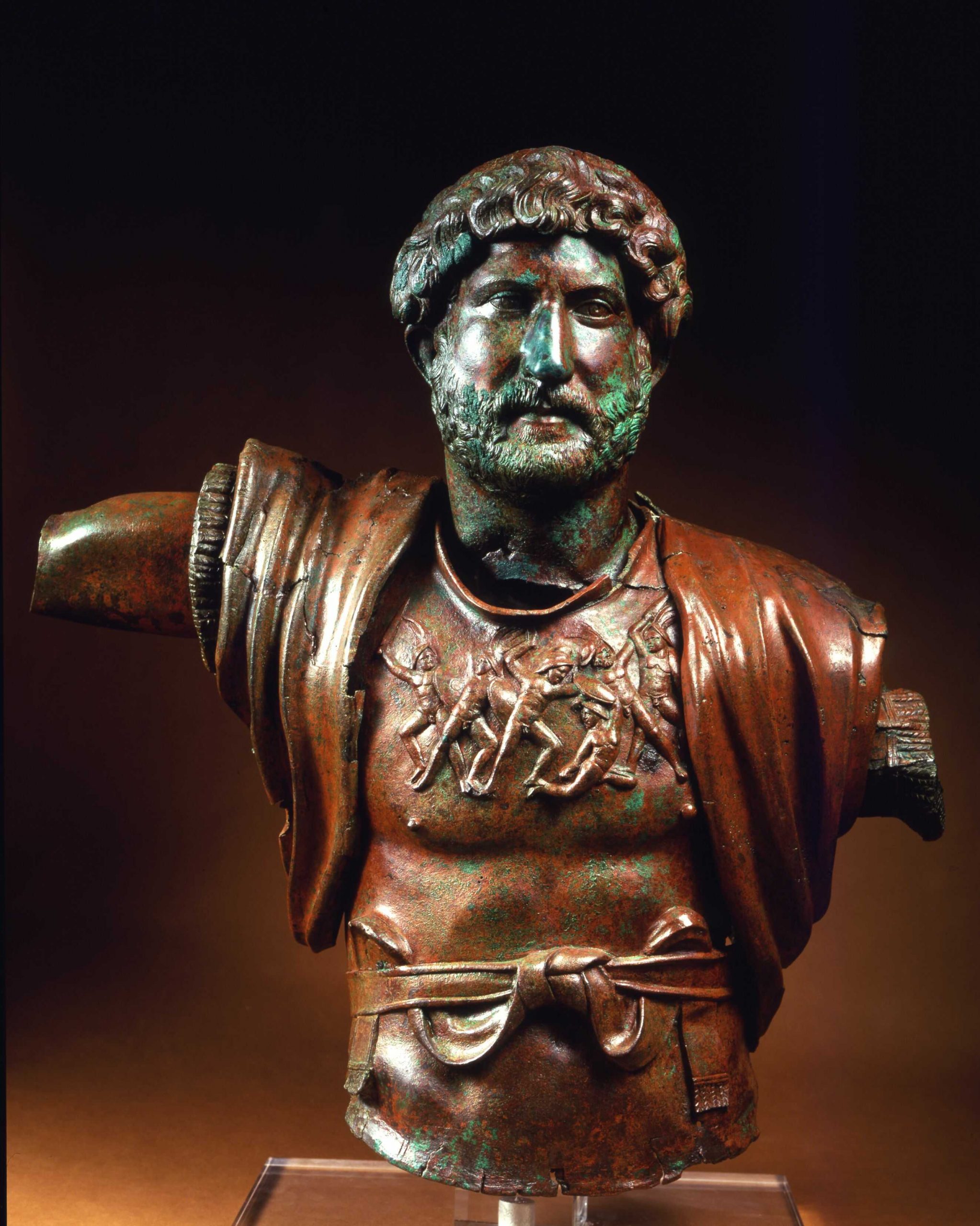
The coins from the Te’omim cave are part of the Israel Museum’s new permanent exhibit, featuring a copper statue of Hadrian and a triumphal arch from Tirat Zvi

The permanent exhibit of the Israel Musuem, set to reopen this coming July, will present a series of artifacts linked to the Bar Kokhba revolt. I was privileged to see the two most significant artifacts, still in the museum’s storage rooms, in the company of the museum’s Roman Era curator, Dudi Mevorach: a magnificent bronze statue of the Emperor Hadrian, and a Latin inscription which was apparently part of an impressive triumphal arch erected in the emperor’s honor after his victory over Bar Kokhba. These two items, which will be displayed together for the first time, were found not in Israel’s Judean region, the center of the revolt, but in the area of Kibbutz Tirat Zvi in the Valley of Springs area of the Beit She’an Valley.

The story of the discovery of the statue and the inscription dates back to 1975, when a tourist from America was staying with his sister at Kibbutz Tirat Zvi. During his stay, he surveyed the area around the kibbutz using a metal detector, hoping to find ancient coins. At some point he did find metal: parts of a bronze statue – Hadrian’s statue. Professor Gideon Forster was called to the scene, and after exploratory digs, more parts of the statue were discovered. These were transferred to the laboratories of the Israel Museum in Jerusalem, where they underwent treatment and were reattached.
This bronze statue of Hadrian is one of a kind – the head of the only known similar statue is in the British Museum, having been found in the Thames River. The excavations showed that the Tirat Zvi statue had stood in the encampment of the Roman Sixth Legion at Tel Shalem, and had served as a votive object in the cult of the emperor, a conventional practice of the Roman Army.
Inscription in the Carrot Shed
Seemingly, none of this has any connection to the Bar Kokhba revolt. Yet, two years later, the members of Kibbutz Tirat Zvi decided to build a shed for packing carrots on a nearby hill. While digging foundations, kibbutz members uncovered tombs from the late Roman period. Once again, Professor Forster was summoned, this time to carry out salvage digs on behalf of the Israel Department of Antiquities. It soon became clear that the stones used in the tombs’ construction bore Latin letters, the largest of which was 42 centimeters high (!) – a letter size observed nowhere else outside Rome.
Not yet a Segula subscriber?
Access our full archive online, have print issues delivered to your door, and moreFeel free to share