

Two socialist Yiddish papers vied for American readers at the turn of the 20th century. Arguing over both purpose and politics, Di varhayt and Forverts engaged in a battle of wits only one would survive

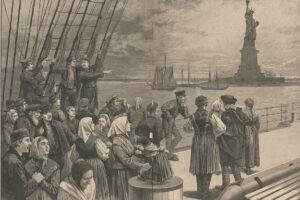
Jewish immigration to America is one of the great modern episodes in the history of the People of the Book. This influx, part of a larger shift from Old World to New, followed a demographic explosion: from 2.25 million Jews worldwide in 1800 to over ten million by 1900. In the early 20th century, 80 percent lived in central and eastern Europe, with over five million in tsarist Russia. Two-thirds of Jewish emigrants ended up in the United States – di Goldene Medina (the Land of Gold).
Most settled on the East Coast, especially New York, dubbed “the Promised City” by Californian historian Moses Rischin.
Population growth and emigration thus joined urbanization, industrialization, secularization, politicization of the lower classes, and racial antisemitism in shaking the very foundations of Jewish consciousness and identity, radically altering conceptions of both past and future.
Young Zionist author Mordecai Ze’ev Feierberg encapsulated the dilemmas facing Jews at this time in the title of his famous novella, “Where To?” It wasn’t just a matter of destination. Even those remaining in Russia were scrambling to survive within the million square kilometers of the Pale of Settlement. “Where to?” was a question that impacted every aspect of Jewish existence: livelihood, identity, community, belief, education, and family life.
The resulting heated debate demanded a platform from which to discuss the paths available to the Jewish people. Enter Jewish periodicals, primarily in countries boasting a free press. Jewish journalism gave visceral expression to political and existential issues, first in eastern Europe, then in the U.S. and the land of Israel.
Forward!
On April 22, 1897 (20 Nisan 5657), a small Yiddish socialist newspaper called Forverts (Forward) was launched. It was named for the much larger German Vorwarts, mouthpiece of the highly influential Social Democratic Party. Herzl founded the Zionist Organization that same year, and in Russia the socialist Bund began campaigning for an autonomous Jewish region within Russia. The paper’s answer to the question of “Where to?” was “Forward!” – toward socialism and its utopian ideals – rather than backward in the direction of tradition or, even farther back, the ancient Hebrew homeland. Indeed, Forverts was among Zionism’s most determined and energetic opponents.
Despite no direct association with the American Bund, the newspaper was part of America’s developing socialist movement. The Social Democratic Party set up shop in the U.S. in 1897, establishing the Socialist Party of America (SPA) in 1901. Forverts reflected this political platform to New York’s roughly one million Jewish adults, known as “the Jewish vote” even though most still awaited that democratic right.

At first Forverts’ founders, who included Abraham (Abe) Cahan and Louis Miller, could only hope their baby would survive. Many similar efforts lasted less than a year, and some never even managed a second edition. Deeming the entire venture too risky, Cahan soon went to work for a respected American newspaper instead. Having perfected his English in the fifteen years since his arrival in the U.S. in 1882, he gained recognition as a serious author. Cahan rejoined Forverts in 1903, however, just as it finally took off. His journalistic background enabled him to revamp the paper and raise standards boosting circulation and sales.
On March 15, 1903, for example, Forverts’ front page announced that its daily edition would expand to eight pages and that the entire paper would be written in simple Yiddish (presumably to appeal to second-generation speakers as well as new transplants from eastern Europe). Furthermore, the editors promised the lowdown on Irish and Italian men converting to Judaism to marry their Jewish sweethearts, struggling families somehow sending their children to college and evening classes, and Protzentenikers (contractors) exploiting new immigrant workers in the garment industry – plus various stories, jokes, and aphorisms, mostly about women.
Aside from daily news columns, Forverts covered everything likely to interest its immigrant readership, from baseball rules to warnings against excessive smoking. Clothing, shoes, and other consumables were advertised alongside pianos, indicating that not all readers were simple, struggling laborers, even if that population was the paper’s target audience.
Forverts also reviewed English-language books and plays. Articles dealt with international issues – especially events in the land of Israel – and of course American politics. And Jewish professional unions in New York received plenty of attention.
Increased immigration, which peaked in the years preceding World War I, further heightened sales. In 1917, Forverts’ circulation exceeded two hundred thousand, but those copies were probably passed around, so at least half a million Jews were reading it daily. Leading headlines were printed in big, bold letters on the front page, a marketing trick adopted by most American dailies. Editorials appeared only on page four. Forverts’ socialism was its religion, and readers were assumed to keep the faith.
Yiddish-Speaking Socialists
From an outsider’s perspective, American socialism sounds like a contradiction in terms. Nonetheless, socialist ideals were popular in the United States, especially when immigration soared, industrialization was at its height, and factory workers labored long hours in poor conditions with no social benefits. Tens of millions were trying to eke out a living in the land of their dreams, but their options were in fact extremely limited. Coupled with the revolutionary communism with which many immigrants had flirted in the old country, these dire straits made for radical politics sharply critical of the American capitalist system.
Forverts’ founders steered clear of Judaism and Jewish nationalism. Like many other immigrants who’d joined English-speaking socialist groups, they saw themselves as Yiddish-speaking socialists holding out for a universal solution to worker exploitation. Thus, an editorial titled “Who Is Forverts For?” called their product “a newspaper for mankind” (Forverts, March 31, 1902, p. 4).
Transferring readers’ loyalty to the political arena proved elusive. Most immigrants voted either Republican or Democrat, because these two large parties had an inbuilt advantage under the American electoral system. Socialists preferred the Democratic Party, since the Republican was identified with the capitalist employers they reviled. Ethnic minorities too found a home among the Democrats, a role the SPA aspired to take over. As immigration increased, Forverts hoped that socialism would yet redeem America.
The SPA reached its zenith in 1912, in the only United States national elections contested by four parties: Republican, Democrat, the socialists, and the Progressive Party, which sought equal opportunity for Americans of all creeds and colors. The SPA won an unprecedented nine hundred thousand votes, but even that was merely 6 percent of the electorate. A modest number of socialists did enter the House of Representatives, however, with a slightly higher proportion in local government all over the country.
Bringing socialist ideals into the public discourse was itself a notable achievement, especially as some were adopted by one or another of the two major parties. The socialist successes of 1912 also marked Forverts’ most extensive coverage of broader issues than just Jewish ones.
Not yet a Segula subscriber?
Access our full archive online, have print issues delivered to your door, and moreFeel free to share