

Lack of water was one of the young State of Israel’s greatest challenges. Though desalinization has made that issue history, the story of Lake Yeruham reflects the state’s changing attitude toward water over the years

Where To?

Water has been a bone of contention in the land of Israel ever since Abraham and Isaac’s shepherds clashed with locals over wells early in Genesis. This land might flow with milk and honey, but not H2O. Generations have struggled to find creative ways of storing the precious fluid amid the all too recurrent threat of drought, especially in the country’s parched south.
The State of Israel’s leaders have long recognized this challenge, which is why the Ministry of Agriculture’s Water Department is one of the state’s oldest institutions. However, already tasked with feeding 1.6 million people in a country that’s half desert, the ministry couldn’t handle water management as well. So in 1952, while still busily absorbing Holocaust survivors as well as Jews from Arab lands, David Ben-Gurion’s government formed Tahal, the Israel Water Management Company.
Apart from coming up with its unimaginative name, the new body registered some successes almost as major as the remarkable water tunnel dug by the biblical King Hezekiah to quench besieged Jerusalemites’ thirst. Within just two decades, Tahal drained Lake Hula and its surrounding swamps in the north (much of which have been reflooded for environmental reasons), created the National Water Carrier, and built a sewage purification plant to put Greater Tel Aviv’s wastewater to agricultural use.
One of Tahal’s more ambitious plans was to construct almost a hundred dams nationwide to conserve the water generated by storms and flooding. The resulting artificial lakes were to provide plentiful freshwater. American experts helped the company identify suitable sites, dotting a map of the country with a series of blue gems known mockingly to insiders as Mini-Finland.
The concept was as welcome as rain in August, particularly to the parched residents of the twelve pioneering Negev settlements founded to ensure southern Israel’s inclusion in the UN’s 1947 Partition Plan. They’d been struggling to survive for years, with brackish wells and cracked cisterns that were adequate for a camel or two but left whole development towns with little to drink.
A feasibility study began with ten dams, scattered from north to south to ascertain which geology and topography were best. The resulting reservoirs include Beit Netofa, near Afula; Kfar Baruch, in the Jezreel Valley; Beit Zayit, on the outskirts of Jerusalem; and Mishmar Ayalon, by the main Tel Aviv–Jerusalem highway.
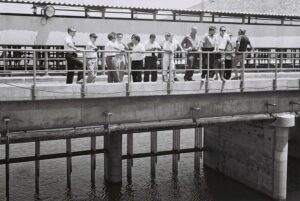
Desert Blooms
In the summer of 1952, work began on one of the southern dams, located not far from the Great Crater, one of the Negev’s three erosion cirques, or “box canyons.” The project was dubbed Yeruham Dam, after nearby Tel Yeruham, a tiny transit camp built in 1951 for Romanian immigrants.
A concrete wall soon stretched across the dry Revivim streambed, close to its intersection with another wadi, also named Yeruham. The idea was to pool the water flowing through these and other local brooks after winter flash floods. Judging by the dam’s soaring height, the resultant lake was expected to drain an area of 110 square kilometers, potentially holding a staggering million cubic meters of water if filled to capacity.
None of this liquid plenty was earmarked for the Romanians, whose needs were seemingly met by their own well plus a pipeline from Beersheba. Rather, the water was to irrigate nearby Kibbutz Revivim, possibly extending as far as Kibbutz Sde Boker, to which Ben-Gurion had moved after resigning as prime minister. There were even plans for ornamental fountains, a water park, and new settlements based on all this newly blooming desert.
By the autumn of 1953, the dam was ready and waiting for the winter rains. Immigrants and kibbutz residents alike held their breath as floodwater finally rushed down from the Judean Desert hills and slammed into the dam. Despite fears of collapse, the mighty wall held. By winter’s end, a pristine lake contained half a million cubic meters of water .
Yet the lake disappeared overnight. The natural limestone lakebed proved unexpectedly porous, so the precious liquid seeped away. Though the dam was watertight, the seam where it met the ground wasn’t adequately sealed, and water escaped from there as well.
The disappointment at Tahal ran too deep to be ignored. British experts overhauled the site, plastering every crack. They worked all summer in the Negev’s searing heat, covering the empty lake bed with earth and pebbles and cementing the base of the dam.
This time it was the immigrants, kibbutz members, and Englishmen who stood with bated breath until the winter floodwaters surged down from the hills. Everyone’s silent prayers were answered: the amount of water gathered was double that of the year before. Now a million cubic meters lapped against the dam. But would they stay?
After all the hora dances and hurrahs, the British engineers tracked the water level anxiously over the next two months, hoping against hope that seepage would be minimal and they’d be free to spend the next summer somewhere cooler.
The leaks were indeed largely symbolic, and in the winter of 1955, champagne flowed in Tahal’s Beersheba office in honor of a job well done. Yosef Weitz of the Jewish National Fund’s Land and Afforestation Department came to see the wonder with his own eyes. He later waxed eloquent in his diary:
A beam of light reflects up from Lake Yeruham, shimmering in the desolation. Maybe we’ll one day be one with the earth through our labors? (Yosef Weitz, My Diaries and Letters to My Children, vol. 4 [Masada Publishing, 1953], p. 288 [Hebrew])
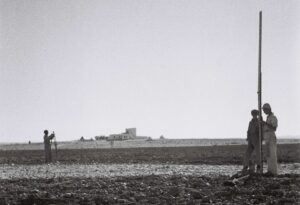
Gone Fishing
Lake Yeruham’s success inspired two initiatives: a pipeline from the lake to two kibbutzim – Revivim and Mashabei Sadeh – and fish farming. Other reservoirs were already being exploited for fishing, so officials fantasized about gefilte fish in every pot. Five thousand imported young carp were soon swimming in Lake Yeruham, prompting Ben-Gurion’s historic pronouncement at a conference in Beersheba that “Never, since the six days of creation, has anyone fished in the Negev” (“Ben-Gurion’s Trip to the Southern Transit Camps,” Davar, July 10, 1955, p. 2)
The pipeline to the kibbutzim was duly laid, and everything seemed to be running smoothly. Cucumbers ripened, parsley sparkled with dew, and a “water festival” complete with giant soap bubbles was celebrated in the area in time for Shavuot in 1955.
But by the end of the summer, the party seemed to be over. The lake almost ran dry amid the copious agricultural demands on its limited supply, and astonished fish were left gasping on its muddy bottom. Only the hardiest made it to the next winter, when the lake refilled. Kibbutz Revivim had learned its lesson, however. The lake was now dismissed as a possible backup, while the Beersheba pipeline once again became the mainstay.
After a few unreliable winters in which floodwaters didn’t always materialize – and thirsty carp expired or had to be harvested prematurely, at a less-than-fleshy stage – Tahal pulled out of the fish industry. Mashabei Sadeh remained the reservoir’s sole customer.
Meanwhile, the Tel Yeruham transit camp had grown into Kfar Yeruham, complete with its own town council and a population numbering in the thousands. For them, the lake offered entertainment in the shape of boating and weekend fishing for the last of the carp. The local fauna also enjoyed the oasis. The municipality planted trees around the site and paved an access road. The only thing missing was a waterfront café.
Not yet a Segula subscriber?
Access our full archive online, have print issues delivered to your door, and moreFeel free to share