The reborn Museum of the Diaspora has a new name, a new narrative, and a new purpose

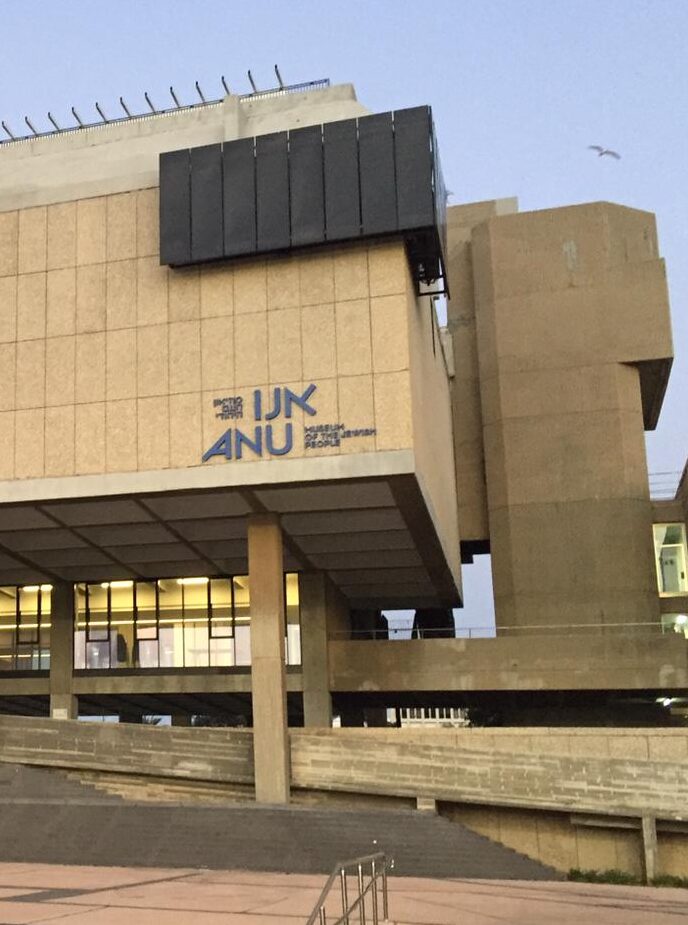
ANU
Museum of the Jewish People
Tel Aviv University Campus
Museums have long ceased to be mere galleries exhibiting artifacts of varying antiquity. It’s hard to know what kind of experience awaits as one steps through the doors of these cultural centers nowadays. A feast for the eyes, the ears, the mind, possibly even the nose? Models, multimedia, reconstruction, theater, debate – inside a 21st-century museum, the possibilities seem endless. As a result, much speculation and expectation has surrounded the reopening of what used to be the Museum of the Diaspora (better known as the Diaspora Museum) on the grounds of Tel Aviv University, after a massive, ten-year renovation.
From Diaspora to ANU
For those of us who visited and revisited the previous museum, the inside is almost unrecognizable. Gone are the three carefully structured exhibitions masterminded mostly by Warsaw ghetto fighter Abba Kovner and the World Zionist Congress. Cutting-edge when the museum opened forty years ago, they were obviously in need of replacement. Not only the media have been updated, however – also the message.
The previous exhibition had a beginning, middle, and end. It moved through Jewish history, from the cessation of Jewish sovereignty with the destruction of the Temple to the development of rabbinic Judaism and Jewish community in the Diaspora and finally to emancipation and the ingathering of the exiles, presented as a choice between assimilation in the Diaspora and reclamation of the Holy Land. It was a powerful narrative, expressing the deep-seated if somewhat presumptuous belief that the Holocaust (itself beyond the scope of the exhibit) had effectively concluded the story of the Diaspora – which could now be consigned to a museum – and that the future lay with the modern Jewish state.
History has proven otherwise. In the seventy years since the Shoa, Jewish life has returned to most of the lands where it once thrived, and the great concentration of Jews beyond the Atlantic has shown that the American Jewish community is here to stay, rivaling Israel as the center of Jewish culture. And while secular Israelis forty years ago might have been content to leave the historiography of rabbinic Judaism and the return from the Diaspora to the religious Zionists, today there are many competing Jewish narratives.
Something for Everyone
The new museum therefore proudly calls itself ANU, as in the Hebrew anu – “we.” It’s a bold attempt to be inclusive, to create a space in which every Jew can find something to identify with. The result is probably less powerful and tells a far less coherent story. The audio guide frequently advises visitors to “find their own path” through the exhibit, as it has no clear trajectory. Perhaps such is the postmodern trend in exhibitions, but here it certainly makes a statement. Far from depicting the Diaspora as on its way out, ANU portrays the Jewish people as an ongoing event – rich, diverse, and therefore almost impossible to define.
It’s remarkable to see an Israeli institution so embrace Jewish multiculturalism. Is this Tel Aviv’s conception of the Jewish people, as at home in Berlin as in Ashdod and much more so in New York? It certainly seems less alien to Tel Aviv University’s “Museum Row” than the Diaspora Museum did. Rubbing shoulders with a stunning new natural history museum, complete with a floor devoted to evolution, ANU seems by no means out of place.
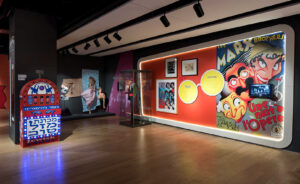
The museum begins counterintuitively, in the present rather than the past, showcasing a wealth of contemporary Jewish families and individuals – some more representative, others famous for their contributions to music, art, literature, or theater.
What’s Jewish about many of the artists featured here? Often little more than the descent of those who’ve donated a beloved instrument or piece of family memorabilia to the exhibition. (Highlights are the typewriter used by Isaac Bashevis Singer while visiting his son’s family on Kibbutz Beth Alpha, Judge Ruth Bader Ginsberg’s lace collar, and one of Leonard Cohen’s guitars.) This floor also features statistics on Jewish populations around the world – based, oddly enough, on the halakhic definition of who is a Jew, i.e., birth to a Jewish mother. I found this essentially racial definition of Jewish culture extremely disturbing. But it’s definitely vibrant, alive, and fascinating, making the question of what constitutes Jewish art even more intriguing.
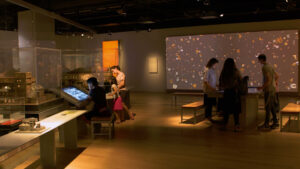
My guess is that the museum’s second floor will prove its most popular, though it’s much darker (for dramatic effect) and less inviting. This floor houses the synagogue models created for the Diaspora Museum over forty years ago. Some of the originals still stand today – in Alexandria, for example, and in Toledo, Spain (though the latter was repurposed centuries ago, after the 15th-century expulsion of Spanish Jewry). Others were destroyed in the Shoa: the great synagogues of Berlin and Warsaw as well as two wooden Eastern European shtiblekh, reconstructed on the basis of photographs. Long a favorite of grandparents showing their offspring some vestige of a community they remember, the exhibit boasts a new audio guide (downloadable to your phone) of recorded testimonies, personalizing each item.
Not yet a Segula subscriber?
Access our full archive online, have print issues delivered to your door, and moreFeel free to share