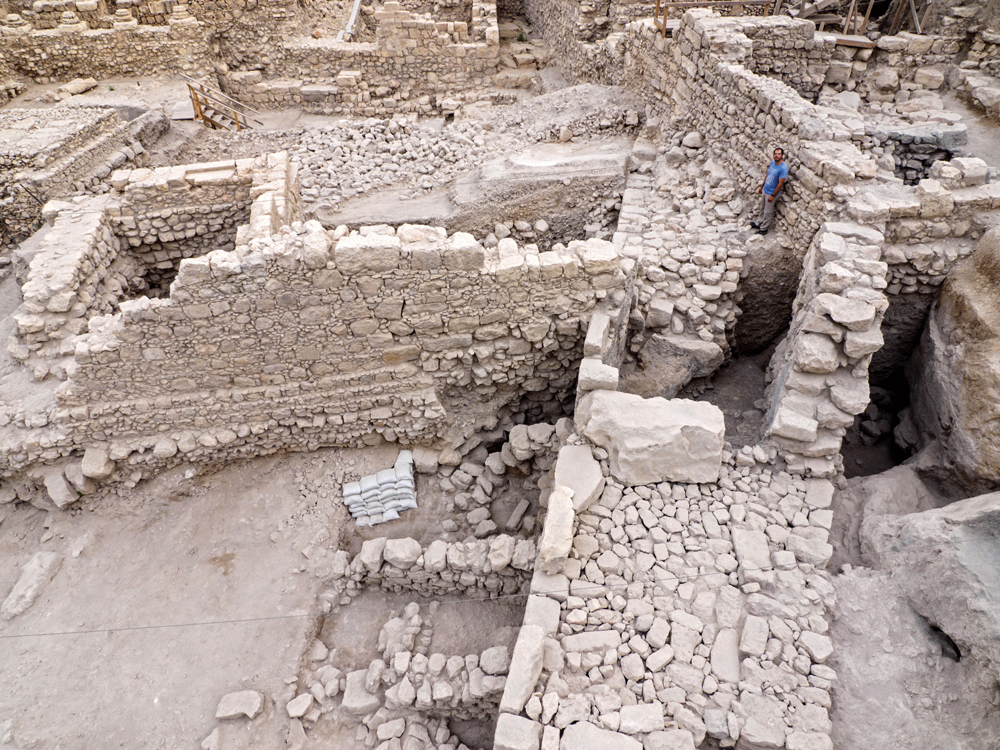
The giant Akra fortress and its garrison of Hellenist soldiers sowed fear among Jerusalem’s Jewish residents well after Hasmonean victories had brought autonomy to Judea. Maybe that’s why this stronghold was razed when the Maccabees finally conquered it. Does that mean the Akra couldn’t be the tower just discovered in the City of David?

People generally assume the history of Hasmonean Jerusalem began with the Seleucid conquest of Judea from the Egyptian Ptolemies, escalated with Antiochus Epiphanes’ anti-Jewish edicts and the idol he placed in the Temple, and culminated with a small cruse of olive oil and Judah Maccabee’s great victory, which drove the wicked Hellenists from the land. In fact things were a bit more complex, and something much larger and more sinister than an idol loomed threateningly over the city for decades. It was called the Akra.
Antiochus’ Castle
The Greek term akra, meaning castle or fortress, is also the source of the word “acropolis,” a fortified citadel dominating an area. When the Seleucids conquered a major city, they’d first destroy much of it, then erect a tower and station a well-equipped garrison there to maintain control. That’s exactly what Antiochus IV Epiphanes did after he captured Jerusalem in 169 BCE, as described in Maccabees I:
Then he fell suddenly upon the city and dealt it a great blow, destroying many people of Israel. He despoiled the city, burnt it with fire, and razed its houses and its surrounding walls. … They fortified the city of David with a high and strong wall with mighty towers, and it became their citadel. (First Book of Maccabees, trans. Sidney Tedesche [New York: Harper and Brothers, 1950], chap. 1, vv. 31–4)
First-century Jewish historian Josephus Flavius calls this fortress the Akra:
And he burnt the finest parts of the city and, pulling down the walls, built the Akra in the Lower City; for it was high enough to overlook the Temple, and it was for this reason that he fortified it with high walls and towers, and stationed a Macedonian garrison therein. (Josephus, Antiquities of the Jews, book 12, Loeb Classical Library vol. 5, trans. Ralph Marcus [Harvard University Press, 1943], p. 129)
These two books are the main sources we have for the history of the Hasmonean period – and of the Akra. They indicate that the garrison posted at the Akra was composed mostly of mercenaries, but it also included Hellenized Jews who saw themselves as part of the occupying power and were extremely hostile toward the city’s Jewish population. Maccabees I calls this group “sinful people,” while Josephus describes them as “impious and of bad character, and at their hands the citizens were destined to suffer many terrible things” (ibid.).
The Akra’s occupants made life in Jerusalem miserable. They hoarded weapons, stole household food, and murdered the city’s inhabitants. Thousands fled, until by 167 BCE the entire city had been abandoned – apart from the Akra. These conditions sparked the fire of revolt in Mattathias the Hasmonean’s native Modi’in and set the stage for the miraculous Hanukkah story. But even after Judah Maccabee’s great victory at Beth Horon in 166 BCE, nothing improved in Jerusalem:
Jerusalem was uninhabited like a wilderness; none of her offspring went in or out. The sanctuary was trodden down, and sons of foreigners were in the citadel. It became a solitary lodge for the heathen. Joy was removed from Jacob, and flute and harp ceased. (First Maccabees, chap. 3, v. 45)
After capturing and purifying the Temple in 164 BCE, the Hasmoneans made valiant efforts to subdue the Akra and banish its inhabitants, but that proved virtually impossible. Raised on a giant podium like an enormous, brooding monster, “high enough to overlook the Temple” (Josephus, Antiquities op cit.), the Akra was impenetrable. Judah and his men attacked its fortified defenses time after time, but despite the Maccabees’ unbroken string of victories, they couldn’t overcome the Seleucid soldiers mocking them from the Akra’s mighty ramparts, with their unscaleably slippery slopes.

A Poke in the Eye
Even after Antiochus IV Epiphanes’ young son Antiochus V succeeded him, nothing changed. Jerusalem was once again a bustling city with much of its activity centered on the Temple, but the Akra remained an eyesore, and its Hellenist occupants periodically lashed out at pilgrims and ordinary citizens alike. Fed up, the Hasmonean leaders laid siege, forcing their opponents to turn to Antiochus V for help.
Some of them escaped from the blockade…. They went to the king and complained, “How long will you neglect to do justice and avenge our brothers? … our people have become estranged from us and have laid siege to the citadel … as many of us as they find they put to death and seize our possessions…. Why, this very day they have besieged the citadel in Jerusalem to take it over…. Unless you stop them at once, they will do more than this, and you will not be able to check them.” (First Maccabees, chap. 6, vv. 21–7)

Antiochus duly sent his army to defeat the Hasmoneans. Arriving in Jerusalem, the Seleucids overran the Temple and surrounded Judah Maccabee’s troops, who’d barricaded themselves on Mount Zion. In the end the Seleucids withdrew to deal with unrest at home, leaving Judah in control of the city on condition that he lift the siege on the Akra. Jerusalem returned to normal – with the Akra and its troublesome garrison still sticking out like a sore thumb.
The Hasmoneans fought off most of the constant Seleucid attacks on the borders of the tiny Jewish commonwealth of Judea, which only increased their frustration with the fifth column in the very heart of their territory – the Hellenists in the Akra. The fortress conveniently sheltered warriors the Maccabees put to flight; Seleucid general Nicanor took refuge there, taunting the Jews with curses and threatening to burn down the Temple. (His subsequent attack failed.)
In 161 BCE Nicanor was soundly defeated by the town of Adasa, north of Jerusalem. Judah brought the general’s head and hand back to the city in a victory procession, calling on his enemies in the Akra to watch the spectacle:
… he sent for them that were of the tower, and shewed them vile Nicanor’s head, and the hand of that blasphemer, which with proud brags he had stretched out against the holy temple of the Almighty. … He hanged also Nicanor’s head upon the tower, an evident and manifest sign unto all of the help of the Lord. (Second Maccabees, The Temple Bible, ed. W. Fairweather [Philadelphia, 1967], chap. 15, vv. 31–5)

Not yet a Segula subscriber?
Access our full archive online, have print issues delivered to your door, and moreFeel free to share