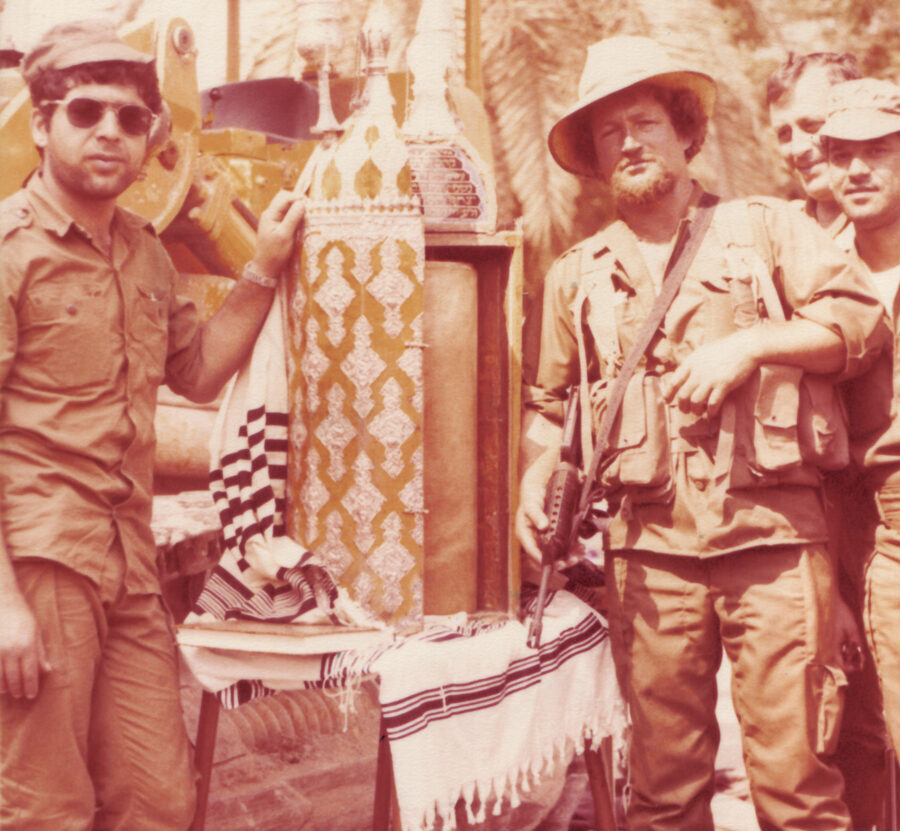
Israeli paratroopers came home from the Lebanon War having lost a friend and gained an ancient Torah scroll. The tale of Danny Brenner and the hidden sefer Torah of Sidon

Israel’s Operation Peace for Galilee (June 1982–May 1985), a military campaign that developed into full-scale war with far-reaching consequences throughout the Middle East, changed the lives of many Israelis forever. One small piece of that conflict was the story of a Torah scroll IDF forces found in the Lebanese city of Sidon, and its connection with Danny Brenner, one of the paratroopers who conquered the city. This story is for him.
Passing through the old city near the bridge leading to the Crusader monastery, we noticed an intelligent-looking, bespectacled man. Stopping our armored car, we listened to him in astonishment: “My name is Yitzhak Halevy; my whole family lives in the Casba.” What could we do? … operations were halted, and we escorted him to a house where we found his aunt, her two daughters, the grandmother, and a small child – all of them Jewish. Many years ago, they told us, one of the houses served as the synagogue of Sidon. We showed them our map, and they gave us a rough location. They were certain that the synagogue contained a Holy Ark and ancient Torah scrolls concealed behind a wooden panel nailed to the wall. … Suddenly I had a powerful urge to find that Torah and return it to Israel, to the synagogue where Danny Brenner – the religious soldier killed in the battle [for Sidon] – had prayed. (From the diary of Captain [Res.] Rafi Gil, assistant commander, 7056th Battalion of the Northern Command paratroopers’ reserve unit, day five of the Lebanon War)

Operation Peace for Galilee was intended to root out the Palestinian terrorist organizations, mainly Fatah and the PLO, which had taken over Lebanon in the late 1970s in the wake of Lebanese civil war. On June 4, 1982, an Israeli air force bombardment destroyed nine PLO installations in Lebanon, whereupon the terrorists fired five hundred Katyusha rockets on civilian targets in the Galilee. Two days later, IDF forces advanced into Lebanon, and war began. The army moved north along four main axes – the coast, the central mountain area, the east bank of the Zaharani River, and the Bekaa Valley. A paratrooper battalion accompanied by armored units disembarked north of the Awali River, cutting off Fatah headquarters in Beirut from terrorist bases in southern Lebanon.
Fire from Hell
The 7056th Battalion was called up that Sabbath, and by Sunday night its paratroopers had crossed the border. The regiment entered Tyre the next day, conquering the ancient Lebanese city with relative ease. Thousands of residents were evacuated to the coast, to be received by the International Red Cross. Monday at dawn, the battalion moved up the coast toward Sidon. In his diary, Gil describes the difficulties of keeping an entire regiment moving with thousands of IDF vehicles jamming the main traffic arteries. Reaching the outskirts of Sidon, they encountered powerful terrorist resistance for the first time: a hail of bullets and antitank missiles resulted in the war’s first casualties. Burning soldiers leapt from one of the tanks escorting the paratroopers and were shepherded into a nearby building for first aid.
Heavy fire from the high-rises surrounding Sidon’s main square held up IDF forces at the entrance to the city. The paratroopers couldn’t gain control of Sidon’s main arteries without first capturing the square, so the 7056th Battalion’s Company C was sent to detour through the orchards around the city and capture the houses adjoining the square. “We were attacked by friendly fire on our way through the orchards,” one combatant recalled. “Not everyone knew about the operation, and they thought we were terrorists. Luckily no one was hurt.”
Regrouping on the edge of the square, platoon commander Noam Wozner sprinted across, leading his fighters toward the tall buildings on the other side. They came under intense fire the second they were exposed, but Wozner kept moving, trying to work out where the bullets were coming from. “They were firing on us from all directions,” Bakish, the sergeant, remembered. “Noam was already more than halfway across the square with part of the company when Danny Brenner was killed. We picked him up and ran with his body to the other side of the square.”
The company was now split into two units – two platoons with Wozner on one side of the square, and one platoon with Gil on the other.
Fighting continued all night. Fierce house-to-house combat cleared the terrorists out of certain buildings, but the company was still cut off from the rest of the battalion, and sniper fire from the tall buildings stopped anyone stepping into the square. Wozner wouldn’t let troops risk trying to reach them to evacuate Brenner’s body and another soldier who’d been injured in the leg. All night terrorists kept trying to sneak up and attack, but each time they were rebuffed.
At daybreak the platoons went back to securing the square house by house, now aided by tanks, artillery fire, and aircraft, which effectively wiped out the high-rises around it. Brenner’s corpse was placed on a tank that retreated to the rear. Then suddenly:
The jets up above rained down millions of flyers, and megaphones announced that all citizens should leave the shelters, as there was no longer anything to fear from the Palestinian terrorists. Then, though none of us understood how and why the fighting had ended, deathly silence fell on all our forces. In minutes the whole square was flooded with tens of thousands of men, women, and children, all waving white flags. The injured, the dead, surrendering terrorists…. White sheets were hung out from the hospital just fifty meters away…. I gave orders to cease fire, turn on the emergency generator, and not remove nurses, doctors, or patients’ relatives from the hospital.
Finally, after so many hours of uninterrupted combat, tears began streaming from my eyes, in front of the soldiers, in front of the captured Lebanese; suddenly we were all weeping. Even fighters, it seems, can cry…. Suddenly I felt that though I was just a small cog, I was at the center of events, with the larger picture all too clear. And we had the ghastly feeling that we’d been fighting in a city packed with innocent people cowering in their shelters while everything around them was being demolished…. and I was glad that I’d cried.
Not yet a Segula subscriber?
Access our full archive online, have print issues delivered to your door, and moreFeel free to share