
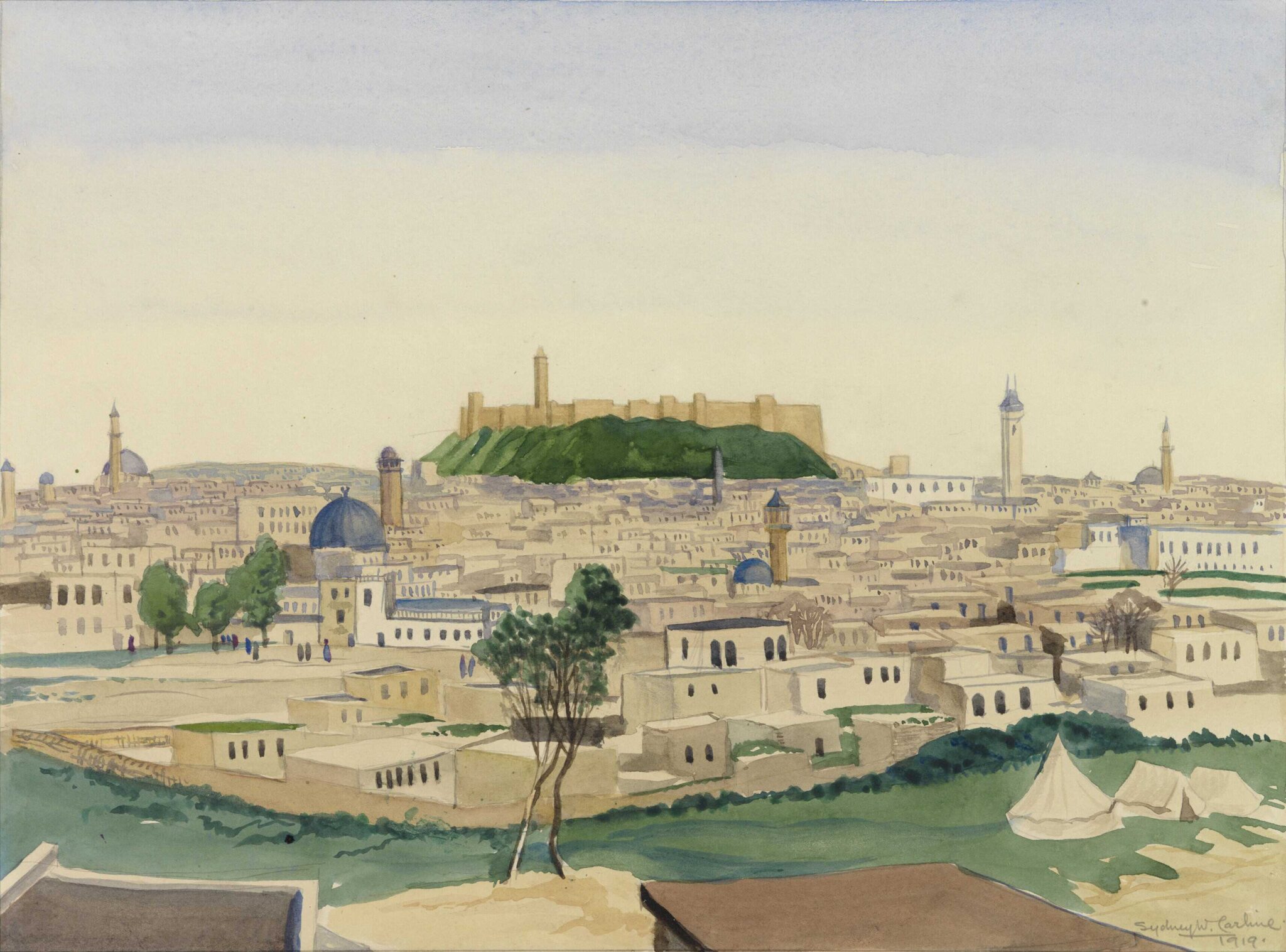
Aleppo’s Jewish community was famous for two things: its trading acumen and its biblical codex. Among its sharpest financial minds and its scholars’ most generous supporters were the Francos, Italian merchants who brought the winds of change to the ancient town

The story of Aleppo’s Jews has been nurtured over many generations among the narrow alleys and ancient khans of the city whose trading linked east and west. Aleppo is one of the world’s oldest towns, located along northern Syria’s caravan route from the Mediterranean coast to eastern Mesopotamia. Its Jewish history is intimately intertwined with the city’s own development, beginning with the Roman period. In Hebrew sources, it’s known as the biblical Aram Zoba and as Haleb, the phonetic equivalent of Aleppo. Passing through, 12th-century traveler Petahia of Regensberg pass noted Haleb’s legendary etymology:
Why is it called Haleb? Because on the mountain was the flock of Abraham our father. Steps led down from the mountain, whence he was accustomed to reach milk [halab in Hebrew] to the poor. (Abraham A. Benisch, trans., Travels of Rabbi Petachia of Ratisbon [Jewish Chronicle Office, 1856], p. 53)
The Muslim conquest of Aleppo in 637 reduced its Jews to dhimmis, protected persons dependent on a ruler’s whim. This status granted them a measure of safety in exchange for payment of a poll tax (jizya), and religious and social restrictions. By the 10th century, Jewish Aleppo was flourishing, blessed with scholars, scribes, and merchants.
These benefits continued with some interruptions under the Mamluks from the 13th century to the beginning of the 16th. The Jews suffered upheavals such as the 13th-century Crusades and Mongol invasions, but stability was more or less restored in 1261, when the hordes were driven back beyond the River Tigris.
In 1400, Mongol ruler Timur the Lame (or Tamerlane) conquered Aleppo, butchering its population and selling many Jews into slavery. When the Mamluks returned, the town prospered, and the main synagogue was rebuilt. After the Jews of Spain were expelled in 1492, Spanish and Sicilian exiles created a subculture integrted within the existing Jewish population.
The Ottoman conquest of Syria in 1516 launched Jewish Aleppo’s golden age. With their distinctive customs, local Jews took pride in their rabbis and synagogues along with their educational and charitable institutions. They ran an international trade network, maintaining close ties with European powers and dominating a wide variety of imports and exports. Their success attracted Jews from elsewhere in the Ottoman Empire as well as Europe, so much so that divisions of language, origin, and status began troubling the previously close-knit community.

Aleppo’s Jews called their city Aram Zoba after the biblical kingdom that had existed in the region. Map of the Holy Land and Syria, Moshe Shlomo ben Yosef, Safed, 1903 | Eran Laor Cartographic Collection, National Library of Israel

The citadel in the heart of Aleppo was built by the Mamluks in the 13th century. Map of Aleppo from Matrakçı Nasuh’s chronicle of Suleiman I’s military campaigns in Iraq and Persia, 16th century
Not yet a Segula subscriber?
Access our full archive online, have print issues delivered to your door, and moreFeel free to share