Where is the critical mass of the Jewish people, and why does it matter? How do different perceptions of Jewishness affect the count? Disputing Jewish population estimates for Israel and the United States

Which country has more Jews – Israel or the United States? Will Israel be home to the numerical majority of world Jewry any time soon?
These are freighted questions, carrying the weight of centuries of ideological dispute and generations of hand-wringing and finger-wagging. For some, the idea of Israel surpassing the United States as the world’s largest Jewish population center is the ultimate vindication of the Zionist project. For others, the debate over the size of the U.S. Jewish population has become the battleground that will prove the feasibility of Jewish life in the Diaspora and, moreover, show that American Judaism’s mores and values are worthy of respect.
Of course, size is only one measure of any Jewish community’s centrality to the Jewish future. Ahad Ha-am famously championed Zion as a Jewish cultural center that would rejuvenate and preserve the Diaspora rather than house the majority of Jews. And today, Israel is indisputably a center of Jewish culture and religious innovation – for example, according to the National Library, more than seven thousand original Hebrew books were published in the country in 2018.
Yet population numbers matter. There are practical Jewish legal implications of a majority of Jews residing in the land of Israel. Furthermore, how Jews are counted illuminates the unities and fractures in the Jewish people’s self-understanding. Perhaps most of all, population matters because it points to the future of world Jewry.
Counting or Labeling?
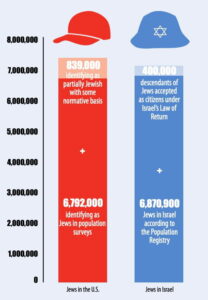
An accurate count of the number of Jews living in Israel is readily available from the Israeli government. Israel’s Population Registry records the nationality of all Israeli residents, with options including Jewish, Arab, and many other small ethno-religious minorities. To be registered as a Jew, one must be born to a Jewish mother or convert to Judaism – a definition that tracks closely with halakha, Jewish law. In February 2021, the Jewish population of Israel was 6,870,900, including the Jewish residents of Judea and Samaria.
The U.S. government doesn’t catalog its citizens’ religious preferences, nor does it ask about religion in its decennial census. Therefore, social scientists must rely on other methods of tallying the American Jewish population, including determining who’s considered part of this group for research purposes.
In general, social scientists classify someone as Jewish if he identifies as such and has some normative claim to bolster that identification. In practice, this means one must either declare Judaism his religion or claim no religion but consider himself Jewish (or partially Jewish) “aside from religion.” He must also have at least one Jewish parent or have formally converted to Judaism. Those who identify as members of another religion are excluded, even if they also identify as Jewish.
Two rigorous, scientific methods are used to estimate the number of Americans who meet these criteria. One method is typified by the Pew Research Center’s 2013 Survey of U.S. Jews, and the other has been spearheaded by Brandeis University’s American Jewish Population Project (AJPP).
Researchers using the first method determine the number of Jews in a very large, representative sample of Americans, then extrapolate regarding the number nationwide. In 2013, the Pew Research Center interviewed more than 70,000 random Americans about their religion and Jewish connections. That study concluded that there were 6.7 million Jews in the United States: roughly 5.3 million adults and 1.3 million children.
The second method combines data from dozens of nationally representative surveys, such as ABC News/Washington Post polls asking, “What, if anything, is your religion?” Complex statistical models are then employed to estimate the number of American adults whose religion is Judaism. Other sources, such as Jewish community surveys, are used to estimate the additional number of Jewish adults claiming to be atheist, agnostic, or “no religion,” as well as the number of Jewish children.
The AJPP estimated the American Jewish population in 2012 at 6.8 million: 5.2 million adults and 1.6 million children (Elizabeth Tighe et al., “American Jewish Population Estimates: 2012” [Waltham, Mass.: Steinhardt Social Research Institute, Brandeis University, 2013]). This number is virtually identical to the Pew Research Center’s 2013 estimate, increasing confidence in both figures.
The Pew Research Center’s updated estimate for 2020 was not released in time to be included int his article, but the AJPP regularly updates its projections. As of 2020, according to the AJPP, American Jewry had grown to 7.6 million: 6 million adults and 1.6 million children (Steinhardt Social Research Institute, “American Jewish Population Estimates 2020: Summary and Highlights” [Brandeis University, 2021]).
Comparative Numbers
The Jewish population in Israel compared with the number identifying as Jews in the U.S.
Currently, even taking into account those eligible for Israeli citizenship under the Law of Return who are not Jews by Orthodox standards, Israel’s Jewish population is slightly less than the number identifying as Jewish or partially Jewish in America
Not yet a Segula subscriber?
Access our full archive online, have print issues delivered to your door, and moreFeel free to share