Was Marc Chagall a painter first, or a Jew? Despite personal protestations to the contrary, and the unique fusion of Cubism, folk art, and Fauvism he created, Chagall’s life and work speak louder than his words

Standing on the rooftop, suspended between heaven and earth, was Marc Chagall’s childhood perspective on his native Vitebsk:
As a boy, I would watch you from our doorstep, childlike. To a child’s eyes you were so clear. When the fence blocked my view, I would climb up on a little wooden post. If I still could not see you, I would climb up onto the roof. Why not? Grandfather used to climb up there too. And I would gaze at you as long as I liked. There, on Pokrovskaja Street, I was born for the second time. (Marc Chagall, My Life, p. 11)
For the Russian-born, Paris-based Surrealist, it was also a perfect metaphor for the lifestyle he chose. Chagall has been described as the greatest Jewish painter of all time. His artwork shifts constantly from reality to fantasy, from physical to spiritual, just as his life brought him face to face with different worlds and conflicting sources of inspiration. He depicts Vitebsk as both “sad and gay,” and his early encounter with its sights and landscapes was both real and illusive.
Chagall may have thought of himself as born anew on the roof of his home on Pokrovskaja Street, but the circumstances of his actual birth were perfectly ordinary. He was born Moshe Segal in Vitebsk, White Russia, in 1887. More than half of the city’s sixty thousand residents were Jewish. Chagall was the eldest of nine children born to Khatskl (Yehezkel), who worked for a herring merchant, and Feige-Ite, who ran a small grocery store. His Orthodox family struggled to make ends meet and found comfort, as did many Jews in Vitebsk, within the Hasidic Lubavitch movement. Like the famed Hasidic master Menahem Mendel of Vitebsk (1730–1788), who led one of the earliest emigrations of Jews to Ottoman Palestine, Chagall’s parents were Zionists, purchasing the Zionist Shekel – despite their poverty – to become official members of the Zionist Organization.
Young Moshe was drawn to folk culture, absorbing the vibrant sights and sounds of his town and its diverse population. Merchants, cantors, neighbors, and relatives all found their way onto his canvas. One of the most influential people in his life was his Uncle Noah, whose fiddle constantly played the rebbe’s klezmer melodies. Chagall’s painting of his beloved uncle as a fiddler on the roof inspired the title of the well-known musical.
But Moshe Segal absorbed much more than the flavor of the Jewish shtetl. Churches and monasteries with onion-shaped roofs towered over his home. Crucifixes met the eye at every turn, and pigs wandered the streets as freely as the dark-robed priests crossing themselves as they walked. Chagall always claimed he’d never shaken the Russian soil of his childhood from his boots; it clung to him all his life.

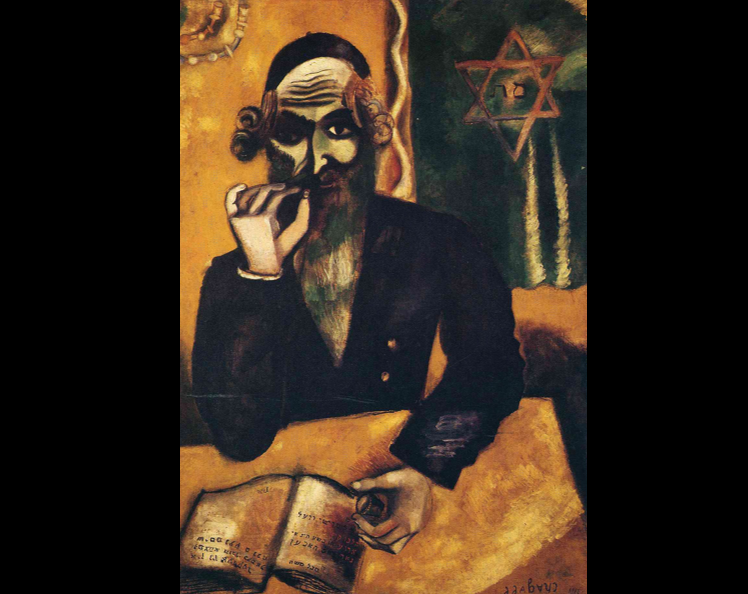
Chagall’s Hasidic roots are clearly visible in his paintings – especially those of the Jewish shtetl and his family. Gender stereotypes define this early depiction of his parents, in which his mother spoon-feeds his father, who is absorbed in a book

Sholem Aleichem wrote Tevye the Milkman in Yiddish in 1894. Chagall’s Fiddler on the Roof (oil on canvas, Paris, 1913) was totally unconnected, but it inspired Joseph Stein, the Jewish American playwright who adapted the book for the stage in 1964
Not yet a Segula subscriber?
Access our full archive online, have print issues delivered to your door, and moreFeel free to share