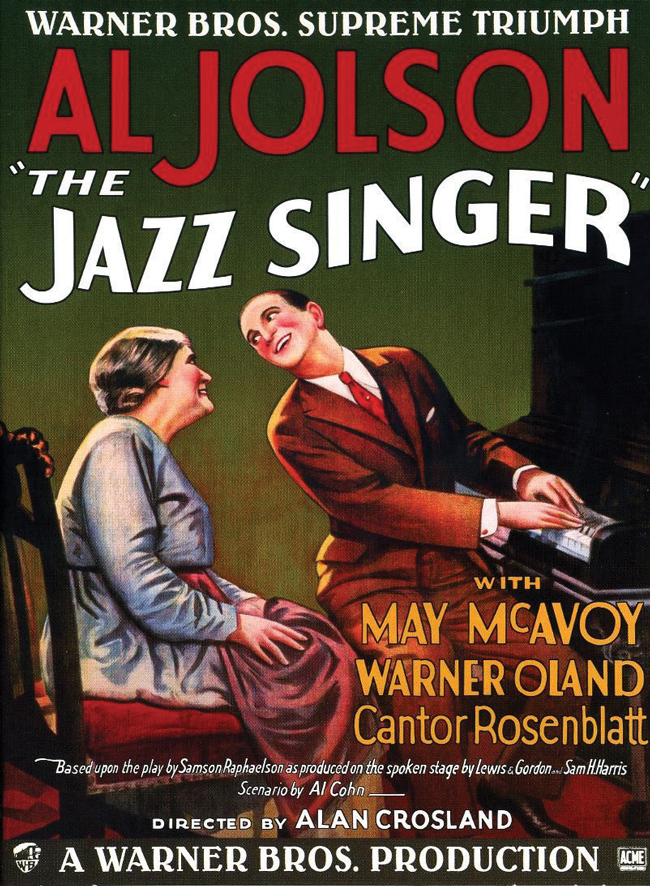
From the creative team behind it right down to its story line, the first talking film couldn’t have been more Jewish. The protagonist of The Jazz Singer was the latest in a long line of Jewish cantors

There’s an old joke about a boy who hadn’t uttered a word since birth. Years passed, until one evening, he turned to the person sitting next to him at the dinner table and asked him to pass the salt. When asked why he had never spoken before, he replied with a shrug, “I didn’t have anything to say.”
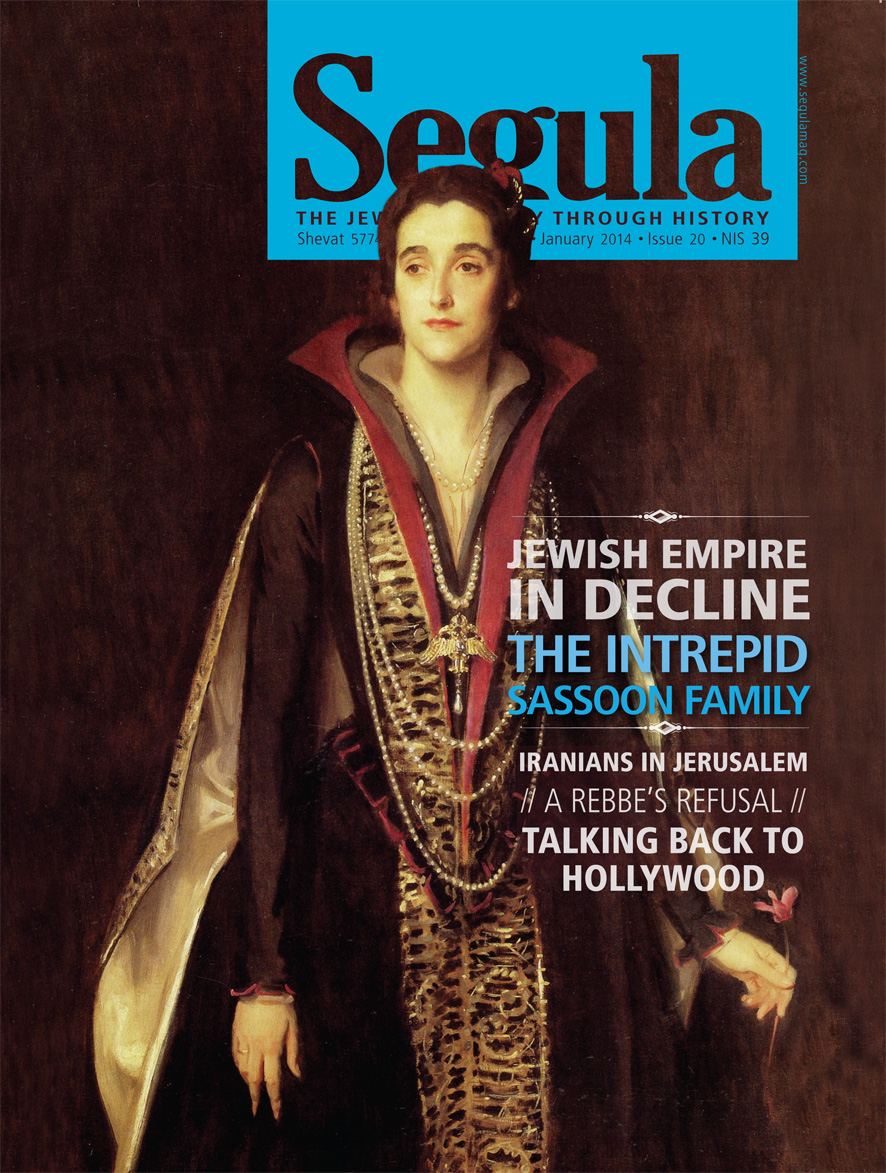
The film industry was silent throughout its first thirty-two years, but not for lack of what to say. Silent movies were packed with artistic innovations and social as well as moral statements; the technical limitations of the medium were the only reason they lacked a voice. Still, in comparison with The Jazz Singer, they’re like the mute boy at the dinner table – they have nothing to say. The first sounds to issue from the silver screen did more than mark the end of the silent film era. They echoed with the existential questions haunting the filmmakers and much of their audience: who am I, and where do I belong? And the way the cinema framed these questions in 1927, in the first feature-length film with synchronized dialogue, was typically Jewish.
Mute Melodrama
The fact that all its characters were mute forced the young film industry to adopt a melodramatic style quite contrary to its inventors’ intentions. The first silent clips, screened at a small Parisian café on Friday night, December 28, 1895, were entirely realistic. They focused on mundane, everyday events – workers leaving a factory, a train pulling into a station, and a snowball fight on the streets of Paris.
Auguste and Louis Lumière had hoped the moving images captured by their cameras would open people’s eyes to the uniqueness of each moment in their lives. But the Lumières’ inability to integrate their pictures with a recorded soundtrack detracted drastically from the realism they’d hoped to achieve. The silent motion on screen was so far removed from the noisy world of its audience that it lacked credibility; the grandiose gestures with which the actors attempted to compensate for the lack of dialogue, and the live music played to accompany the silent screen, pushed the medium toward escapism, histrionics, and extreme artistic experimentation.
For many filmmakers, such limitations were untenable. Artists dreamed of films that would “hold a mirror up to nature,” and the search for a technical solution that would tear down the sound barrier dividing reality from the silver screen became a challenge attacked by engineers from every side.
The long-awaited breakthrough was finally achieved in the mid-1920s. Western Electric developed the “Vitaphone” and offered it to leading Hollywood studios. This technique connected the film projector to a phonograph. A slight time lag remained between the actors’ facial expressions and the sound, but short scenes in which the cast’s voices were projected over prerecorded background music could now be integrated into otherwise silent films.
Studio owners were skeptical. Incorporating the Vitaphone into movie theaters was complex and expensive, and who knew whether the new technology would be a hit? Faced with a choice between guaranteed income and a risky investment in the film industry’s future, moguls preferred their cash in hand. In desperation, Western Electric finally peddled their product to the ambitious managers of a small, dynamic studio, who agreed to give the Vitaphone a chance.
The Screen Comes to Life
The four Warner brothers – Albert, Harry, Sam, and Jack – had been a part of the film industry since 1903. Their chain of movie theaters provided a decent income for the family, but the Warners were determined to work their way up and create their own films instead of selling and distributing those produced by other studios. The small, family-owned studio was falling behind the big names; its only big success had been its Rin Tin Tin series, featuring the exploits of a daring dog.
Unlike Paramount and MGM, Warner Brothers had nothing to lose. They hoped the Vitaphone would be the breakthrough they’d been looking for. In 1926 they began showing short talkies as a warm-up to their main, full-length features, which remained silent. Finally, in late 1927, the time was ripe for the appearance of The Jazz Singer, the first full-length motion picture to include sequences with dialogue. Though silence dominates the eighty-eight-minute film, sound breaks through briefly at several points. In the climactic final scenes, the actors can be heard speaking – and singing. Finally sound had come into its own. The Jazz Singer proved conclusively that pictures and sounds could indeed be synchronized, and marked the beginning of the end of the silent movie era. For the first time, sound was introduced not as a gimmick but as an integral part of a film’s story line. The actors’ initial silence symbolized repressed parts of their characters; they finally began speaking only when the progression of events allowed them to “find their voice.”

A Wrenching Dilemma
The Jazz Singer is Alan Crosland’s film adaptation of a play by the same name written by Samson Raphaelson, a prominent Hollywood screenwriter. The play was based on a short story by Raphaelson called “Day of Atonement,” which had appeared in Everybody’s Magazine in January 1922. Jack Robin, formerly Jakie Rabinowitz, hails from a dynasty of Jewish cantors. He dreams of breaking the mold and making a name for himself in the nightclubs and concert halls frequented by the younger generation. His spirit chafes at the traditional melodies of the synagogue, yearning to express itself in the freedom of jazz. In the film, Jakie is played by Al Jolson, born Asa Yoelson, a well-known entertainer and himself a cantor’s son. Jakie’s father pressures him to abandon his newfound love and remain within the Jewish community. Sold on jazz, convinced that it captures the spirit of the age, Jakie leaves home.
Years later, the long-lost son is summoned to his father’s deathbed. On Yom Kippur eve, Jakie’s parents and their entire community beg him to sing the Kol Nidrei prayer in the synagogue that evening instead of his father. But that evening is the opening night of a show that could be the long-awaited turning point in Jakie’s career. Torn between his family, his Jewish identity, and the American individualism on which he’s built his life, Jakie has to choose.
The Jazz Singer is a journey between identities. It begins with the Jewish community’s attempt to imbue young Jakie with traditional values. These Jews expect him to play his part, dutifully passing the torch of faith and tradition to the next generation. Aware that by succumbing to the temptations of the outside world, he could sever his connection to his roots forever, Jakie risks becoming a stranger to his own family. For Raphaelson, the greatest pull of tradition was the warm embrace of the Jewish home. As Tevye the milkman says in Fiddler on the Roof, “Because of our traditions, every one of us knows who he is, and what God expects him to do.” Secure in that knowledge, “every one of us is a fiddler on the roof, trying to scratch out a pleasant, simple tune without breaking his neck.”
Jakie’s problem is that the “pleasant, simple tune” is no longer enough. He is drawn to the world beyond his community, where each individual defines himself, making the collective irrelevant. With Judaism no longer a liability, he has no need for the warmth of a support group. The community’s sheltering wings are suffocating, preventing him from spreading his own. Yet anxious as he is to break away from Judaism, when it comes to cutting his ties to his father, and particularly his mother, he hesitates. Traditional ideals may seem meaningless in the modern world, but everyone needs a home and a family. How can he throw away the trappings of religion without losing his family, the kernel of his being?
Not yet a Segula subscriber?
Access our full archive online, have print issues delivered to your door, and moreFeel free to share