Two rabbis, a stonemason’s guild, a Jewish merchant, and the archbishop of Cologne all helped solve the riddle presented by a magnificent, medieval prayer book found in Amsterdam

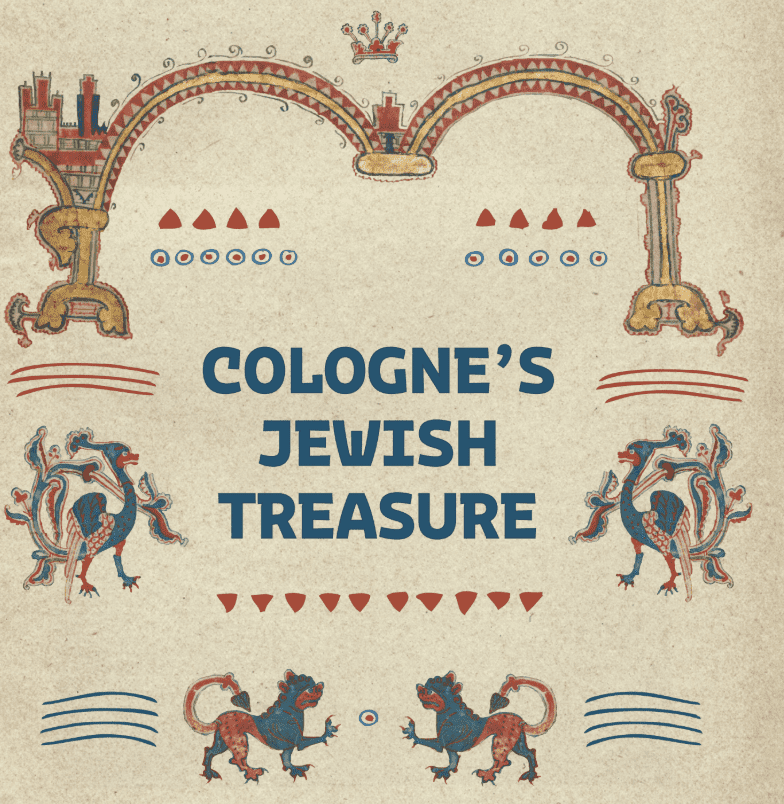
In September 2019, an armored truck sped along the Rhine en route from Amsterdam to Cologne, Germany. Inside the vehicle, carefully packed into a custom-made, padded, moisture-proof box, was a large, heavy book. Known as the Amsterdam Festival Prayer Book, after the city where it was long preserved, this 751-year-old volume was actually written, illustrated, and illuminated in Cologne. In the 17th century, the mahzor (as festival prayer books are called in Hebrew) was transferred to a member of the Spanish and Portuguese Jewish community in Amsterdam, where it’s been on exhibit in the Jewish Museum ever since the early 1900s. In 2019, the work finally came home to Cologne, where it was originally used by the town cantor not just on festivals but on special Sabbaths and the high holy days.
Smack in the Middle of Town
This unique volume was temporarily on display at the Wallraf-Richartz Museum in Cologne, in a bespoke sixth-floor chamber overlooking a large construction site and the town hall. Until 1424, this spot was the center of the Jewish quarter. Then the city’s Jews were driven out, and the medieval community ceased to exist. Only in the late 1700s, when Napoleon’s troops unleashed the freedoms of the French Revolution on Germany, could Jews once again settle there.
After the expulsion, Jewish homes were distributed among wealthy burghers. Tombstones were uprooted, the mikveh (ritual bath) was walled up, and the synagogue became the Saint Mary of Jerusalem municipal chapel, where weddings were held well into the 19th century.
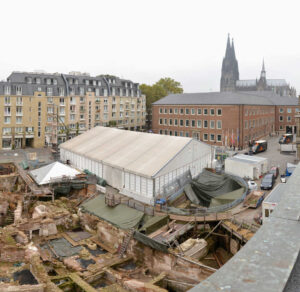
Over the last decade, on the building site next door, work has been advancing on the MiQua-LVR (Rhineland Regional Association) Museum, erected over the mikveh’s remains (discovered seventy years ago in the town hall parking lot). The museum’s name alludes to both the mikveh and the Mittel Quarter, the heart of the former Jewish district. The ritual bath is now right in the middle of Cologne’s cultural and historic center, which stretches from the train station and cathedral at its northern end to the Severins City Gate, in the ancient city wall to the south.
The concept of a museum showcasing finds in situ is part of a new German effort to present the country’s Jewish past not only in monuments to the communities destroyed in the Holocaust but as an integral part of the multiethnic history of German cities.
Cologne is one of the earliest examples of German Jewish settlement, with the city’s past and that of its Jews interwoven from Roman times until the Middle Ages and again in the modern period. The year 2021 marked seventeen hundred years of Jewish history in Germany, beginning with documentary evidence of a Jewish community in Cologne in 321. Capital of the province of Lower Germany, Cologne was then known as Colonia Claudia Ara Agrippinensium – the colony of Agrippina, wife of Claudius – or Cologne (or Köln) for short.
The new museum’s focus will be medieval. Its central exhibit will be the remains of the synagogue and the magnificent ritual bath. The latter’s impressive 12th-century stairwell led bathers sixteen meters underground to an artificial basin through which the local aquifer still flows. The water in the mikveh is thus constantly and effortlessly replenished by a natural source, as prescribed by Jewish law.
Archaeological finds will be displayed in the actual cellars of the Jewish quarter. Relics include scale armor; fragments of a Judenstern (Jewish star), a star-shaped lamp used in medieval Jewish homes on the Sabbath; dice; and dozens of slate tablets inscribed with Hebrew characters. Hundreds of such slabs have been found and apparently bore everyday notes and drafts of correspondence.
Extensive excavations begun in 2006 by the Cologne municipality revealed not only remains of the Jewish quarter, but a Roman governor’s palace dating from the fourth century and medieval goldsmiths’ workshops. The dig ended in 2016, but construction has proceeded slowly, to protect both past and future finds.
When the museum eventually opens, the Amsterdam Mahzor will be on display within the walls of the very synagogue where it was used in the Middle Ages. The Amsterdam Jewish Museum and the MiQva Museum have agreed to shared ownership of the priceless prayer book, which will alternate between the two.
Not yet a Segula subscriber?
Access our full archive online, have print issues delivered to your door, and moreFeel free to share