Two orphans are about to tie the knot. But the wedding procession leads to the local cemetery. What was behind this strange 19th-century custom, and what storm brewed in its wake?

On the first day of Nisan, 1909, a Jerusalem burial society made the following entry in its log:
Let it be noted for posterity that on this day, toward evening, the congregation raised a wedding canopy over two Yemenites on the Mount of Olives, as a means of ending sickness. [Hebrew]
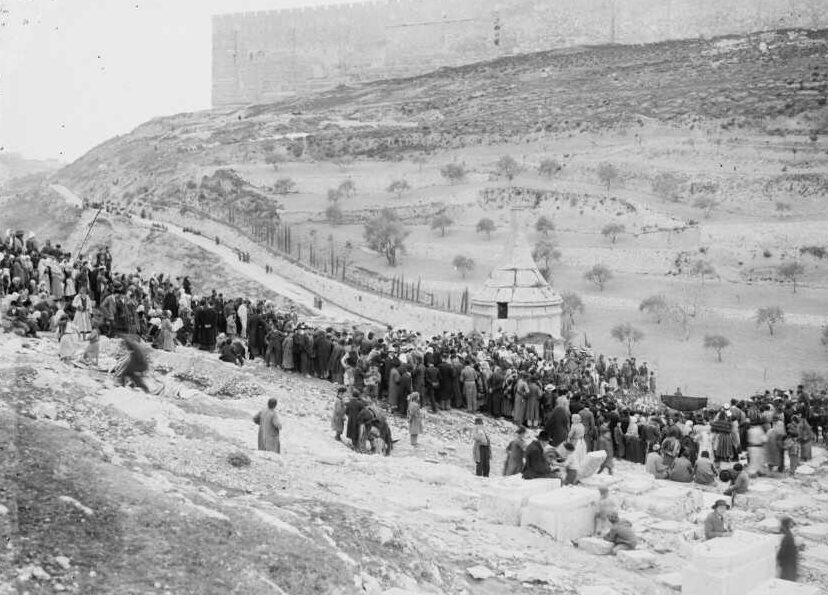
Photographers from the city’s missionary American Colony caught the moment on film, and two days later, the wedding was reported in Eliezer Ben-Yehuda’s daily paper, Ha-zvi (The Gazelle), with more than a touch of irony:
Don’t think there’s any dearth of highly effective superstitions in Jerusalem, for some loyal agents have finally been found to see to the city’s health and wealth. Today, on the first day of Nisan, one hour after noon, the cure was concocted […]. A lengthy procession stretched all the way from the gate almost to Absalom’s Pillar. When I turned toward the Mount of Olives, the entire slope above the Cave of Zechariah and Absalom’s Pillar was covered by a mass of people. The procession joyously sang its way to the Mount of Olives. Despite a slight, pleasant breeze blowing from the east, the heat was stifling.
Among the Jewish throngs that spilled heavily and lazily over the crest of the hill, amid the weathered graves were English, American, and German representatives. What were the consuls doing here? Nothing less than spectators, watching the Jews’ strange goings-on.
And truly, is there anything more ridiculous than this spectacle? A great crowd assembles on the Mount of Olives to watch the wedding of an orphan bride and her orphan groom, that the merit of their match might end the city’s terrible plague. (Ha-Zvi, 3 Nisan/March 25, 1909)
What brought the lively wedding of two young orphans to the somber, grave-lined slopes of the Mount of Olives? Had the wedding halls all shut down? Was this a selfless act of charity on behalf of a destitute couple without family, or was it a superstitious hope that the good deed of the living and the joy of the ceremony would stop the plague raging through the city? Did anyone really believe that the dead lying in the graveyard would intercede on behalf of the living? Or was it more of a preemptive declaration of victory by the surviving children of plague victims, who’d beaten the odds and reached child-bearing age?

Canopy of Black
Jewish sources have a special term for a wedding ceremony joining two orphans in a graveyard: a “black wedding,” or “plague wedding.” This practice was thought to magically remedy plagues and other tragedies. Nor was it invented in Jerusalem; Eastern European immigrants brought it to the holy city in the 19th century. In his Be’erot Mayim (Wells of Water), Rabbi Zvi Hirsch of Rymanów recounted such a ritual, held in his hometown in 1831:
Cholera, woe unto us, rested upon the land that year, and they performed the well-known good-luck charm of marrying off a pauper to a destitute virgin. They erected the wedding canopy in the graveyard, and when they went to lead the bride and groom beneath the canopy, the bride was afflicted with that plague. [… ] They told our teacher, the holy rabbi Zvi HaKohen, may his memory be a blessing for the world to come, who spoke with his holy mouth, saying: “We have a tradition that the corpse should pass before the bride.” At once, she was cured of her sickness, her strength restored. (Zvi Friedhaber, “Plague Weddings in Hebrew Literature and Newspapers,” Dappim Research in Literature, vol. 7 [Haifa University, 1990], p. 306 [Hebrew])
A similar ceremony was conducted in Zambrów, Poland, in 1893, and described by Meyer Zukeravitz. After all efforts to drive out the plague of cholera had failed, he wrote:
Not yet despairing of God’s salvation, the people tried a third method – the wedding of an orphan bride. There was a crippled virgin in town named Hanna Yente, who was also an orphan, and a stammering beggar who was still single and slept at night on a hard bench in the hostel. The town’s burghers made a match between the two, and the couple agreed.
It was decided that the wedding would be held in public at the community’s expense, in the graveyard. […] The couple was led to the wedding canopy with drums and dancing, and everyone in town – Christians included – came out to rejoice with the bride and groom.
The merit of rejoicing in a good deed stood us in good stead. God saw our affliction and regretted the evil He’d brought on His people, and the plague came to an end. (Shmuel Glick, Light Shone upon Them: Connections between Wedding and Mourning Customs in Jewish Tradition [Efrat: Keren Ori, 1997] p. 175 [Hebrew])

Not yet a Segula subscriber?
Access our full archive online, have print issues delivered to your door, and moreFeel free to share