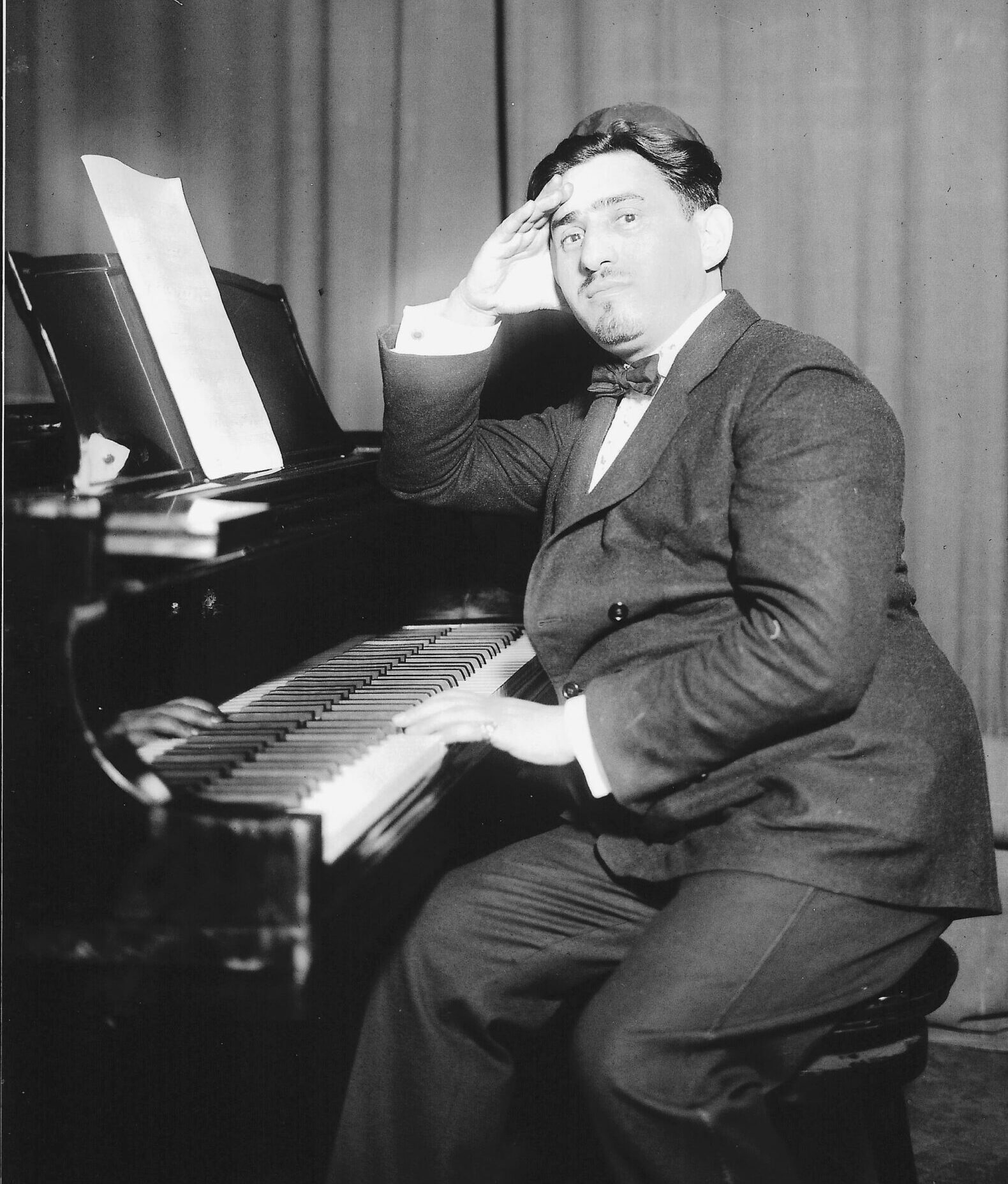
The huge popularity of cantorial concerts and records during the first half of the 20th century turned the most talented cantors into celebrities. But did they cross the line from prayer to entertainment?

A century ago, in the 1910s and 1920s, waves of emigration from Europe’s troubled Jewish communities brought many of the world’s finest cantors to American synagogues. Thanks to this extraordinary array of talent, the first half of the 20th century became known as the golden age of cantorial music. Its stars set the standard by which cantors are still judged, and the liturgical classics of those years remain synagogue staples and favorites at cantorial concerts around the world.
Music has been a central feature of Jewish worship since Temple times. As communal prayer in synagogues became the norm following the destruction of Jerusalem’s Second Temple, liturgical poems composed by paytanim (poets) – who also often led the congregation in worship – were added to the basic prayer text. Standards had to be established regarding who could lead the services, but it wasn’t always easy to find cantors to fit the bill.
Beyond the obvious requirement of a pleasant voice, the arbiters of Jewish law determined that the leader should be scholarly, fully conversant with the prayers, pious, and known for his modesty and good deeds. He should preferably be a man of meager means, with a family to support, so as to lend his appeals to Heaven urgency and passion. Empathy with the congregation’s needs was vital as well (Ta’anit 16a).
In the Middle Ages, there was much discussion as to which of the aforementioned requirements took precedence. Ultimately, if a candidate met at least the basic standards, his vocal ability won the day.
Following the Emancipation, as ghetto walls came down and Jews were exposed to Western culture, cantorial music grew more sophisticated. Pioneering cantors, composers, and choirmasters such as Salomon Sulzer (1804–1890, Vienna), Samuel Naumbourg (1817–1880, Paris), Louis Lewandowsky (1821–1894, Berlin), and David Nowakowsky (1848–1921, Odessa) introduced more formal and elaborate choral pieces. While consistent with the character and nusach (musical modes) of the various prayer services, these compositions also conformed to the musical standards of the day. Many such works became fixtures in Ashkenazic cathedral synagogues. In addition, while aspiring cantors had traditionally trained under their predecessors, quite a few now studied with professional music teachers or at conservatories, becoming proficient in musical notation and vocal techniques.
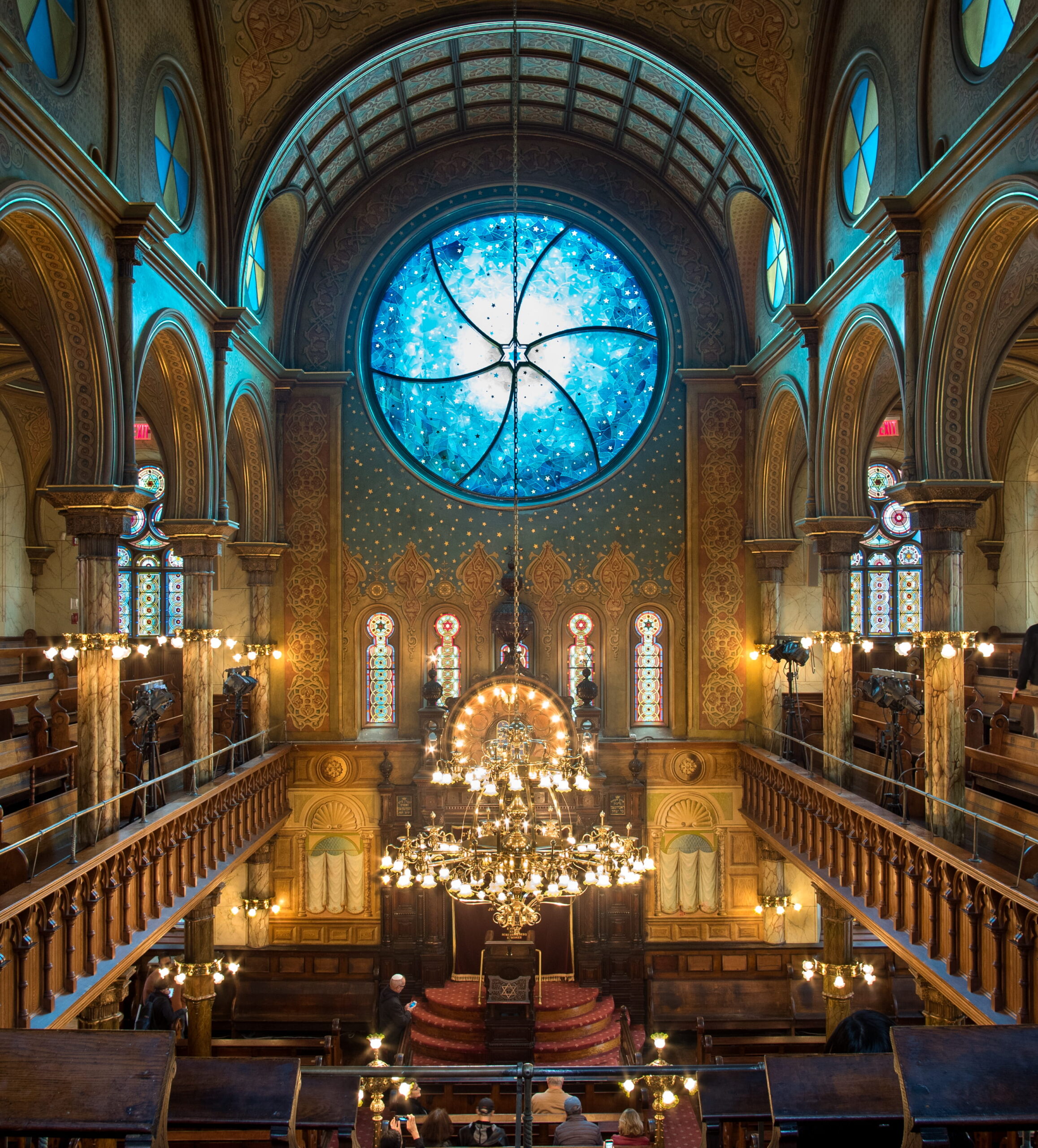
Photo: Rhododendrites, 2018
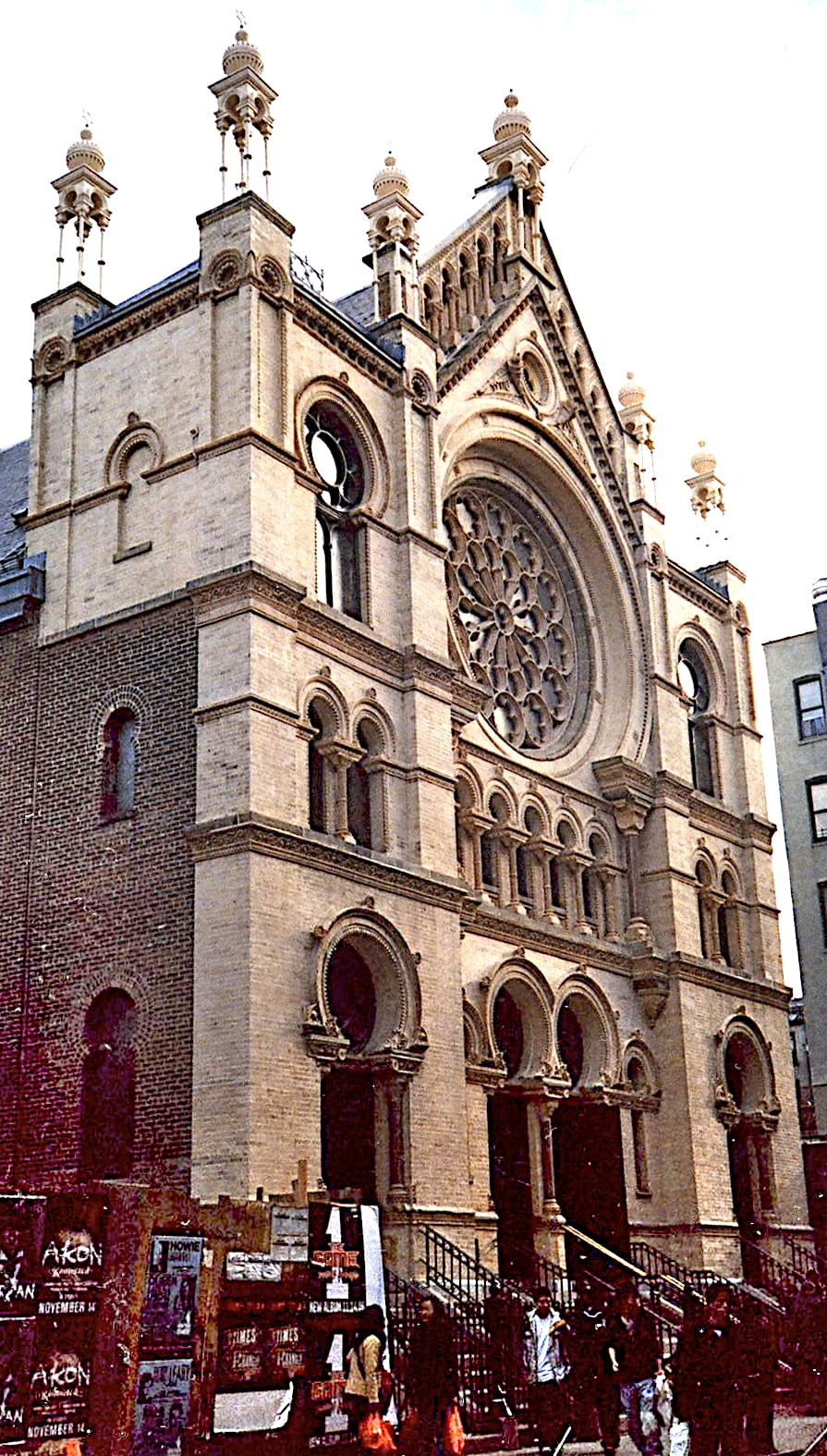
Photo: G. K. Tramrunner, 2006
Cathedral synagogues. Built in 1887 on New York’s Lower East Side, the Eldridge Street Synagogue boasted stained-glass rose windows, a dome seventy feet high, and a barrel- vaulted ceiling. But by the 1930s the congregation could no longer fill the vast space and moved to the basement. Today the building is a Jewish museum
Virtuoso Cantors
The golden age was rooted in the closing decades of the 19th century. In major European Jewish centers such as Vilna, Odessa, Warsaw, and Vienna, you would find a chorshul, a cathedraltype synagogue with a virtuoso cantor and a large choir of men and boys. But as congregants fled the increasingly oppressive imperial regimes for the New World, most cantors followed them to the Goldene Medina.
In New York and other big cities, leading congregations competed fiercely for the star cantors, tempting them with huge salaries and benefits. Popular opinion tends to grant countries like Italy a monopoly on great tenors. Yet talent knows no boundaries, and certain cantors were blessed with voices no less magnificent than the greatest international vocalists. Upon hearing Gershon Sirota, the famous cantor of Warsaw, opera star Enrico Caruso reputedly remarked how fortunate he was that Sirota, who’d received many offers to sing opera, preferred the synagogue.
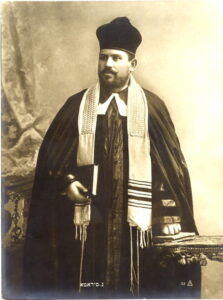
Hailed as one of the most powerful and highly trained tenors of his time, Sirota was known for his climactic high notes and outstanding voice control. Born around 1874 in Imperial Russia’s Podolia region, he landed his first position in Odessa when he was only eighteen. Just three years later, as accounts of his extraordinary prowess spread, he was appointed cantor of the enormous Vilna Synagogue, a prestigious post previously filled by some of the biggest names in cantorial music.
In 1905, Sirota became Oberkantor (chief cantor) of Europe’s most renowned house of Jewish prayer, Warsaw’s Great Synagogue. Seating upwards of two thousand worshippers, it was attended by the city’s most prosperous Jewish elite. From 1927 on, he focused on international concert tours and was the only virtuoso cantor of his era to decline a position in America.
Trapped in Warsaw when war broke out, Sirota continued to inspire those who heard him lead High Holy Day prayers in the ghetto. He perished together with his family during the suppression of the Warsaw ghetto uprising in May 1943.
Another superstar of the golden age was Zavel (Zevulun) Kwartin. Born in the same region and year as Sirota, Kwartin possessed a beautifully expressive and powerful lyric baritone. He composed as well, and many of his emotionally charged pieces remain popular to this day. Having officiated in Vienna, St. Petersburg, and Budapest, Kwartin emigrated to the United States in 1919. He visited Palestine in 1926, settling there in 1931, but returned to the New York area in 1937, where he remained until his death in 1952.
Mordechai Hershman (1888–1940) served as chief cantor in Vilna in 1913 before relocating to New York in 1920. A magnificent and versatile tenor, Hershman sang the synagogue liturgy with polished elegance and charmed audiences with his mastery of Yiddish folk songs. He officiated at Temple Beth El in Brooklyn, New York’s equivalent of an Orthodox chorshul, which engaged the greatest cantors of the day. An ornate structure seating thirteen hundred, the synagogue still boasts the acoustics of a concert hall.
Perhaps the most famous of Beth El’s luminaries was Moshe Koussevitzky (1899–1966). In 1920, when Hershman left Vilna for the U.S., Koussevitzky replaced him at that city’s Great Synagogue; in 1927, he succeeded Gershon Sirota as chief cantor of Warsaw. Koussevitzky spent World War II singing opera in the Soviet Union. He emigrated to the U.S. in 1947. A robust but graceful tenor with a phenomenal upper register, Koussevitzky was widely regarded as the greatest cantor of the postwar era.
The best-known and most beloved of the celebrity cantors was Yossele Rosenblatt (1882–1933). After officiating in various European cities, Rosenblatt was brought to America in 1911 by one of New York City’s leading shuls, Ohab Zedek. Located in what was then the fashionable Jewish neighborhood of Harlem, the synagogue overflowed on Sabbaths and holidays when Rosenblatt led services. Police even had to be on hand at times to control the crowds jostling to enter.
The sweet timbre of Rosenblatt’s extraordinary voice was at once resonant and poignant. With his huge range and trademark “sob,” he inspired congregants and concert audiences alike. Rosenblatt had perfect pitch and could sight-read even the most difficult score. And much of his repertoire was his own composition, echoing the tones of his Hasidic background.
No other cantor has ever attained such popularity and renown among audiences both Jewish and non-Jewish while retaining his synagogue position. But Rosenblatt’s life story was filled with highs and lows, from Hollywood and opera companies luring him with lucrative offers (which he consistently refused) to near poverty after a bad investment. The 1920s found him touring America in vaudeville just to pay back his creditors. Yet Rosenblatt’s admirers stuck with him through it all, and he never compromised his strict Jewish observance. He died of a heart attack at only fifty-one, hard at work on a film in Jerusalem.
Not yet a Segula subscriber?
Access our full archive online, have print issues delivered to your door, and moreFeel free to share