
Saladin’s personal physician and Maimonides’ friend, Hibat Allah ibn Zayn ibn Jumay‘ left a colorful paper trail of Arabic medical works and fragmentary documents from the Cairo Geniza. Discovering an unsung Jewish hero

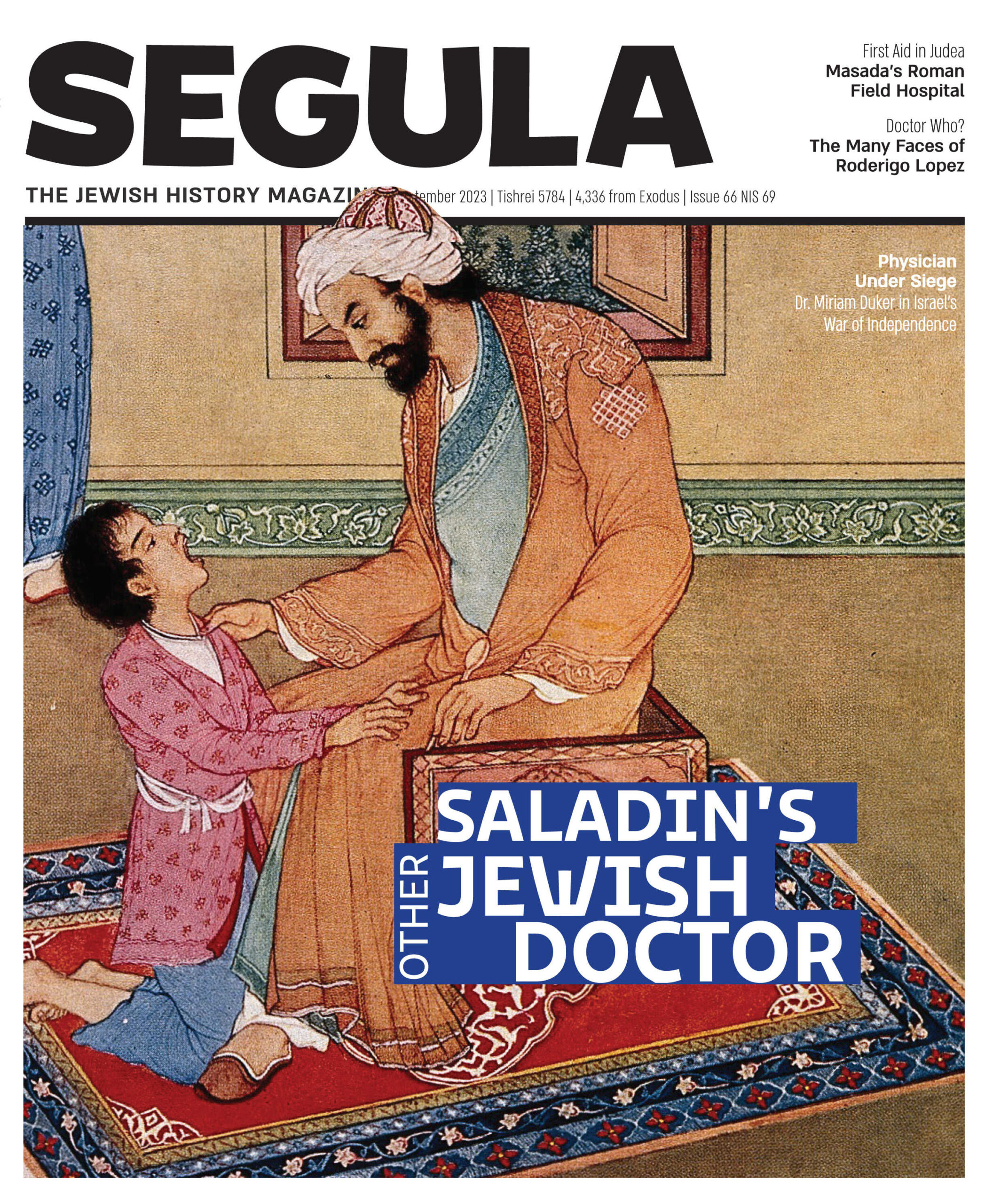
More than a few Jews and Christians living under medieval Islam were physicians. Regarded as a noble undertaking, medicine guaranteed a steady income, social standing, and intellectual satisfaction. Furthermore, military and religious appointments were off limits to the protected but inferior “dhimmis,” or non-Muslims. For Jews and Christians, therefore, medicine was one of the few routes to prosperity and honor; some of the most outstanding of these doctors rose to attend to the sultan himself. Why would a Muslim ruler prefer the medical attentions of an unbeliever? By hiring a Jewish doctor, who often doubled as a community leader, a caliph or sultan might consider this minority more easily controlled. Furthermore, when trusting someone with your life – and your most intimate secrets – best to choose a member of a lower class, who’ll never pose a political threat and whose well-being depends directly on his employer.
Thus, throughout Saladin’s twenty-two-year rule over Egypt and Syria – during which he restored Egypt to the Abbasid Empire in 1171 and defeated many Crusader armies – he retained eight Jewish doctors alongside eight Muslim ones and five Christians. Moses Maimonides wasof course the best-known of these Jews, but he became a successful court physician only later in life, in the 1190s. One of his predecessors was Hibat Allah (God’s Gift), better known by his family name, Ibn Jumayʿ al-Isra’ili. Diverse medieval Islamic sources as well as Jewish documents from the Cairo Geniza yield a colorful biography of this unusual figure, covering not only his medical career but also his political, social, and commercial ties. Highlights include his friendship with Maimonides and his role within the ruling elite in an era when generals – Saladin and his heirs chief among them – controlled Egypt.
Success Story
The most extensive Islamic source on Ibn Jumayʿ is a 13th -century collection of medical biographies beginning in the Hellenistic period and written by Muslim doctor Ibn Abi Usaybiʿa. The entry on Ibn Jumayʿ calls him by his full name, Hibat Allah, son of Zayn son of Hasan son of Ifraim son of Yaqub son of Ismaʿil. His honorific is also included: al-Shaykh al- Muwaffaq (The Successful Master), a title often assigned to doctors of all faiths.
Ibn Abi Usaybiʿa notes that Ibn Jumayʿ was born and raised in Fustat, the Old City of Cairo, where his clinic was later located in the lamp market. The author praises Ibn Jumayʿ’s broad knowledge of science, particularly anatomy and medicine. Ibn Abi Usaybiʿa also mentions his subject’s pure Arabic, his Muslim teacher, and his many students.

As Saladin’s personal physician, Ibn Jumayʿ won the ruler’s trust and rose to a high rank within the royal court. One medical concoction he adapted for the sultan was theriac, considered a potent cure-all.
Ibn Jumayʿ’s book The Revival of the Medical Art was even dedicated to
Saladin. Written after a conversation between the two on the sorry state of medicine, the work attributed this deterioration to inadequate medical training. Knowledge of Greek medical theory wasn’t enough, Ibn Jumayʿ maintained; students needed clinical experience. Another two of Ibn Jumayʿ’s works – one on hunchbacks, the other a Guidebook for the Welfare of Souls and Bodies – were dedicated to the grand vizier of Egypt (and patron of Maimonides), al-Qadi al-Fadil.
Savior or Suspect?
One interesting anecdote recounted by Ibn Abi Usaybiʿa illustrates Ibn Jumayʿ’s prodigious talent. As a funeral procession passed his clinic, he noticed that the shrouded corpse’s protruding feet were pointing straight up rather than flopping sideward, indicating that the “deceased” was in fact alive! The doctor rushed outside and persuaded the mourners to uncover their relative, douse him with warm water, and apply hot bandages. Ibn Jumayʿ treated the patient until he regained consciousness, claiming to be none the worse. All present were convinced the physician had miraculously raised the dead.
Ibn Abi Usaybi‘a’s portrait of Ibn Jumay‘ isn’t all complimentary, however. For comic relief, Muslim historians incorporated satirical poems into their otherwise informative works, and Ibn Abi Usaybi‘a was no exception. His biography of the great doctor is therefore interspersed with verses mocking Ibn Jumay‘ and his medical knowledge:
Ibn Jumay‘ is a medical idiot / And the medicine of Jesus is reviled because of him. / He can’t figure out what’s in a flask of sick urine / No matter how much he churns it. / Yet most amazing of all was the time / He asked the bereaved to pay him for killing the patient. (Ibn Abi Usaybi‘a, Uyun al-anba’, p. 577)
This final verse reflects a traditional Islamic belief that Jewish healers harmed or even murdered Muslim patients. Another poem quoted by Ibn Abi Usaybi‘a derides Ibn Jumay‘ with a play on his name, pronouncing it as the Arabic equivalent of “all.”
You lied and misspelled when you claimed / Your father is Jumay‘ the Jew. / For Jumay‘ the Jew is not your father / No, all the Jews were your father. (ibid., p. 578, translated in D. S. Nicolae, “A Medieval Court Physician at Work: Ibn Jumay‘’s Commentary on the Canon of Medicine,” doctoral thesis, University of Oxford, 2012, p. 37)
In contrast, a third poem, written by a Muslim colleague, is a long, flowery lament mourning the Jewish doctor’s death.

Not yet a Segula subscriber?
Access our full archive online, have print issues delivered to your door, and moreFeel free to share