In the early 1960s, a young teacher named Adin Steinsaltz gave a lecture envisioning a Hasidic revival in Israel. Today, his words seem prophetic – but they were simply a personal plan of action

In the State of Israel’s early decades, rather than confine themselves to the ivory tower of academia, historians took on significant leadership roles in both politics and society. Two such scholars – Yitzhak Ben-Zvi and Zalman Shazar – became presidents; another (Benzion Dinur) served as minister of education. Still others, such as Gershom Scholem, left their mark on the nation’s cultural development, much as spiritual and religious leaders and writers do today.
Just a Position Paper?
Prof. Shmuel Ettinger belonged to the second generation of the “Jerusalem School” of historians, succeeding Dinur and others. Ettinger too championed non-academic cultural activities, including parlor meetings in his home with historians and other public figures. One such series of get-togethers was devoted to Talmud study, while another was launched in the second half of the 1950s and continued well into the 1960s. Upcoming historians, philosophers, and scholars from a variety of fields met once or twice a month to explore Jewish identity in the new state. These exchanges were not merely theoretical; there was a sense that intellectual arguments could truly shape Israel’s everyday life.
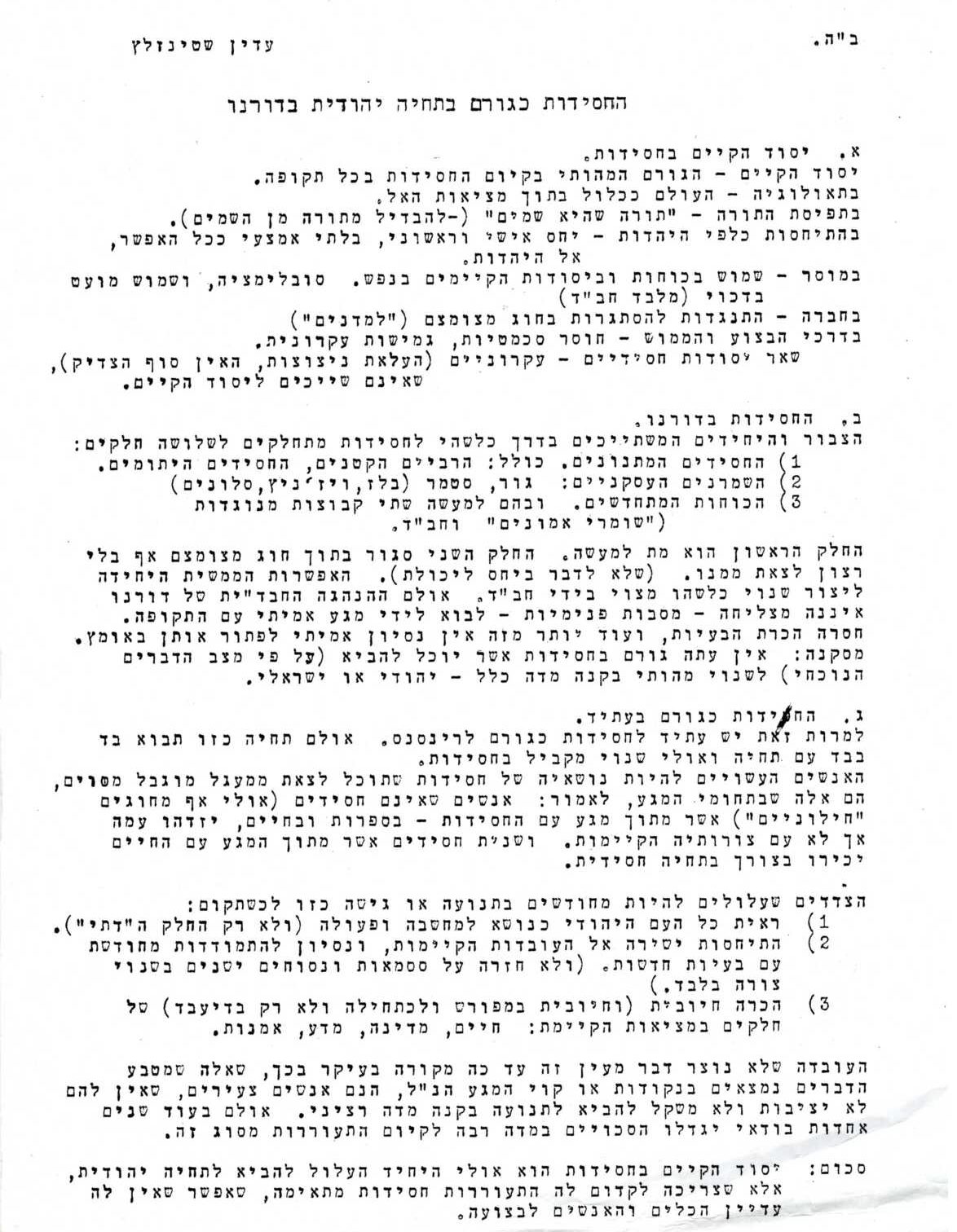
Among Ettinger’s papers, now housed in the Central Archives for the History of the Jewish People, are brief outlines of the various lectures given in this setting. Stenciled, duplicated, and distributed at each meeting, these notes give us an inkling of the many fascinating discussions the professor hosted. The lectures were devoted to a philosophical or historical issue, analyzing its current situation and usually proposing activities to be undertaken in the field.
One of these talks, dated March 27, 1962, was given by twenty-five-year-old Adin Steinsaltz, later known as Rabbi Adin Even-Yisrael. Steinsaltz was then publishing a monthly pamphlet, Reshafim (Flames), in which he and his friend Moshe Shapira called for a Hasidic revival and even tried to set up a village along these lines in the western Negev.
Steinsaltz discussed “Hasidism as a Catalyst for Jewish Revival in Our Generation.” He opened with Hasidism’s “eternal foundation,” developing his theme in keeping with the subheadings listed on his handouts.
For Steinsaltz, Hasidism in the 1960s was at best obsessed with internal politics and at worst an obsolete Judaism unable to impact the public:
The communities and individuals connected one way or another to Hasidism today fall into three groups:
- Degenerating Hasidic Jewry [including the minor Hasidic courts, many more of which existed in the post-Holocaust generation than today] and “orphan” Hasidim [attached to no particular rebbe].
- Conservative, politicized Hasidic dynasties such as Gur, Satmar, Belz, Vizhnitz, and Slonim.
- Self-renewing branches of Hasidism, of which there are two opposing factions – Shomrei Emunim and Lubavitch.
The first group is basically dead. The second is confined to a very limited circle with neither the wish nor the ability to escape it. The only possibility of change lies within Chabad (Lubavitch). But the current leadership has so far failed – for internal reasons – to truly engage with this day and age. Not only do [these leaders] lack awareness of the problems, they don’t have the guts to address them properly.
Conclusion: right now nothing and no one within the Hasidic communities can truly change the general Jewish or Israeli population.

Not yet a Segula subscriber?
Access our full archive online, have print issues delivered to your door, and moreFeel free to share