
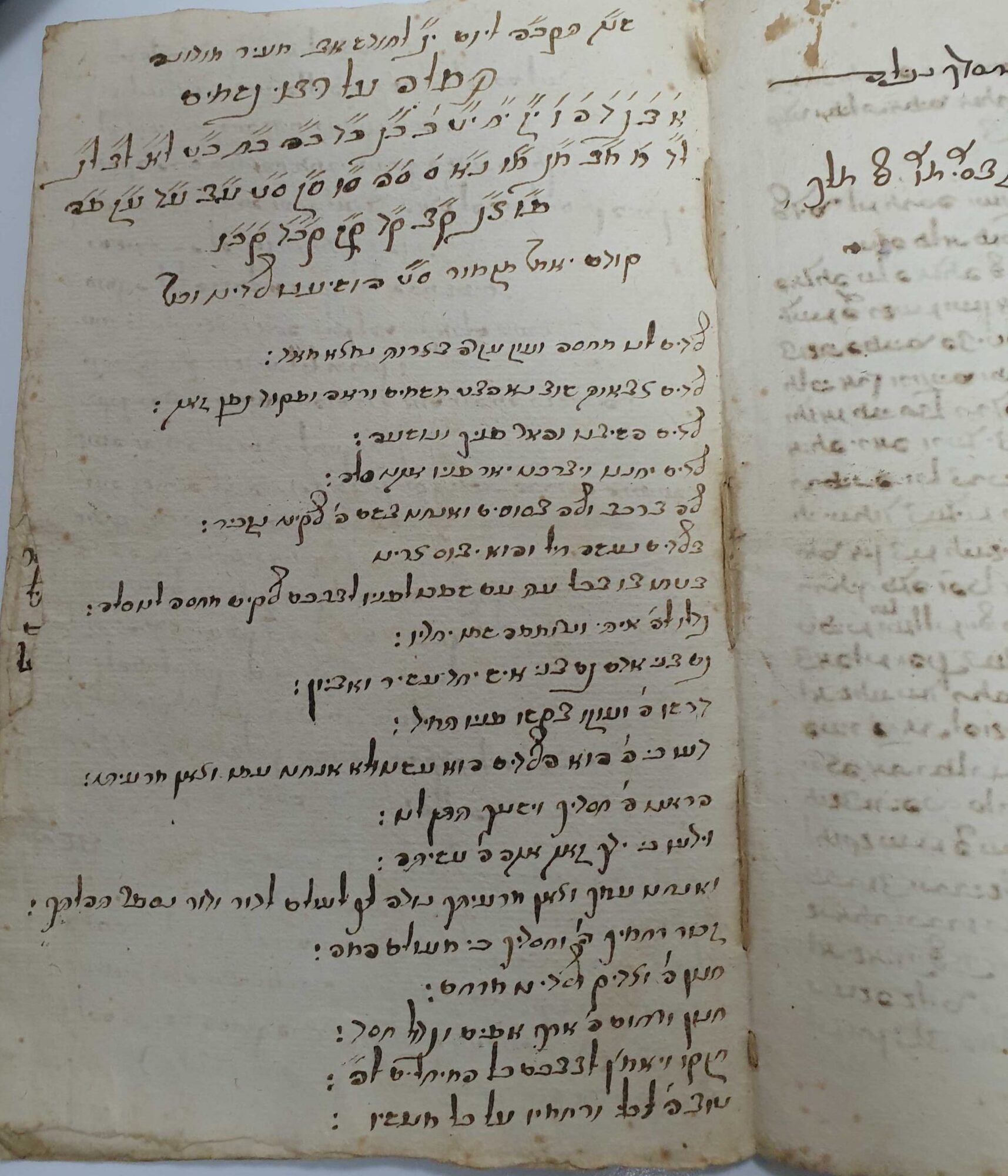
Jews have always prayed for rain, but those in northern Italy suffered from too much rather than too little, inspiring prayers for protection from flooding

The Mishnaic tractate Ta’anit (Fasting) devotes extensive space to the existential problem posed by lack of rainfall in an agrarian land of Israel. The Mishna delineates calendrical red lines after which insufficient rainfall sets off a series of fasts, prayer assemblies, and soul-searching. Today, such dependence on rain seems so foreign to our mostly urban society that we have a hard time identifying with this angst. Our water – much of it desalinated – is so far removed from its source, we have little idea of where it comes from. Our produce – if not drip-irrigated – relies on sprinkler systems to kick in when rain falls short. We associate fast days only with mourning over historical catastrophes such as the Temple’s destruction, but in Mishnaic times, most fasts were prompted by drought.
The Talmud, Midrash, and halakhic literature all focus on too little rain rather than too much. Even the legend of Honi the circle-drawer (Ta’anit 19a), who asked God to calm the raging storm invoked by his prayers, begins with the sage praying inside a circle from which he refuses to budge until God blesses the withering crops with rain. The Talmud does point out that excessive rain in Babylonia warrants a siren even on the Sabbath (ibid. 22b). Rashi understands this alarm as a flood warning. The Tosafists and Maimonides, in contrast, see the threat as the collapse of mud roofs during a downpour. As the Talmud itself continues, “Think of your brethren in the Diaspora [in your prayers], that their homes not become their graves.”
Jews in medieval Europe weren’t so involved in agriculture, and the continent’s chilly climate made droughts a rarity. Yet many European towns were subject to flooding. Generally situated in valleys, they often straddled rivers untamed by dams and levees. Melting snows after a harsh winter almost always resulted in flooding, and sudden summer storms could ruin crops.
Straight from the Heart
Jewish community archives usually reflect everyday life and therefore include few sacred texts, prayers, or philosophical or halakhic exchanges. Sometimes, however, these repositories include liturgies for special occasions. Alongside original, celebratory prayers, we find – particularly in the records of Italian communities – appeals to God in times of trouble. Some of these entreaties are printed, others handwritten.
The archive of the Modena Jewish community contains a hundred original prayers. Some are personal supplications, such as this one recited by a husband on opening the Ark to remove the Torah scroll for public reading when his wife is soon to give birth:
May it be Your will, O Lord, our God and God of our fathers, in the merit of the commandment of opening the gates that I am about to perform, in order to take out and read from the scroll of Your holy law, that You may open – at the proper time, with the key of childbirth that is in Your hand and that You relinquish to no messenger – my wife’s womb, that she may easily birth the child within her, and that neither she nor the child come to any harm or trouble. Amen, so may it be Your will.
Most of these prayers are not short utterances for the individual in need, but long, fully developed communal petitions. Most begin with psalms touching on similar subjects, continue with biblical verses expressing appropriate sentiments, and end with the actual prayer. Some are directed against plagues such as cholera:
And so, merciful Father, Lord of forgiveness, we come to beg and entreat before the seat of Your glory, since a poisonous sickness known as morbid cholera is spreading in the world, and increasingly in certain Italian cities and in our environs. Pestilence destroys outside, and terror reigns within; wrath is abroad and storm sojourns anon, unto the gates of death. Many have already perished as a result. For the sake of Your great goodness, rise from the throne of justice and seat Yourself on the throne of mercy, and tell the destroying angel, “Stay your hand!” Put an end to plague and pestilence from upon them and all Your creatures, for all are Your handiwork. Send those suffering from that fever a speedy recovery, and in the greatness of Your loving-kindness, let [the disease] not go on loosing its arrows elsewhere.
Not yet a Segula subscriber?
Access our full archive online, have print issues delivered to your door, and moreFeel free to share