Once upon a time in southeastern Syria, the Roman and Sassanid-Persian empires battled over a city nestled among the dunes. Its ruins revealed a synagogue with some of the most exquisite murals ever seen. Who were the Jews who gathered there, what were their professions, and whose side were they on?

While digging trenches in eastern Syria in the 1920s, Indian soldiers serving in the British army stumbled upon a wall covered with spectacular murals. These turned out to have decorated a temple dedicated to the god Baal. Explorers had photographed and mapped Dura-Europos at the end of the 19th century, but major excavations of the ancient city began in earnest only after the murals’ discovery. Over the next two decades, expeditions from the U.S. and France recovered unique artifacts of inestimable value.
Dura-Europos was a border town where the Sassanid-Persian Empire and its Parthian predecessor had clashed with the Roman Empire. Situated on the Silk Road trade route, the city was destroyed by the armies of Persian king Shapur I (known in the Babylonian Talmud as King Shavor) in the year 256 CE. It was never repopulated, so its remains were never buried or damaged by later construction. Furthermore, the town’s Roman defenders fortified it by filling the buildings near the walls with earth and rubble, protecting them not only from the enemy but from the ravages of time. These ancient structures are thus exceptionally well-preserved. Regrettably, certain relics unearthed in the 1920s weren’t widely publicized until this century.
One of many remarkable finds in the city was a magnificent synagogue, providing unexpected insights into Dura-Europos’ Jewish population, such as its relationship with the local Romans and its military role within Imperial Rome.
Houses of Prayer
No other ancient synagogue comes anywhere near Dura-Europos’ level of preservation. Built near the city wall, two streets south of the gigantic Roman camp, the synagogue was among the buildings fortified by the three thousand defenders scrambling to protect Dura-Europos from the approaching Persian army. The earth packed against the synagogue’s walls preserved most of the decorations, along with almost the entire structure. In contrast, excavations typically reveal only the foundations of buildings and possibly the walls’ first few rows of stone. Thus, floor mosaics are usually the sole surviving works of art, with wall paintings being extremely rare.
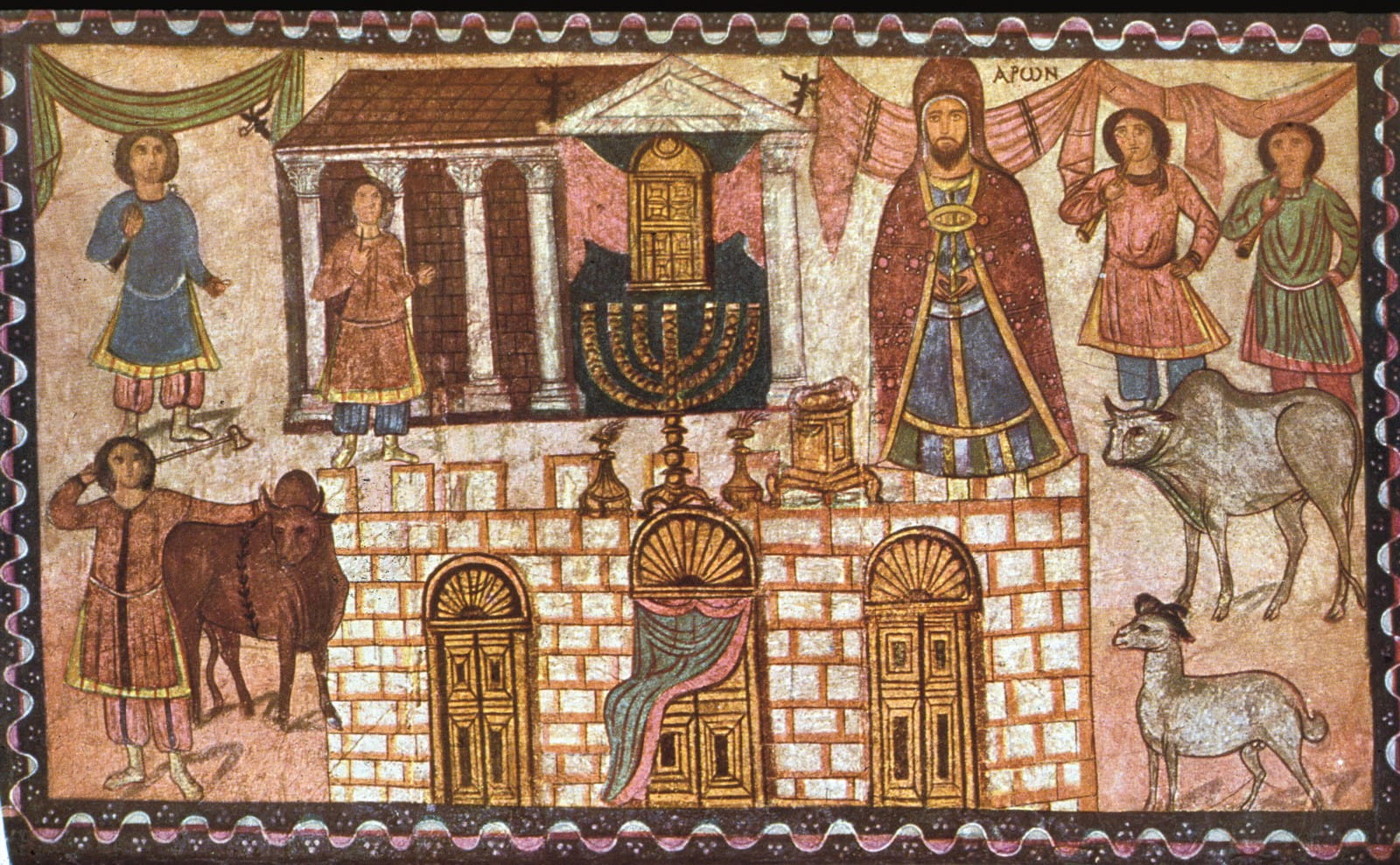
Twenty-eight of the Dura-Europos synagogue’s murals were preserved, probably half the original number. The west-facing wall, which contained the ark, survived in its entirety. The southern and northern walls retained about half their murals, and on the eastern wall, only part of the bottom row of decorated panels was intact. Most of the paintings depict biblical scenes, although they’ve been variously interpreted.
In the center of the western wall, which faces Jerusalem, a decorative niche was carved between two columns. This indentation apparently housed a Torah scroll, making this the earliest known example of such an ark. Such niches may have been a Diaspora innovation, arriving in the Holy Land only afterward. The two pillars were deliberately modeled on the two great copper columns known as Jachin and Boaz, built by Solomon at the entrance to the First Temple. The top of the niche is shaped like a scallop, an element used in various religions to denote sanctity. Above it, an image of the Temple is sandwiched between paintings of the binding of Isaac and likenesses of a lulav and etrog as well as the Temple’s seven-branched candelabra.
Lining the synagogue’s walls were two stone benches. The outer walls were decorated with carved flowers and geometric flourishes. In addition to the sanctuary, the building included other rooms, which enclosed a small courtyard.
When the murals were taken apart for storage in Damascus’ National Syrian Museum, an earlier synagogue was discovered. This more modest house of prayer held only around sixty worshippers, whereas the later structure (dedicated in approximately 245 CE) could accommodate double this number. The third-century renovation shows that the Jewish community (or at least the proportion attending this synagogue) must have grown considerably, constituting a fairly large Jewish presence.
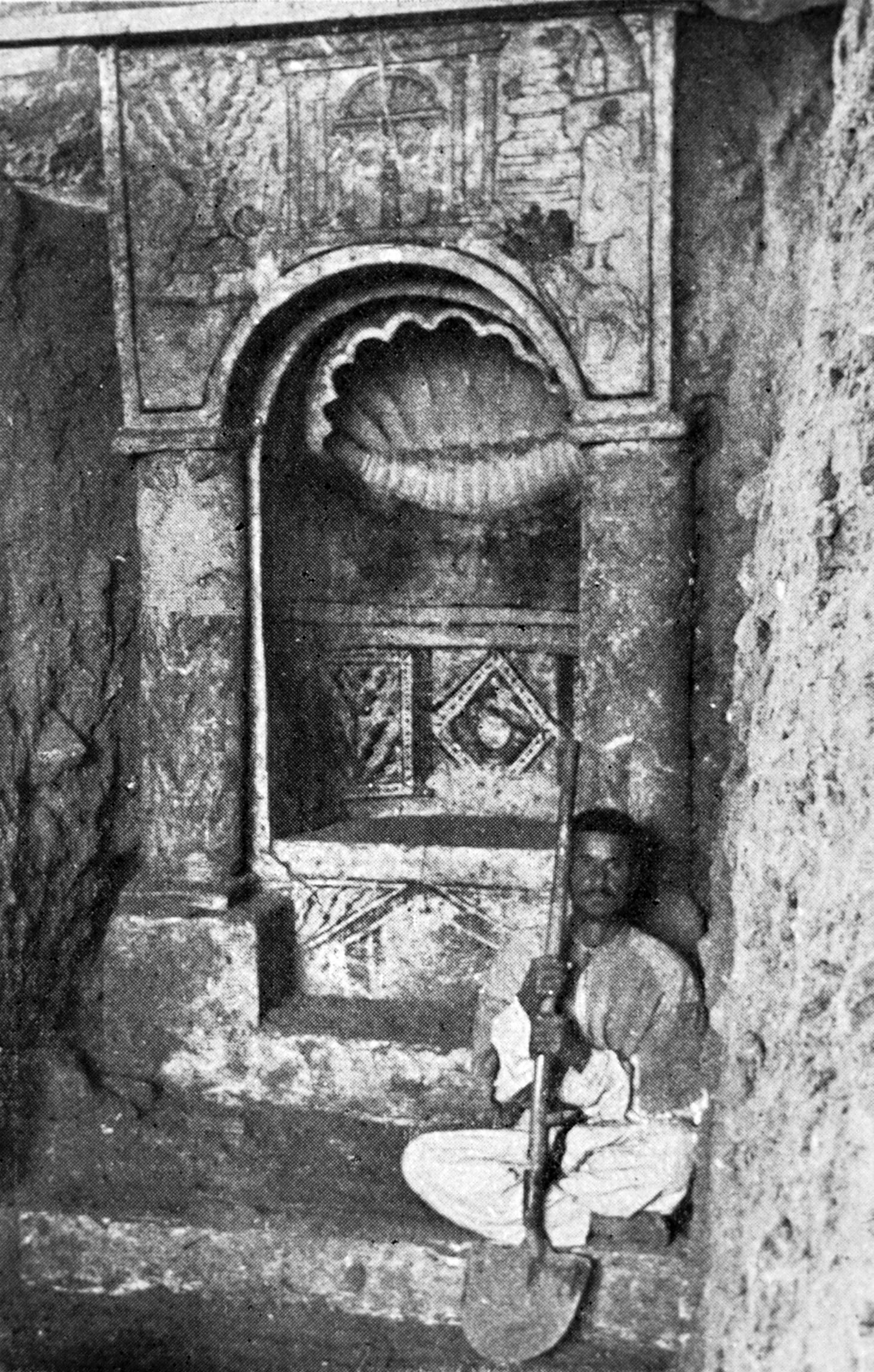
Excavation worker seated by the niche that evidently housed the synagogue’s Torah scroll. Photo from an article in L’Illustration, a French weekly, publicizing the discovery of this house of worship in July 1933 | Photo: Maurice le Palud

Founded around 300 BCE as Dura (“Fortress” in Aramaic), where an east-west trade route met the Euphrates, the town was renamed Europosby conquering Greeks. “Dura-Europos” is a modern designation. The Palmyrene Gate, the main entrance to the town of Dura-Europos | Photo: Heretiq
Not yet a Segula subscriber?
Access our full archive online, have print issues delivered to your door, and moreFeel free to share