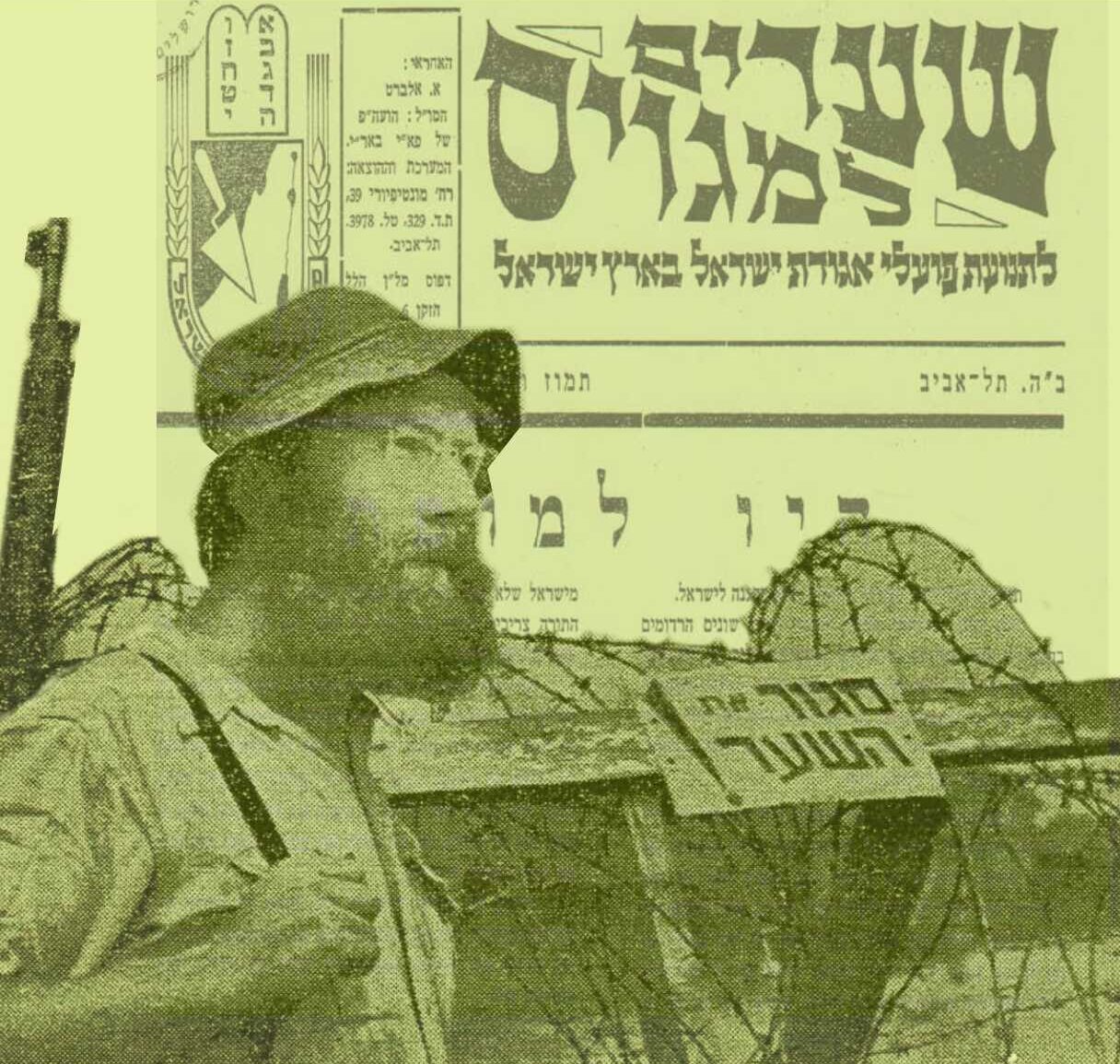
Though Israel’s ultra-Orthodox yeshiva students have long been exempt from military service, they weren’t always. In the struggle to secure what became the Jewish state, this camp’s rabbis and public figures were clear that their followers had to fight for Israel’s independence alongside everyone else

The Council of Great Sages (Moetzet Gedolei Ha-Torah), which governs Israel’s ultra-Orthodox sector, has traditionally opposed Zionism and boycotted Zionist institutions. However, during the feverish international negotiations leading up to the United Nations vote awarding the Jewish people a country, this rabbinical body joined forces with the rest of the Jewish community in the land of Israel. That’s partly because the rabbis were wooed by the Jewish Agency, which effectively ran the Zionist state in the making and presumed to represent the entire Jewish population.
Once the establishment of the state was inevitable, the ultra-Orthodox resolved to influence from within rather than remain outsiders, especially given the dangers facing the Jewish community in Mandate Palestine. With the Jewish people as a whole still reeling from the Holocaust, and displaced Jews uncertain of their final destination, there seemed only one realistic solution. A Jewish state would shelter all these homeless and eliminate assimilation, ensuring Judaism’s survival.
Safety and Security
In October 1947, the executive council of World Agudath Israel – representing the ultra-Orthodox – set up an emergency committee in Mandate Palestine to consult with the Council of Great Sages. Other issues would be addressed to a smaller council of scholars, who would confer with four senior rabbis from Jerusalem: Yosef Zvi Dushinsky; Isser Zalman Meltzer, dean of Etz Hayim Yeshiva; Yitzhak Zev Soloveitchik (the Brisker Rav); and Akiva Sofer-Schreiber.
On November 29, 1947, some three weeks before the UN vote to partition Palestine, the executive committee of the Council of Great Sages decided that Aguda (as the movement is abbreviated) would not work against the establishment of a Jewish state. Furthermore, the committee undertook
To send representatives of Aguda to the security committee [of the Jewish Agency] purely for safety and security purposes, with no ramifications regarding other places and branches of the Jewish Agency and the Jewish National Council, to which no representatives will be sent at present. (Agudat Yisrael Archive [Hebrew])
The hostilities following the UN decision prevented the executive committee from meeting and authorizing further measures. Two weeks later, during Hanukka, four members of the Council of Great Sages determined that Aguda representatives should present the army recruitment committee with their conditions for supporting enlistment. These four rabbis – Meltzer, Zalman Sorotzkin, Meir Karelitz, and the Hasidic Master of Sadigor, Avraham Yaakov Friedman – also formulated their requirements for allowing their community to join the military. These included an exemption for women and – temporarily at least – yeshiva students, no training on the Sabbath and festivals, and separate units for religious soldiers, allowing them to remain strictly observant during their army service. All these conditions were accepted by the committee.

Endorsing Enlistment
Aguda fliers and newspaper ads soon called on members to enlist, stipulating that doing so wouldn’t compromise their religious values. This campaign was addressed to the rank and file rather than yeshiva students, whose recruitment was still under discussion. Aguda constituents promptly arrived in droves for medical examinations prior to becoming combat soldiers. Ultra-Orthodox organizations took care of all their religious needs, troubleshooting each new issue as it surfaced.
Young Aguda (Agudat Yisrael’s youth organization) encouraged ultra-Orthodox youngsters to join the struggle for the prestate Jewish community’s survival, choosing an army service tailored to their religious lifestyle. Special editions of Young Aguda’s Diglenu (Our Flag) newspaper were geared toward them, and the organization also published a Letter to Soldiers periodically. Young Aguda’s Jerusalem branch even printed its own Letter to Soldiers when the city was under siege.
Aguda dailies and journals urged Jerusalemites to enlist at recruitment centers designated for the ultra-Orthodox. These appeals included glowing descriptions of army exercises and accounts of battle conditions. Journalists praised those who’d already signed up, with one Aguda paper even enthusing:
Our aim is not just to take care of Jewish dietary issues, but a much higher purpose: to return to the ancient and original form of warfare we once practiced against our enemies. These young men’s bravery and actions will sanctify the name of Heaven. (Ha-yoman, 19 Adar I 5708/February 29, 1948)

Yeshiva Regiment
As recruitment expanded, exemption criteria narrowed. Students in college, university, or post-high-school yeshiva programs were generally the perfect recruits. On the other hand, inasmuch as these young people were the future of the country, their needs had to be taken into account. After meeting with the directors of the Hebrew University in Jerusalem on February 16, 1948, David Ben-Gurion, as chairman of the Jewish Agency’s, declared:
Every student engaged in scientific research for military purposes will not be discharged from such work or deployed anywhere else. Other students should not be excused [from army service] completely, but some kind of continuity in their studies should be attempted, to the extent possible. (David Ben-Gurion, War Diary, 1948–1949, vol. 1 [Ministry of Defense, 1982], pp. 248–49 [Hebrew])
Jerusalem commander David Shaltiel thus gave university students defending Gush Etzion daily breaks to resume their studies.
Meanwhile, the Recruitment Census Office for National Service was negotiating with yeshiva deans regarding their students. Chief Rabbi Isaac Halevi Herzog’s archive includes a letter from the census office dated 2 Adar I 5708 (February 12, 1948) and detailing an acceptance “with understanding” of the deans’ request to defer student enlistment for three months, pending further review at that time.
As Arab armies were expected to invade the new state once the British Mandate ended, a state of emergency was declared on May 1, 1948, and all enlistment exemptions were cancelled in the Jerusalem area. This unilateral decision incensed the city’s ultra-Orthodox, and a new round of negotiation with yeshiva deans began. Ten days later, an agreement governing the draft and release of yeshiva students was finalized.
During May 16–28, nine hundred yeshiva students presented themselves at the Jerusalem recruitment office created for them. Some 270 – including Holocaust survivors and others suffering from malnutrition – were excused for health reasons. Another 260 – outstanding young rabbis and scholars – were exempt as per the agreement. The remaining 370 were deemed fit to serve.
Fierce battles were already raging in the Jerusalem area, especially after the Jordanian Arab Legion joined the fray on May 19. With neither time nor ammunition to train the yeshiva students, they were put to work sandbagging, building fences, digging shelters, and the like. Tuvia Bir led the group, known as Tuvia’s Regiment, and company commanders were selected from among the new recruits. Their rabbis were in constant contact and produced a monthly newsletter, Ha-mivtzar (The Fortress), distributed to other religious units as well.
Not yet a Segula subscriber?
Access our full archive online, have print issues delivered to your door, and moreFeel free to share