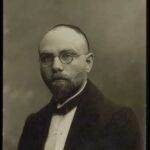
Shmuel Zvi Holzman is best known as the man who purchased the land that became the Etzion Bloc, but few are aware of his many globe-trotting ventures

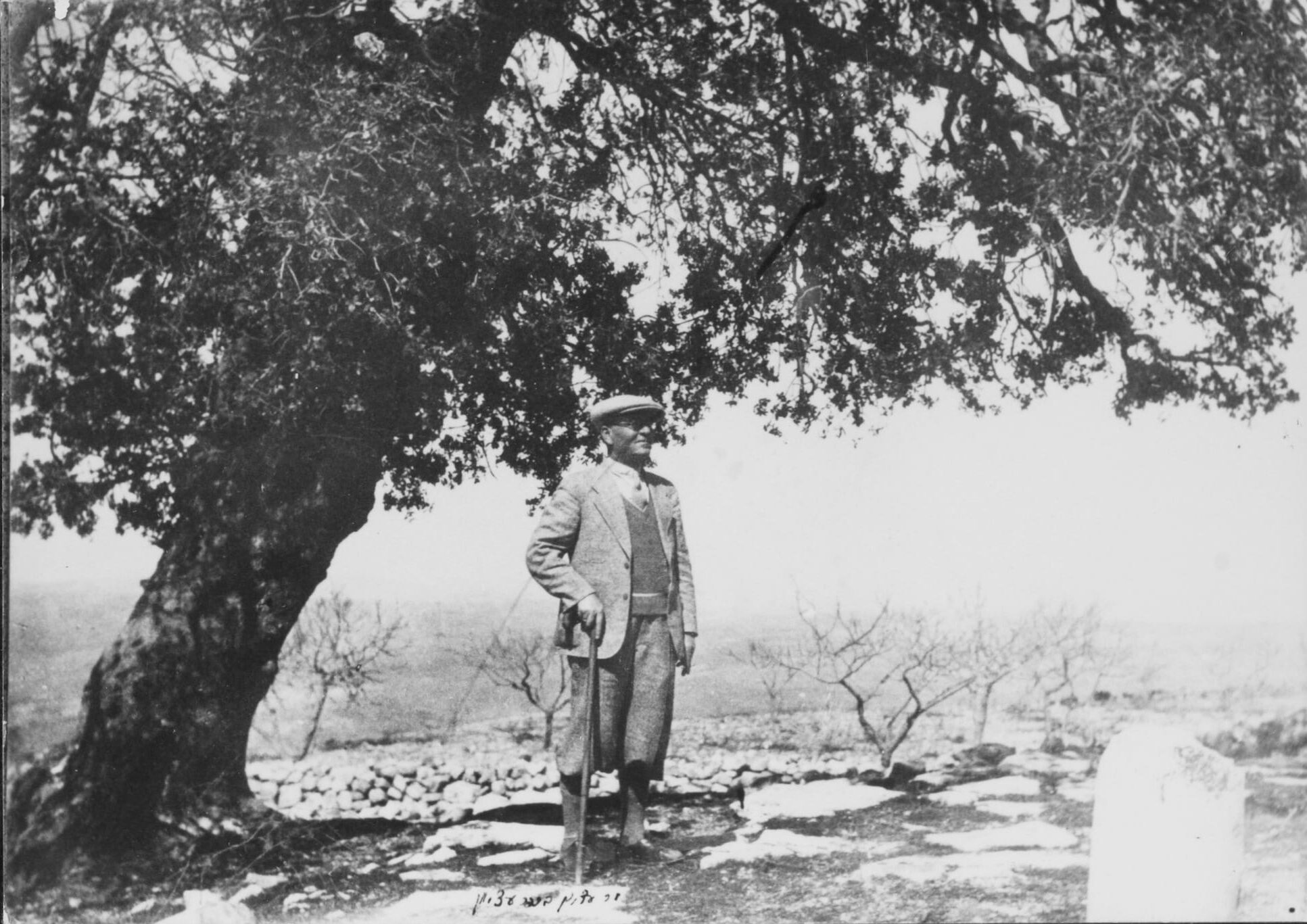
Shmuel Zvi Holzman is known as the father of the Etzion Bloc, the cluster of settlements just south of Bethlehem. He even named the area after himself, since etz, the first syllable of “Etzion,” means “tree” in Hebrew, as does holz in German. But Holzman’s purchase of the area in the 1930s (which proved to be almost the worst deal imaginable) is far from the sum total of his accomplishments. By age fifteen, he already had clear goals in life, and he spent the remainder of his days traveling the world to achieve them.
Young Man of the World
Shmuel Zvi Holzman was born on Rosh Hashana 1883 in Jerusalem’s Old City. His parents, Meyer Shimon and Esther Bayla (née Meshel), supported themselves in the Holy Land by means of sophisticated grape presses they’d brought with them from Belarus for use in the wine industry.
Young Shmuel Zvi was gifted beyond his years. Despite his almost total immersion in Jewish studies, he was fascinated by botany. With no room in the Old City’s Jewish Quarter for gardens, he grew his own small but impressive flower bed on the roof.
When Shmuel was fifteen, his parents sent him to an American rabbinical school, expecting their son to come back a communal leader. Yet the Jewish Theological Seminary was the last place he wanted to be. Roaming the streets of the land of opportunity, he wanted to make it big in business.
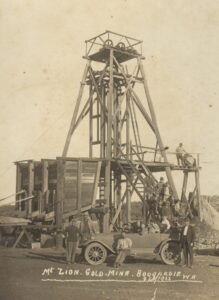
Hearing rumors that Australia was filled with gold, Shmuel packed his few belongings and sailed across the world. By age seventeen, he was running his own gold mine in Western Australia. Enjoying unprecedented success, Holzman invited his brother in Jerusalem to join him. They named their mine “Mount Zion,” reflecting their longing for home.
For three years, Shmuel’s brother managed Mount Zion while his elder sibling cut deals in New Zealand, South Africa, South America, and even Malaysia. By age twenty, Holzman was fabulously rich, trading on his warmth, charm, and confident, professional appearance. Interviewing him some thirty years later, journalist Ouri Kessary wrote:
He was of average height, suntanned, and wore his white shirt sleeves rolled up, along with a wide-brimmed straw hat and spectacles, through which lively, intelligent eyes looked out, having already seen a thing or two in all manner of climes, times, and fates. The introductions are quickly made, and we’re friends at once. It’s hard to be distant with Mr. Holzman. There’s something of the sailor’s familiar cheer in his speech. (Ouri Kessary, “An Inexhaustible Wellspring of Energy and Activity,” Do’ar Ha-yom, October 20, 1932, p. 2 [Hebrew])
Despite his success, Holzman was homesick, and by 1903 he was back in the Holy Land. Yet he seemed determined to bring some of the big, wide world with him; for the rest of his life, he invested all his fortune and energies in agricultural experiments designed to breathe a new spirit into dusty Ottoman Palestine.
Holzman began with an exotic orchard, hoping to show that the land of Israel could grow more than oranges and clementines. Four years in the making, the project included a sprinkler system that was the marvel of farmers for miles around, drawing a steady stream of curious onlookers.
Special Species
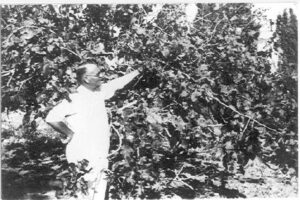
Holzman was extremely friendly with another Zionist associated with agriculture – Avraham Ze’ev Gordon. Part of the first wave of Zionist immigrants, Gordon had settled in Rehovot, then bought a farm in Rishon Lezion and built a magnificent home there (which later became the London Hotel). In 1905, at age twenty-two, Holzman married Gordon’s pretty daughter Ayelet (Hinde), and two years later the couple set out for the Far East. They collected a hundred tropical and subtropical species, including various types of bananas, for acclimatization in Holzman’s nursery in Rishon. Most came from Singapore, but a few Thai saplings introduced the land of Israel to the pomelo.
Holzman loaded all these goodies onto a ship customized with a builtin watering and climate control system – extremely advanced for its time – to keep his delicate plants alive all the way to Jaffa. When the vessel finally docked there, however, Ottoman officials quarantined it indefinitely to protect indigenous species from imported crop diseases. Bribery proved useless, and Shmuel watched in despair as his vegetation wilted.
Five weeks later, Holzman was finally allowed to move his precious flora to Rishon Lezion, but only a third had survived. He planted these saplings in his experimental orchard and fought fiercely to maintain each and every one. His dedication paid off: in just five years, his pomelos were all over the Holy Land and even exported to Europe. Some botanists insist that the bananas growing throughout the region today were also “descendants” of this historic shipment.
In 1912, Holzman developed a new fixation – raising ostriches for the Egyptian fashion industry, whose ladies’ hats required frequent re-feathering. Having briefly owned a profitable ostrich farm in Capetown in 1899, Shmuel set off for the Dark Continent to bring back some young specimens, only to discover that South Africa had outlawed all such exports. He turned instead to Sudan, acquiring eleven baby ostriches, which he housed at first at his in-laws’ in Rishon Lezion. The local children loved their new neighbors, but Holzman soon transferred the brood to his experimental plantation, where they doubled as a form of ecological weed and pest control.
Yet ostriches can be vicious when annoyed – as Holzman found out after narrowly escaping death in a pitched battle with one of his flightless charges. Furthermore, the birds had trouble adapting to the Middle East, and within a few months, half had perished. Fortunately, the rest proved hardier, providing their delighted owner with both plumage and eggs galore, and Holzman proudly added “ostrich-breeder” to the title of “horticulturalist” already gracing his calling card.
Not yet a Segula subscriber?
Access our full archive online, have print issues delivered to your door, and moreFeel free to share