
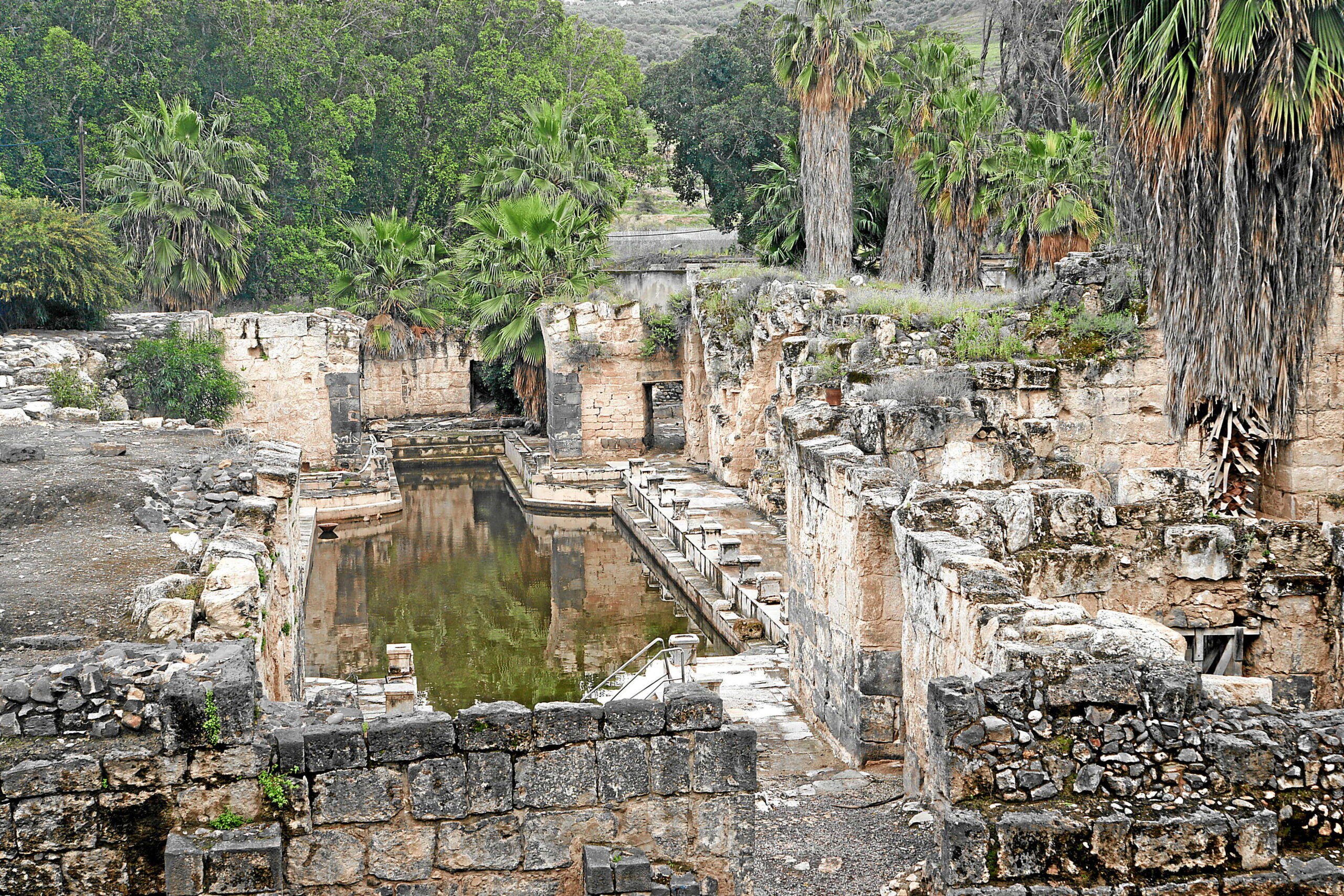
From ancient geological wonder to crocodile spa, Hamat Gader has gone through many incarnations and as many hands. Despite its pagan statues, its hot springs drew even the Talmudic sages

Where To?
Hamat Gader
Historic baths and synagogue from the late Roman period

Israel is fortunate enough to sit safely on the western edge of the Syrian-African Rift. The rift valley’s eastern side is still drifting north, centimeter by centimeter, such that in a few centuries (or perhaps millennia), the Arab-Israeli conflict will be resolved by the forces of nature alone, as the Syrians find themselves parked in Asia Minor with the Turks rather than in Israel’s backyard. Meanwhile, we can enjoy the rift’s fringe benefits along the Jordan Valley: the three liquid jewels of the Dead Sea, the Sea of Galilee (the only one of them that’s potable), and beautiful little Hamat Gader.
Southeast of the Sea of Galilee and the banks of the Yarmuk River, the rift runs so deep that boiling mineral water from an aquifer two kilometers underground spurts joyfully upward. Brimming with sulfur, magnesium, and potassium – plus a couple of radioactive isotopes of radium and radon – it offers a bubbling natural experience for lovers of the extreme.
Levantine Hot Spot
The Romans, always on the lookout for a luxurious bath, were the first to harness the water’s healing properties some two millennia ago. Hearing of the seething pothole in the southern Golan Heights – near the Hellenist town of Gadara, long known as Hamat (meaning “Warm”; see Joshua 19:35) for its hot springs – they soon located the sources of four such springs and one cold, clear one. The place was soon provided with all the amenities of a well-appointed Roman spa complex – caldarium, tepidarium, fridgidarium, etc. Sprawling over five hundred square meters and tastefully decorated with statues, marble pillars, and fountains, it had wading pools set around the largest hot spring of all, Ain el-Maqle.
Reeking of sulphur, this spring could cook you at 52º Celsius (126º Fahrenheit); hence its nicknames: “the Frying Pan” and “Hell.” Like any standard spa, the Roman baths in Hamat Gader boasted several pools, in which cold water was carefully added to hot to reach different temperatures. Each of the seven pools was located in its own hall, and visitors traded tips about which pool cured what ailment. There was even a pool reserved for lepers.
As the healing process involved repeated immersion over an extended period, most visitors stayed nearby. The site’s off-the-beaten-track location necessitated fine dining and entertainment to stave off boredom, and the Romans made the place a Middle Eastern mini–Las Vegas. It had ample guesthouses, a theater seating two thousand, as well a pagan temple where sacrifices and incense could be offered to bolster the mineral waters’ effect. A Roman inscription on the premises honors Emperor Antoninus Pius (138–161 CE), who evidently contributed generously to their development. His investment paid off: Hamat Gader’s fame spread far and wide. As the fourth-century Greek historian Eunapius enthused:
Gadara, a place which has warm baths in Syria, inferior only to those at Baiae in Italy, with which no other baths can be compared. (Eunapius, Lives of the Philosophers and Sophists, Loeb Classical Library, vol. 134 [1921], p. 369)
Statues and Sages
Gadara’s pagan atmosphere didn’t stop the sages of the Mishna from enjoying its health benefits, ignoring the half-naked Roman statues gazing down on them. The rabbinic literature of the period mentions Hamat Gader dozens of times. Scholars patronized its inns, and Rabbi Hama bar Hanina even noted the size and flavor of the miniature eggs he and his colleague were served for breakfast (Jerusalem Talmud, Terumot 2:1). Rabbi Yehuda Ha-nasi, editor of the Mishna, was a frequent visitor (ibid., Shabbat 4:2), and some sages even permitted bathing there on the Sabbath (Babylonian Talmud, Shabbat 109a).
The baths were apparently so inspiring that many halakhic rulings originated there. For instance, Rabbi Yehuda Nesiya, grandson of Rabbi Yehuda Ha-nasi, determined during one of his stays that the child of a Jewish woman fathered by a slave or a non-Jew isn’t an outcast (mamzer) (Jerusalem Talmud, Kiddushin 3:12).
The poolside contact between Jews and non-Jews raised no few issues, as in the unfortunate case of Rabbi Ami, who pricked his finger while visiting Hamat Gader with Rabbi Yehuda Nesiya and required immediate medical attention, resulting in a discussion of the permissibility of treatment by a non-Jewish doctor. (ibid., Avoda Zara 2:2) On another jaunt to Gadara, the pair borrowed silver dishes from some Romans and wondered if they had to be purified in a mikveh prior to use by Jews (ibid. 5:15).
Hamat Gader’s wealthy Jewish clientele evidently warranted the erection of a generously proportioned prayer house, extended in the fourth century into an enormous, elaborate synagogue complete with mosaic floors dedicated in Aramaic (as opposed to Latin or Greek) to kind donors from Zippori (Sepphoris), Kfar Akaviya (just east of the Sea of Galilee), Capernaum, Tiberias, Arbel, and even Gadara itself. The main inscription heaps praises on six well-feathered donors, all from one family, whose contribution was outstanding:
And remembered be for good Kyris [Master] Hoples and Kyra [Mistress] Protone and [Master] Sallustius his son-in-law, and Comes Phroros his son and [Master] Photios his son-in-law and [Master] Haninah his son – they and their children – whose acts of charity are constant everywhere (and) who have given here five denarii (of) gold. May the King of the Universe bestow […] blessing upon their work. Amen. Amen. Selah. (E. L. Sukenik, “The Ancient Synagogue of El-Hammeh” The Journal of the Palestine Oriental Society 15 [1935 (1955)], p. 131)
This tribute was framed by a circular medallion and ornamented with a pair of lions and two graceful cypresses. Much of the original synagogue walls remain, including some arches and a few ornate capitals from fallen columns. The dedication, however, now decorates the entrance to Israel’s Supreme Court building in Jerusalem.
Not yet a Segula subscriber?
Access our full archive online, have print issues delivered to your door, and moreFeel free to share