Though the planet’s lowest point might sound like hell on earth, a few crazy dreamers discovered its heavenly promise of health and beauty. The story of Dead Sea Works’ rise from the sands

Where To?
Northern Dead Sea
Potash Works Commemorative Site and Moshe Novomeisky
Visitors and Heritage Center

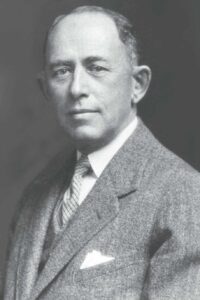
Who could have imagined that a son of Jewish gold miners in frozen Siberia would carry on the family tradition in equally stark but utterly opposite conditions? Born in 1873, Moshe Novomieski, grew up so enamored of his father’s occupation that he too joined the Siberian mining industry. In 1911, arriving in the Middle East at age thirty-eight to evaluate the region’s mineral potential, he discovered the joy of temperatures above freezing. A few years later, he ditched his fur coats and kolpak hat, packed up his family, and boarded a ship carrying the first wave of postwar immigration to the land of Israel.
From Moses to Moses
Word of Gedera’s new Siberian farmer soon brought Jewish laborers knocking at Novomieski’s door. One of them was another Siberian Moses, twenty-year-old Moshe Langutzky. The two became friendly and, perhaps due to their mutual frosty experiences, settled on a mining project in their new homeland’s hottest spot – the Jordan Rift Valley and the Dead Sea.
Beginning in 1925, while Novomieski negotiated with the British Mandate government for a license to extract minerals from this lowest place on earth, Langutzky spent two and a half years surveying the Dead Sea’s northern shore. Extracting potash and bromide from its warm waters in the desert heat, he surely felt somewhat nostalgic for the frigid climate he’d left far behind.
Potash is an excellent fertilizer, while bromine chloride is used as a disinfectant in pharmaceuticals. Both minerals are therefore valuable commodities, and Langutzky’s promising experiments assured his partner of the venture’s profitability. So Novomieski raised capital and hired Jews idealistic enough to submit to backbreaking labor in the searing sun and dusty air.

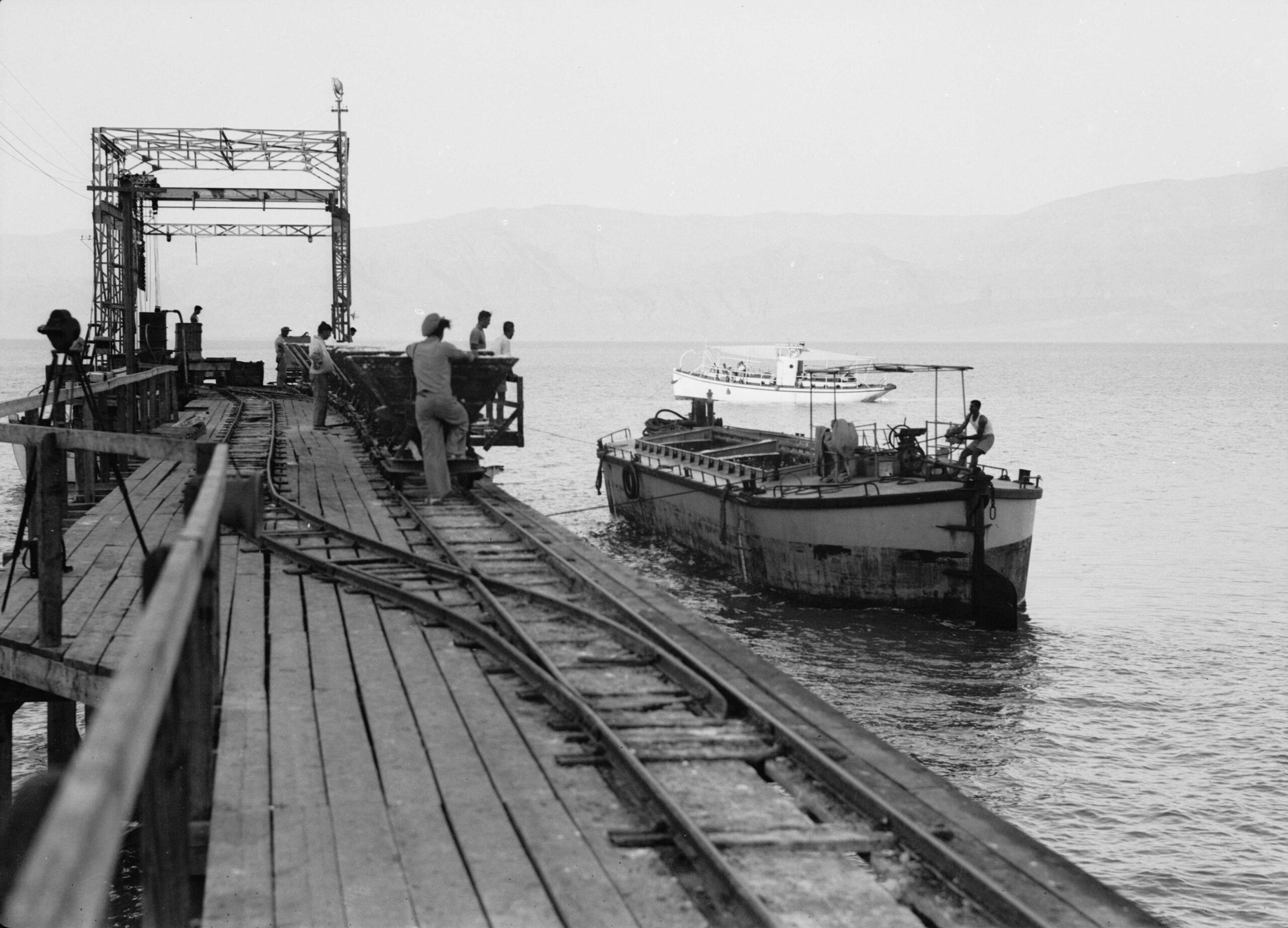
The licensing process took another two years. With Jordan’s new Hashemite Kingdom on the Dead Sea’s other shore, the British left Novomieski hanging while they tried to interest the Jordanians in the deal. Meanwhile, Langutzky and his sweaty pioneers kept the experimental station going, building evaporation ponds, pumping them full of Dead Sea saline, setting up a transportation system along the shore, and operating heavy machinery in 40º Celsius (104º Fahrenheit) in the shade, if you could find any.
Finally, after both the Mandate government and the Hashemites had read the fine print, Novomieski got the go-ahead for Palestine Potash Ltd., or the Land of Israel Potash Co.
High Winds on the Lowest Sea
After celebratory cheers, champagne toasts, and hora dances, Novomieski faced a major logistical problem: how to eliminate his Jerusalemite workers’ long, daily commute via Jericho to the shores of the Dead Sea? Though ostensibly evenhanded, the Mandate government prohibited Jewish work camps on state land in the Dead Sea region, but Novomieski’s stubbornness eventually secured permission to build such facilities on the northern shore.
Langutzky suggested opening a second plant some eighty kilometers south, in the lower Dead Sea basin. Mineral concentrations were much higher there, promising significantly lower extraction costs, plus the salt deposits on the shore next to Mount Sodom were a perfect natural sealant for the company’s evaporation ponds, preventing the brine stored there from seeping away.
Yet there were two drawbacks: the heat in the Dead Sea’s southern basin, and no springs to provide drinking water or cool the proposed factory’s equipment. The lake’s water levels were also relatively high that season, leaving no room for a road along the western shore. The only way to the Sodom salt marsh was thus an hour’s trip by motorboat, meaning workers would be cut off from their families for weeks if not months at a time.
Novomieski insisted that no one, not even the most dewy-eyed idealist, would tolerate such impossible conditions. Langutzky, hardened by his years in the burning heat, countered that he could find men to work anywhere.
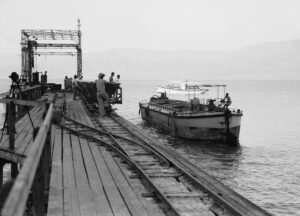
He was right. From all over the country, twenty young men from socialist work battalions and the United Kibbutz Movement’s defense units turned out, hoes in hand, to conquer the Dead Sea. On May 1, 1934, amidst May Day festivities, they boarded the SS Callirrhoe (named for an ancient harbor on the lake’s eastern shore) at the port on the Dead Sea’s northern bank, sailing into the unknown to the tune of “The Internationale,” the socialist anthem, followed by its Hebrew equivalent, Tehezakna (Be Strong). In their wake, barges loaded with building materials, machinery, food, and water were pulled along by the ship.
Just as prospects seemed rosiest, with a Hebrew work camp destined to rise from the salty sands, everything went topsy-turvy as surely as in a classic farce. The sea suddenly turned rough, heavy rain ruptured the ship’s mast, and the barges broke away and disappeared in the waves. The workers were stranded!
At dawn, one boat was found waterlogged, its planks split and leaking, on a sandbank near Masada. The second was a slight distance away to the north. Part of it was unloaded there, and the Callirrhoe sailed on with the boats to the southern shore. A guard was left to take care of the cargo abandoned at Masada. On May 2, after a three-hour journey, they reached the shore by Mount Sodom. That very day, hammers flew and the first stakes were set for the factory. (“Linchpin of Jewish Settlement in Sodom,” from Israel Even-nur’s diary, quoted in Abraham Ya’ari, Memories of the Land of Israel [1947], vol. 2, p. 1230 [Hebrew])
Not yet a Segula subscriber?
Access our full archive online, have print issues delivered to your door, and moreFeel free to share