Guerilla leader turned charismatic statesman, Jonathan the Hasmonean exchanged his daring tactics for shrewd diplomacy to take the Hasmonean rebellion center stage

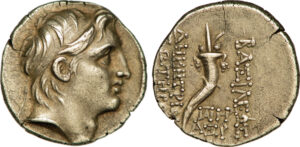
The year 160 BCE found the Hasmonean family in a sorry state. Judah had fallen in battle, his army decimated and the Maccabee rebellion all but quashed. Seleucid king Demetrius I Soter controlled Judea with his powerful army. In the Temple in Jerusalem, it was business as usual. The religious decrees had been repealed and the priesthood restored, with Alcimus serving as high priest. Ostensibly, the rebellion should have ended there. Judah himself had made a truce with the Seleucid kingdom, and most Judeans had no problem living under foreign rule. There seemed nothing left to fight for.
But Alcimus soon proved even worse than his predecessor, Menelaus, and the Seleucid government was too weak to protect the pious Jews of Judea. Some identify Alcimus as none other than Jakim of Zerorot, an infamous tax collector and nephew of Jose son of Joezer of Zeredah, one of the generation’s outstanding Jewish leaders. If so, Alcimus was responsible for assassinating his uncle and killing many of his disciples. In any case, Alcimus didn’t last long. Whether he committed suicide (according to the Midrash) or died of a stroke (as in I Maccabees 1:9), his death left the Temple without a high priest and the Hellenists in Jerusalem rudderless.
It was a grim picture: the Hellenist ruling class had no popular support and no one to state its case to the authorities. With no high priest, much of the Temple ritual was simply abandoned. And in the hills around the city, a group of guerrilla fighters with widespread grassroots backing struggled to maintain a toehold despite being constantly hunted down. In Syrian Antioch, meanwhile, young and energetic King Demetrius also had his problems. His popularity was eroding rapidly, and worse still, he had embroiled himself in a prolonged conflict with the emerging superpower, the Roman Republic.
Lessons in Diplomacy
Why the Maccabee rebels chose Jonathan as their new leader over his older brother Simon remains a mystery. According to the book of Maccabees, Mattathias had designated his sons Judah and Simon as military commander and political leader, respectively, leaving Jonathan out in the cold. But he turned out to be an excellent choice. Jonathan had a good eye for opportunity – and the patience to wait for the right moment to exploit it. Personal charm in no small measure helped him win the Seleucid king’s confidence, turning the latter’s anger to sympathy on more than one occasion. Cautious and sensible but also extremely shrewd, he was as skillful a diplomat as he was a warrior. From brother Judah’s alliances with Seleucid general Lysias and with Rome, he had learned that agreements with the enemy must be backed by a strong power if they are to be honored. Bitter experience taught him to see such treaties as mere stepping-stones to the next pact. And Jonathan understood that the promises made in one round of negotiations, formalized or not, came back to haunt you as the starting point for future talks.
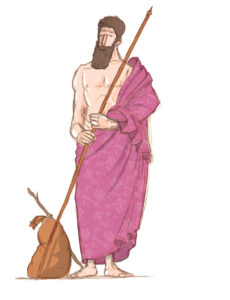
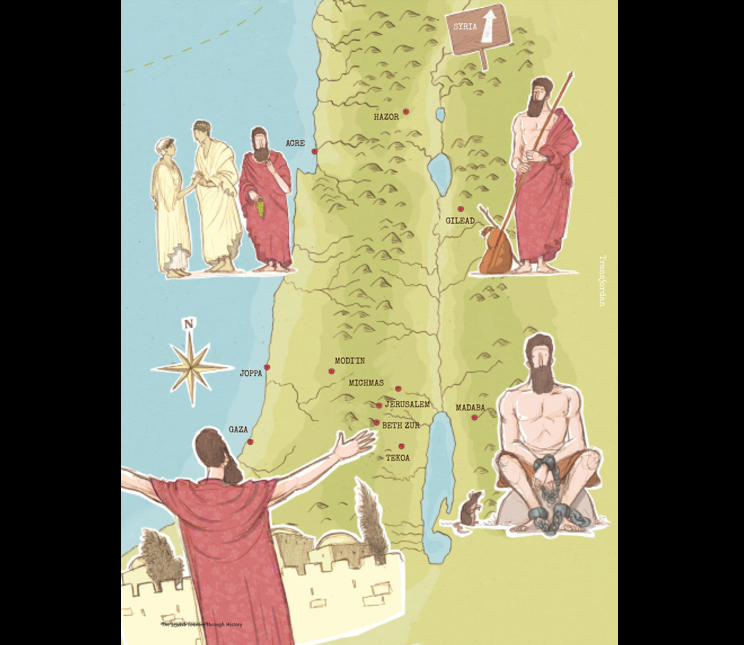
At first Jonathan avoided direct military confrontation with the Seleucids, preferring guerilla warfare to consolidate his position in the Judean Hills. His patience paid off when Bacchides, the Seleucid general who had defeated Judah and was now military governor of the province, realized he was wasting time and resources in Sisyphean pursuit of the rebel forces. Bacchides concluded that he would be better off recognizing Jonathan, the people’s favorite, as their authentic representative instead of some member of the corrupt Hellenist establishment. Jonathan was given license to operate from Michmas, granting him official status in the eyes of the Seleucids – a turning point for the Hasmonean family. Time was also on his side. The Middle East was in turmoil, with major geopolitical changes under way – the perfect opportunity for Jonathan to prove his skills and put his keen political instincts to the test.
Expert Juggler
Instability and violence, the result of Seleucid infighting as well as regional conflict, characterized Jonathan’s fifteen-plus years of military and political leadership of Judea. He exploited this unrest, juggling the warring powers and chalking up gains for his people and country. To understand his frequent zigzags in foreign policy, we must first identify the key players.
On one side of the Mediterranean Basin was Rome – the rising power and a force to be reckoned with. The Romans had already dictated terms of surrender to the warring Ptolemies and Seleucids during the reign of Antiochus III (the Great), when they held members of the Seleucid ruling family hostage in Rome. The Roman Senate took decisions as a group, so the rise and fall of specific individuals influenced policy much less than in the divided Hellenist empires, where each change of ruler could alter the delicate balance by which the Ptolemies and Seleucids alternately dominated the region. The events of Jonathan’s tenure took place against an increasingly Roman backdrop, both militarily and politically; the Roman Republic sacked Corinth and Carthage, overturning the old order and ensuring that every kingdom in the area included Rome in its calculations and decisions, including its choice of leader.
Not yet a Segula subscriber?
Access our full archive online, have print issues delivered to your door, and moreFeel free to share