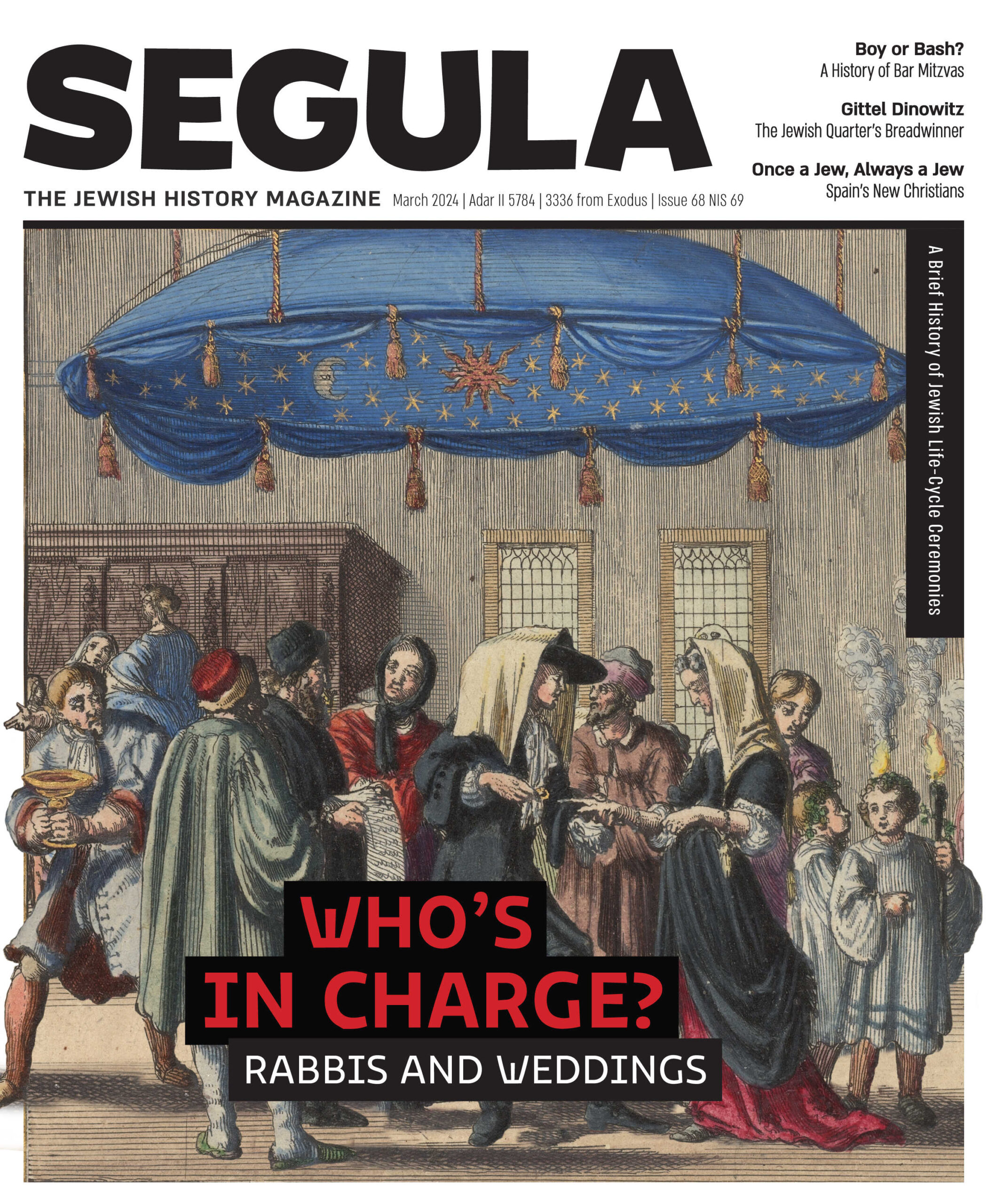

Rabbis have officiated at weddings for centuries, but the Talmud mentions no such practice. So how did Jewish clergy become an integral part of the ceremony?

Many human endeavors begin spontaneously but gradually become so institutionalized that authorization is required. For instance, the ancient art of healing has evolved into the science of medicine, in which practitioners must be not just knowledgeable and experienced but certified MDs.
This phenomenon applies to Jewish marriage as well. In the Talmud, the creation of such a union requires no more than a man gifting something valuable to a woman in the presence of two witnesses for the express purpose of matrimony, and her accepting the item with that in mind. Talmudic literature details countless marriages and divorces, all performed without supervision. Rabbinic authorities get involved only when complications arise, as in the following example:
An incident occurred involving five women, including two sisters, in which a man gathered a basket of figs […] and declared, “Behold, you are all betrothed to me with this basket,” and one accepted it on behalf of all. The sages ruled: the sisters are not betrothed. (Mishna, Kiddushin 2:7)
The Talmudic sources all describe a man betrothing a woman with no rabbi (or anyone else) performing any ceremony. So how did the role of officiant develop, and when did it become reserved for rabbis?
Ordination
Actually, the position of community rabbi also has a history. Ever since the Second Temple period, local religious leaders have addressed halakhic matters both communal and personal. However, the official rabbinic position known in Aramaic as mara de- atra, “master of the location,” is less ancient and doesn’t even appear in the Talmud. The relationship between rabbi and community was formalized as late as the medieval period, and according to scholar Prof. Mordecai Breuer, the rabbinate became an Ashkenazic profession – complete with ordination documents – only in the 14th century.
Communal politics swiftly surrounded the new, paid position, with power struggles between established rabbis and up-and-coming rabbinic talent. With personal incomes at stake, incumbents accused their competition of professional trespassing.
One example, cited by Rabbi Yitzhak bar Sheshet Parfat (acronym Rivash) in a responsum, concerns two French rabbis in the 1380s. Rabbi Isaiah Astruc, leader of the Savoy Jewish community, aimed to become chief rabbi of France. He therefore decreed:
All bills of divorce and levirate release issued without Rabbi Isaiah’s permission by any rabbi attempting to settle in France shall be invalid; [any such rabbi’s] books are those of an idolator. (Responsa of Rivash 271)
Yet the rabbi of Paris, Johanan ben Mattithiah Treves, son of the country’s previous chief rabbi, aspired to succeed his father, only to have his authority undermined by Rabbi Isaiah’s proclamation. Rabbi Johanan turned to Rivash, head of the Spanish Jewish community of Zaragoza, for help. The resulting responsum discussed the origin and nature of the halachic authority bestowed by ordination. Rivash wrote that the Talmudic chain of rabbinic ordination had been broken, making its contemporary equivalent much less binding. Therefore no rabbi could impose his authority.
Such is the ordination customary in France and Ashkenaz. When a student becomes capable of teaching […], he is rabbinically forbidden to do so without his teacher’s permission […] That is to say: he is henceforth no longer a student; rather, he’s worthy of teaching others anywhere and deserves the title “rabbi.” (ibid.)
In other words, according to Rivash, ordination stems not from the relationship between a rabbi and his community, but from that between a scholar and his teacher. No rabbi’s authority is territorial.
Rivash’s response notwithstanding, the trend toward granting rabbis local jurisdictions seems only to have gained momentum in the region in question.

The local rabbi was part of the community leadership but not necessarily the exclusive authority. Klezmer musicians dominate this portrayal of a Jewish wedding procession by Wincenty Smokowski, 1858 | Courtesy of the Warsaw National Museum

It only takes two to tango – or to wed – in this medieval illustration featuring bride and groom. Festival prayer book, Leipzig, 1320 | Courtesy of ANU – Museum of the Jewish People
Not yet a Segula subscriber?
Access our full archive online, have print issues delivered to your door, and moreFeel free to share