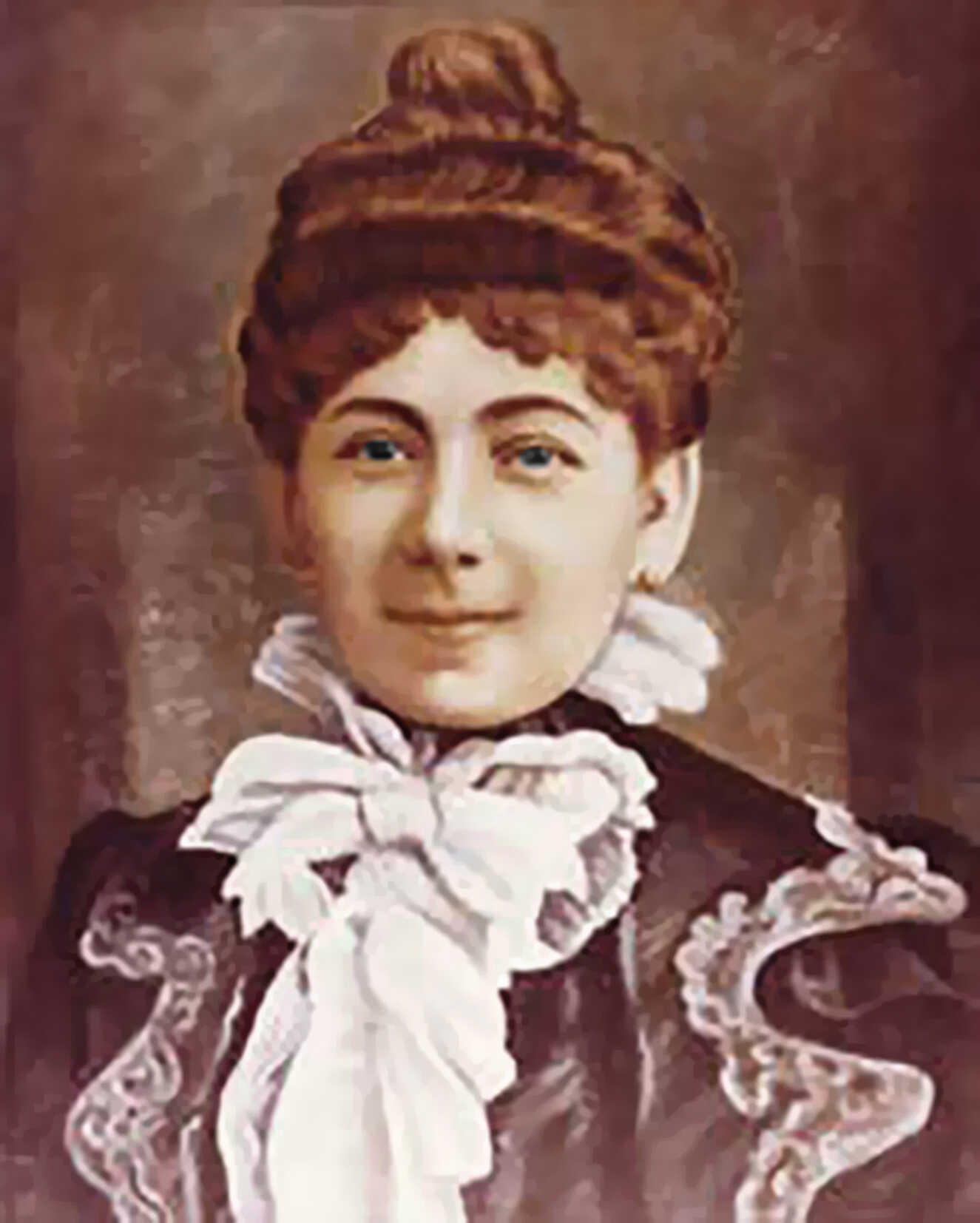
Very few know anything about her, and even the street sign bearing her name says precious little. Yet Gittel Dinowitz was a pillar of pre-state Jerusalem’s Old City, her leadership growing out of the store she ran through thick and thin, siege and scarcity

Jerusalem contains only 72 streets named after women, versus 1,035 named after men. In other Israeli cities, the proportions are about the same. In Tel Aviv, for example, you’ll find only 61 streets celebrating women, as opposed to 878 commemorating men. Although men have certainly maintained a higher profile throughout history, it can’t be that women’s impact – especially in the land of Israel – amounts to just 7 percent of that of the opposite sex. We can only speculate that the women immortalized on street signs were special or exceptionally well connected, thereby winning over the various municipal naming committees.
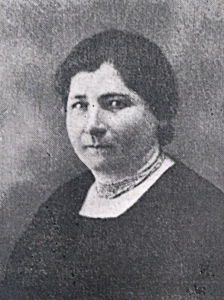
One of those rare women who’ve merited a Jerusalem street of their own is the obscure Gittel Dinowitz. The unassuming alley named after her branches off from Jaffa Road, opposite the Mahane Yehuda market. Googling “Dinowitz” yields mainly news of the goings-on on her street: an apartment for sale here, a new clinic there, etc. The few results pertaining to Gittel herself provide scant information, copied from one site to another, and focus primarily on her late husband or her civic-minded son Avraham. Even Wikipedia is silent. Her own street sign sheds little light, describing her only as “Woman of valor and defender of Jerusalem, 5639–5699.” Her tombstone on the Mount of Olives is equally unhelpful, paying tribute to “A woman of valor and much activity.” So who was this mysterious woman?
Jerusalem-Bound
Gittel Berakha Schlessinger was born in 1879 in the tiny Russian town of Topchiev, near Bryansk. Her father, Yosef Nahum, was an affluent Orthodox Jewish merchant who sought a better Jewish life for his children. So the family headed south to the vibrant Jewish community of Odessa, on the Black Sea coast. In this cosmopolitan bastion of Jewish culture, creativity, and modern Hebrew, Gittel came of age. Equipped with a modern Orthodox Jewish education, she grew into an independent, intelligent Jewish woman with a flair for commerce.
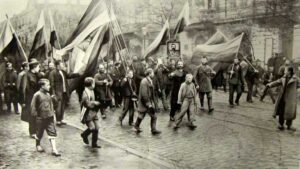
At age twenty, Gittel Schlesinger met young Yitzhak Yaakov Dinowitz of Pinsk, manager of a large food store in central Odessa. The two were wed, and Gittel worked in the shop while raising their children, who were born in swift succession. This family and its thriving business might have simply stayed in Odessa had revolution not broken out in October 1905, forcing the tsar to grant the Russian people civil and political rights. As usual, those who objected to these developments vented their anger on the Jews, unleashing pogroms throughout Russia. One of the hardest-hit Jewish communities was Odessa. Within days, hundreds were murdered, with Jewish stores looted and torched. Saved by the skin of their teeth, Gittel and her husband decided to liquidate their business and emigrate to Jerusalem.
Perhaps they set their sights on the Holy City in particular because Sarah, Yitzhak Yaakov’s sister, already lived there. Sarah had come to Jerusalem in her youth to support her grandfather, who’d joined the city’s growing community of pious, elderly Jews. Her husband, fundraiser Yaakov Yehuda Reichman, spent most of his time abroad, so she became the family breadwinner, running a stationery store and print shop on Ha-yehudim Street, in the Old City.
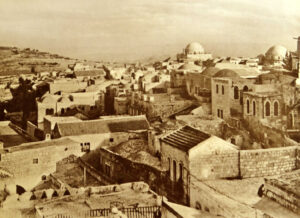
Yitzhak Yaakov set off for Jerusalem alone to pave the way for his family. Purchasing a large store next to his sister’s, he opened the Dinowitz Trading House, situated among the city’s first Jewish wholesale establishments. Dinowitz also acquired a large, half-underground space behind his shop, which he used as a warehouse. Meanwhile Gittel closed the store in Odessa, and early in 1906, along with her three children and elderly mother-in-law, she reunited with her husband in Jerusalem.
Joint Venture
The Dinowitz Trading House took off, thanks to a fruitful division of labor between its proprietors. Yitzhak Yaakov shuttled regularly between Jerusalem and Europe, importing wholesale foodstuffs and household goods, while Gittel ran the store and raised her six surviving children (four others perished in their youth).
The new emporium was a breath of fresh European air in Jerusalem, offering delicacies the city had never known, such as salted, pickled, and smoked fish, barley and potatoes, and the latest in household contraptions, attracting Jerusalemites of all nationalities. The Dinowitzes’ large warehouse was filled with jumbo canned goods purchased by eateries, hotels, grocery stores, and institutions both Jewish and not throughout the city. Merchandise was displayed European-style, on tidy shelves. And while other vendors required customers to scoop goods out of sacks and into their own baskets, the Dinowitzes provided paper bags Yitzhak Yaakov had brought with him from Odessa, printed with the store’s emblem – a definite departure for the Middle East.
Gitel Dinovitz [sic] […] was probably the most successful and shrewd of […] female businesswomen. Unlike the women whose sole object was to enable their men to study Torah, Gittel managed a wholesale grocery business […] together with her husband. (Margalit Shilo, Princess or Prisoner: Jewish Women in Jerusalem, 1840–1914 [University Press of New England, 2005], p. 116)
Evidently, Gittel saw store management as a career, not just a burden imposed on female breadwinners. The Dinowitzes were financially stable, so Gittel could have easily hired someone to work in her place, but she insisted on opening the shop herself every morning and doing what she did best. In his eulogy years later, Jerusalem historian Pinhas Greivsky noted her contribution to Jerusalem’s wholesale sector:
For her, trade wasn’t just another way of making a living, but a profession to which she was devoted. She worked with all the major merchants, Jewish or not. Everyone treated her with respect and relied on her promises. Her word was as good as a signature. […]
When a historian comes to write the chapter on the history of Jewish commerce in the Holy Land, he won’t be able to omit this woman, who was both typical and unique. Mrs. Gittel Dinowitz was among those who laid the foundations for the development of Jerusalem’s wholesale trade. (“The History of a Jerusalem Family – In Memory of Gittel Dinowitz,” Hed Yerushalayim 32 [Nisan 5699], p. 4)
Not yet a Segula subscriber?
Access our full archive online, have print issues delivered to your door, and moreFeel free to share