
What place was there for music, let alone an orchestra, amid the Zionist practicalities of state-building? For internationally renowned cellist Thelma Yellin and the young musicians she nurtured in Jerusalem, the question struck a chord

One foggy morning in 1878, as legend has it, four horseback riders cantered out of Jerusalem. Near the Arab village of Um-Labbes, where they’d hoped to found the first Zionist agricultural settlement, desolation greeted them. Not a single bird chirped – a bad sign, thought Mazurki, the Greek doctor in the group; this was no place for human habitation. Incredibly, the foursome’s leader, Yoel Moshe Salomon, somehow persuaded the birds to return, and soon houses sprang up and children played in fields long fallow. Since then, it seems, music has played an essential part in the Zionist dream.
Growing up in England some twenty years later, Thelma Bentwich (later Yellin) probably never heard this famous anecdote, which was eventually immortalized in song. But in her life too, Zionism and music went hand in hand.
Carmel Court
Thelma’s father, lawyer Herbert Bentwich, seems to have caught the Zionist bug from his illustrious employer, Sir Moses Montefiore. Bentwich hosted Theodor Herzl, Israel Zangwill, and a host of other prominent Zionists at his London home, which later became the Israeli ambassador’s residence. Chaim Weizmann, Israel’s first president, was a close friend, and Bentwich helped formulate the Balfour Declaration of 1914. Entranced by his first visit to the Holy Land in 1897 but not yet able to emigrate, he dubbed his summer estate in seaside Birchington “Carmel Court.” His daughter and son-in-law, Nina and Nicholas Lange, later gave their Zichron Ya’akov home the same name.

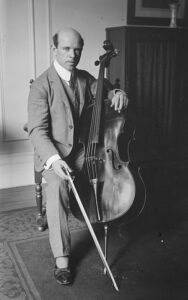
Along with a traditional Jewish upbringing and a lively interest in Zionism, Herbert and his wife, Susannah, were determined to imbue their eleven children with a love of music, especially since their mother was a gifted pianist who had given up her musical career to take care of them. With true British orderliness marred only by the fact that the family fell one short of a dozen, the children were divided into threes and fours. Each group had its own bedroom, nursery, and classroom as well as its part to play in the family orchestra. The eldest in each group usually played piano; the second-oldest, violin; and the third-, cello. As the ninth child, Thelma (born in 1895) therefore became a cellist more or less by default.
Thelma quickly devoted herself to her unwieldy instrument, and her natural aptitude, hard work, and determination soon made her a sought-after addition to string ensembles. She won a three-year scholarship to the Royal College of Music at age sixteen, studying under the famous Spanish cellist Pablo Casals, who realized her potential. Yellin’s sister recalled a telling exchange between the two musicians. “When [Thelma] once remonstrated against his desire to become a conductor, saying, ‘There is only one cellist like you,’ he told her: ‘And you will then be that one cellist!’ ” (Margery Bentwich, Thelma Yellin – Pioneer Musician [Rubin Mass, 1964], p. 17).
As Thelma grew older, music became her path to spirituality and truth. In early 1914 she wrote in her diary:
For these years are my precious years, and every deed in them matters; and I hate to let them go as if they were of no value. I pray that every day may record some fresh activity, all leading to the great goal – the truth, in music as in all. Let me never feel that the day has gone with no part of a step added to the ladder. The life of man is short, but he can make it long who strives every hour and every day for something beyond himself – the ideal that has no beginning and no end. (ibid., p. 18)
Doubts and Difficulties
Thelma’s music brought her both satisfaction and intense anxiety. Other issues, too, gave rise to soul searching and self-doubt. With the outbreak of World War I, she wondered about devoting herself to superfluities while the world was coming apart at the seams:
October 18. The world gets sadder and ever sadder…. Especially at night the terribleness of it all comes over one like an overwhelming wave…. And my little efforts to achieve something feel so infinitesimally small by the side of the great questions and trials being solved every day that I wonder I could ever see a bigness in them. And yet music is a great and good thing, and in these dreadful times it is a blessing for me to think that I can give of its beauties to others. (ibid., p. 19)

Deciding that at the very least she could share her music’s beauty with the boys at the front, Thelma joined a group of musicians performing for the troops in France. The trip was exhausting but satisfying.
In 1915, Thelma’s mother died suddenly, and the loss affected the entire family. Thelma struggled to live up to her mother’s legacy and remain faithful to both her religion and her music. She coped with the many concerts scheduled on Saturdays by timing her appearances to coincide with the end of the Sabbath. But the tension between her two loves came to a head. Her need for freedom of expression conflicted with the religious restrictions that bound her. In addition, Thelma had fallen for a young medical student and amateur musician whose mother was Christian. After much turmoil, she buried her affections and remained within the fold.
Yet the perfectionism demanded by Thelma’s music took the heaviest toll. The grind of rehearsals, the need to achieve new heights as a performer, the never-ending competition, and stage fright finally culminated in severe physical symptoms. Protracted bouts of pain preceded a nervous breakdown. When her family suggested an overseas breather, she jumped at the idea.
A New Beginning
Mandate Palestine was the obvious destination for Thelma. It was the land of her childhood dreams, and three of her siblings already lived there. Joining her brother Norman, then legal adviser to the British military government in Jerusalem, Thelma soon felt she’d left her worries as well as her symptoms behind. On her second day in Jerusalem, in May 1920, she wrote in her diary:
Jerusalem. An atmosphere of sun and breeze, the air full of the scent of acacias and pines, the roads dusty but full of interest. The German Colony is just like a country village, the population equally divided between English and Arab; also some Indian soldiers. These pray at a little shrine opposite my window. It is an atmosphere for prayer, or at least for taking life peacefully and seriously. I am more at peace than I have ever been, I think. For the first time, the sense of competition has left me, and I am content to be one in the cycle of human lives. (ibid., p. 37)
Thelma’s pace might have slowed, but even in Jerusalem she pursued her impossible dreams. While improving her Hebrew and mingling with local intellectuals, she kept up with her music and even began performing again. Classical music in Palestine was in its infancy, with Tel Aviv’s Shulamith School of Music (launched by Shulamith Ruppin) and the Jerusalem Music Academy. With enthusiastic support from the British high commissioner, the governor of Jerusalem, and her brother, Thelma founded the Jerusalem Music Society. Appearing in a variety of musical ensembles with her cello – then something of a novelty in the musical landscape – she was soon an integral part of the city’s cultural life.
Eliezer Yellin, son of the well-known academic David Yellin (who founded one of the first Hebrew-speaking teachers’ seminaries in the country), became a close acquaintance. Eliezer was an architect and engineer, and an unusual combination of East and West, tradition and modern European culture. (His grandfather was Rabbi Yehiel Michel Pines, a leader of the early Zionist movement Hovevei Zion.) Thelma the dreamer and Eliezer the pragmatist complemented each other perfectly, and they were married in March 1921. Despite quickly becoming a mother, Thelma continued organizing concerts and running her musical society. Soon after the birth of her first child, in January 1922, she wrote to her father:
My time has been divided between baby and the Musical Society. The latter is much more troublesome than the former. (ibid., p. 48)
Not yet a Segula subscriber?
Access our full archive online, have print issues delivered to your door, and moreFeel free to share