

In the fourth century CE, a Roman emperor found it expedient to spearhead construction of a Third Temple for the Jews in Jerusalem. Who was Emperor Julian, how did the Jews react to his initiative, and how did his temple fall before it was even built?

The “Third Temple” was destroyed in the year 363, but the event resonated far less within the collective Jewish consciousness than the fall of the first two. In fact, Jews still pray for the Third Temple to be built. What went wrong with Emperor Julian’s audacious plan, and why do so few remember it? The story of Julian’s “Third Temple” illuminates the complex reality of the Roman Empire in the fourth century as well as Jews’ ambivalence toward rebuilding their most sacred shrine.
The Tetrarchy
Four men ruled the Roman Empire at the beginning of the fourth century: two emperors, each bearing the title “augustus,” and their two deputies, each JULIAN THE bearing the title “caesar.” One augustus and his caesar governed the eastern part of the empire, while the other such pair commanded the west. This tetrarchy, or rule of four, was instituted in 285 when Emperor Diocletian promoted Maximian to be his co-emperor and sent him to govern the western part of the empire, presiding over the east himself. In 293, each augustus selected his heir, who meanwhile had to serve under him as caesar. Diocletian envisaged that each senior emperor would retire in due course, to be replaced by his deputy rather than clinging to power until death.
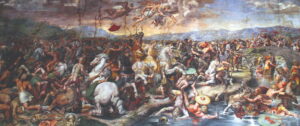
Diocletian indeed retired as planned – and withdrew to tend his garden in Spalatum (today the Croatian city of Split) – but he was the only emperor to remain in retirement. The tetrarchy also failed to bring lasting stability to the Roman Empire. Soon after senior emperors Diocletian and Maximian abdicated in 305, the empire descended into civil war. To make a long story short, Constantine, son of Maximian’s deputy Constantius, defeated Maximian’s son Maxentius in 312 at the Battle of the Milvian Bridge, at the gates of Rome.
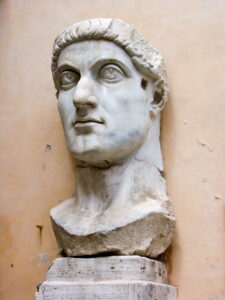
Legend has it that Constantine had a heavenly vision which eventually led him to Christianity. In this vision, he was told to emblazon the sign of Chi-Ro (the Greek letter chi, or X, superimposed on the letter rho, or P, abbreviating the Greek word Christos) on his army’s shields to secure victory. Constantine’s decisive victory made him the sole ruler of the empire’s western sector. Then, in 324, he defeated Licinius, his counterpart in the east, unifying the entire empire anew.
While Diocletian had persecuted Christians, Constantine adopted their faith, as did most of his family. He restored dynastic succession as well, and his descendants reigned in his wake. Julian was a member of Constantine’s dynasty.
Who Was Julian?
Julian was probably born in 331 and was raised as a Christian. Among his tutors were Eusebius, bishop of Nicomedia, and Georgius of Cappadocia, who later became the bishop of Alexandria. He was also taught by pagans such as the eunuch Mardonius, of Gothic origin. While visiting Constantinople (today’s Istanbul), the city renamed for Constantine I, Julian met Livy, the famous rhetorician of Antioch. Another profound influence was the Neoplatonist Maximus of Ephesus.
In 351, after a stay in Athens, Julian abandoned Christianity and returned to the ancient Roman religion. However, to protect his life and status, he initially kept his decision under wraps, continuing to serve as a lector in the church of Nicomedia.
A succession struggle following the death of Constantine I in 337 left Julian’s every male relative dead except his half-brother Gallus and three sons of Constantine: Constantius II, Constans, and Constantine II, who all became joint emperors. By 351, only Constantius remained, and he appointed Gallus caesar of the eastern part of the empire, under him. After Gallus fell out of favor and was executed, Constantius married off his daughter Helena to Julian, who became the new caesar.
Julian was sent to the Roman province of Gaul (France), from which he directed several military campaigns and earned a reputation as a talented commander. His greatest achievement was his victory over the Alemanni, a group of German tribes whom he trounced at Strasbourg in 357.
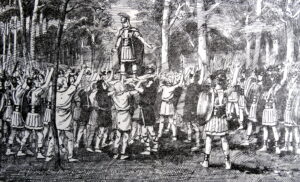
Julian’s winning streak made him extremely popular with his troops – a fact he would soon use to his advantage. In 360, Constantius requested that Julian dispatch legions from Gaul to fight the Persians. Capitalizing on his superior’s preoccupation with these foes, Julian incited the troops to declare him augustus. Constantius at first did nothing. Then in April 361, after Constantius had been away a year and a half fighting in the east, Julian and his soldiers advanced toward the Balkans.
Finally, Constantius turned around and marched against Julian. However, before the armies could face off, the senior emperor took ill, dying on November 3, 361, at age forty-four and without male heirs. To avoid civil war, Constantius’ officers crowned Julian sole ruler of the Roman Empire. He moved his armies straight to Constantinople and stayed there until May 362.
The Gods or the Cross?
Right from the start, Julian’s rule was very different from his predecessors’. He swiftly ousted any senior officers he didn’t trust, until his actions encountered fierce opposition. Some of his decisions seemed outrageous. For example, he claimed that the emperor, too, was bound by the law and once fined himself ten pounds of gold. Yet it was his attempt to reinstate Rome’s ancient pantheon that aroused the greatest resistance, later causing the Church to label him “Julian the Apostate.”
More than half the Roman Empire was still pagan, and such rites were particularly entrenched among the aristocracy, in rural areas, and in the military. Yet Christianity was gaining ground, with many pagan ceremonies and rituals discontinued or even outlawed. Julian tried to turn all this around and block the advance of Christianity throughout the empire. He believed Rome’s glory rested squarely on its ancient traditions; only a return to that creed could restore the empire’s grandeur.
Knowing better than to persecute the Christians, who’d only been strengthened by centuries of martyrdom, Julian chose to actively support the ancient religions instead. In 362, he declared freedom of religion throughout his realm. Bishops exiled as heretics were welcomed home, and the resulting schisms weakened the ascendancy of the Council of Nicaea, endorsed by Constantine. Pagan temples were repaired and reopened, and the property stolen from them was returned; new shrines were built and sacrifices were reinstated.
The emperor himself oversaw and funded a hierarchy of pagan priests throughout the empire. Like Church leaders, they were to be incorruptible, devoted to their flock, kind to the weak, and solicitous of the poor. Christians were forbidden to be educators. Julian claimed that anyone who didn’t respect the beliefs and gods of Aristotle, Homer, and Plato couldn’t sufficiently respect their works and therefore shouldn’t teach them.
Julian and the Temple
In his bid to undercut Christianity, the emperor saw Jews and Judaism as his natural allies. Though Christianity’s origins were Jewish, many Jews regarded it as the illegitimate offspring of their creed and looked forward to the upstart’s demise.
The emperor’s Jewish sympathies were not only politically expedient. His classical education valued tradition over innovation, and the Romans respected the Jewish religion for its antiquity. Indeed, ever since the later years of the Roman republic, Jews had been granted the same rights as all other subjects – and sometimes additional privileges as well. For instance, Jewish citizens were exempt from the imperial cult and pagan rituals.
As a significant, well-integrated minority, the Jews could contribute to the success of Julian’s reforms. Their faith also competed with Christianity for the allegiance of those who’d rejected polytheism. Before Christianity’s relatively new appearance on the scene, many had adopted Jewish festivals and customs, and Roman matrons’ flirtations with Judaism had become so commonplace that the empire had tried to limit them.
Julian hoped to win over the Jews by restoring the status they’d enjoyed in previous centuries, including the Temple. Such a move would have conveniently undermined Christianity as well, for Jesus had explicitly prophesied the Temple’s destruction:
Then as he went out of the temple, one of his disciples said to him, “Teacher, see what manner of stones and what buildings are here!” And Jesus answered and said to him, “Do you see these great buildings? Not one stone shall be left upon another, that shall not be thrown down.” (Mark 13:1–2)
Many other gospels reiterate these sentiments almost word for word.
Tinged with Reservation
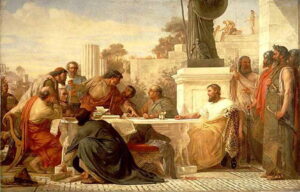
Had the Temple’s reconstruction been perceived as Julian’s initiative, not only would the Jews have resisted, but he himself would have drawn criticism from all over the empire. Therefore, he simply summoned Jewish leaders and asked why they’d abandoned their God and His sacrifices. He expected them to respond that such rituals were impossible in the absence of the Temple, whereupon the emperor would graciously allow them to rebuild.
Yet Julian’s offer wasn’t unanimously accepted. Some Jews objected to rebuilding the Temple with foreign aid. Others, however, lent their support precisely because the Second Temple had been constructed under the patronage of Cyrus, king of Persia. The Talmudic sage Rabbi Aha expressed the latter view:
In other words, the Temple is destined to be rebuilt before the restoration of the House of David. (Jerusalem Talmud, Ma’aser Sheni 5b)
Members of this camp were thus overjoyed at Julian’s overture. Saint Ephrem the Syrian, a contemporary living in Nisibis (today’s Nusaybin, in Turkey), wrote of them:
The Jews were seized with a mad excitement. They blew rams’ horns and rejoiced. (Michael Avi-yonah, In the Days of Rome and Byzantium, p. 168 [Hebrew])
And in Italy, Christian theologian Rufinus of Aquileia chided:
The Jews became so exceedingly impudent that some even thought the days of prophecy had returned. They began insulting our people as if their kingdom had been restored. (ibid.)
Julian could never have embarked on this ambitious project without active Jewish cooperation. Jews raised money, amassed materials, and set about fashioning Temple vessels. Alypius of Antioch oversaw construction on Julian’s behalf, but Jews evidently prepared the site, clearing away the ruins there. Some in the Diaspora even planned to return to Jerusalem.
Interestingly, there’s no mention of Julian’s project in any Jewish texts. Maybe that’s because it took place only ten years after a messianic rebellion by a Jewish faction in the land of Israel. The revolt was directed against the emperor’s half-brother Gallus during his brief reign as caesar of the eastern part of the empire. Presumably the sages feared similarly disastrous reactions to Julian’s initiative.
Though priestly families were eager to regain their historic status, other Jewish elites – many rabbis and Jewish leaders in the land of Israel, for example – feared a swift loss of influence.
Finally, Jews may have hesitated to rally around an emperor who’d opposed Christianity despite its popularity throughout his empire. After all, what would become of Julian’s allies after his death?
Not yet a Segula subscriber?
Access our full archive online, have print issues delivered to your door, and moreFeel free to share