For much of the 20th century, the vast majority of the Jewish people was homeless. Jews were constantly on the move, sometimes in search of a living, sometimes just to survive. The Hebrew Immigrant Aid Society was always there for them, and its history is also ours

Between 1881 and 1914, over two million Jews emigrated to the United States in search of a better life than eastern Europe offered. Their journey was difficult; leaving familiar towns and villages behind, they crossed borders (often with the help of smugglers), then an ocean. But before they could enter their new “promised land,” they faced the challenge of registering with the immigration authorities.
Immigrants were processed at Castle Garden, in New York’s Battery Park, until their growing numbers demanded a larger facility. On January 1, 1892, just such an immigration station opened at the legendary Ellis Island. Surrounded by water, the island prevented hopefuls from simply jumping a fence and sneaking into the city.
Ships laid anchor in Manhattan Bay, where their wealthier passengers entered America without examination or bureaucracy. Those below deck waited to be ferried the short distance to Ellis Island, where the slow absorption process began. There, aided by interpreters, clerks recorded newcomers’ names, ages, marital status, occupation, origin, destination, height, and fitness. From 1899 onward, ethnicity was noted as well.
Arrivals who failed to complete the entry requirements by nightfall stayed overnight, and those in need received medical care. Only about 2 percent were turned away, a shattering blow for both them and their families.
Leaving their belongings in the entrance hall, immigrants went upstairs and stood in long lines as physicians checked for physical or mental illness, including trachoma screenings. Those diagnosed with or suspected of sickness had a mark chalked on their lapels and were taken off to side rooms for further examination pending a decision whether to allow them to remain. Men and boys underwent a full physical, while female doctors examined women and girls less invasively, unless there was reason to believe they carried sexually transmitted diseases.
Speaking Their Language
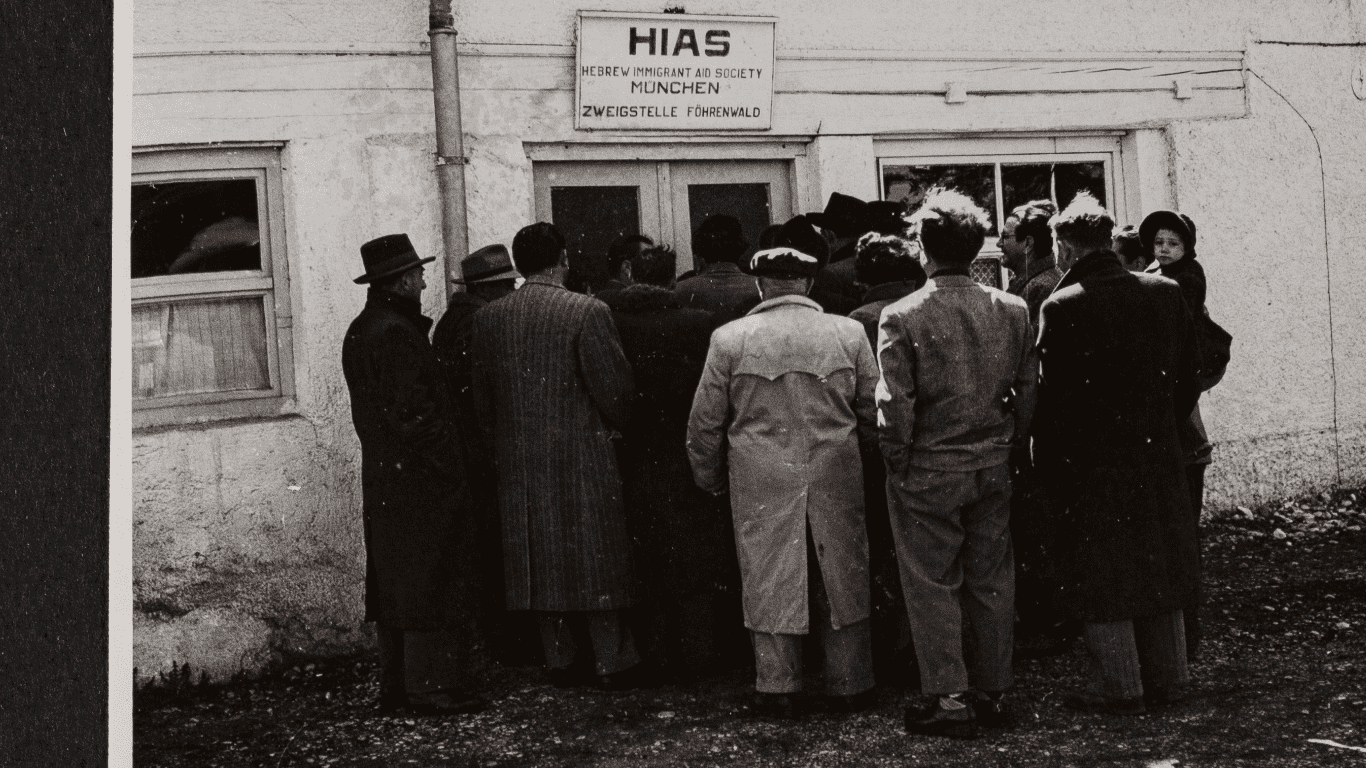
The same year the immigration station opened on Ellis Island, the Hebrew Sheltering House Association (HSHA) was established in Manhattan, replacing the Hebrew Emigrant Aid Society, which had operated from 1881 to 1883 in response to a wave of pogroms in Russia. This body was refounded in 1902 as HIAS (replacing “emigrant” with “immigrant”) and merged with HSHA to become the Hebrew Sheltering and Immigration Aid Society of America in 1909.
One of the revived organization’s first steps was to place representatives at Ellis Island to liaise between immigration officials and incoming Yiddish speakers. Extending a warm welcome in a familiar tongue, HIAS staff eased anxiety and conveyed solidarity and brotherhood. Sporting blue caps embroidered with the organization’s initials, these employees explained immigration regulations, translated clerks’ inquiries into Yiddish, helped convert rubles and kroners into dollars, and offered legal advice to those being sent back to where they’d come from. HIAS workers also discouraged arbitrary processing delays and outright rejections.
Yet HIAS’ helping hand extended far beyond Ellis Island. Aside from shielding new immigrants from con men, the organization located transplants’ family members in New York and elsewhere, ran an employment agency on the Lower East Side, and schooled immigrant children. Legal aid was provided to those seeking citizenship. HIAS even published the Jewish Immigrant, a Yiddish-English newspaper distributed all over the U.S. as well as in Russia.
The best-known HIAS activist on Ellis Island was Alexander Harkavy. A member of the Am Olam (Eternal People) movement, which aimed to establish Jewish agricultural communities in the United States, Harkavy had arrived in America in 1882. Later the compiler of a Yiddish-English dictionary, he was posted on Ellis Island from 1904 to 1909, when Jewish immigration peaked. In 1906, HIAS sent him on a two-and-a-half-month tour of European ports to survey the living conditions of would-be immigrants and improve travel for passengers in steerage. Thanks to Harkavy and other HIAS reps, the German shipping company Hapag began listing its regulations in Yiddish and even serving kosher meals on some voyages.
By World War I, HIAS had offices throughout the U.S. As Irving Howe points out in his classic work, World of Our Fathers (Galahad Publishing, 2001), in 1912 alone, over 150,000 people visited the HIAS information bureau in New York. More than fifteen thousand received aid that year, and over four thousand children participated in HIAS educational programs on Saturday afternoons.
Not yet a Segula subscriber?
Access our full archive online, have print issues delivered to your door, and moreFeel free to share