The first to boldly associate the Statue of Liberty with welcoming refugees, Emma Lazarus was also arguably the first public voice of American Zionism. Her work raises questions of identity we still struggle with today

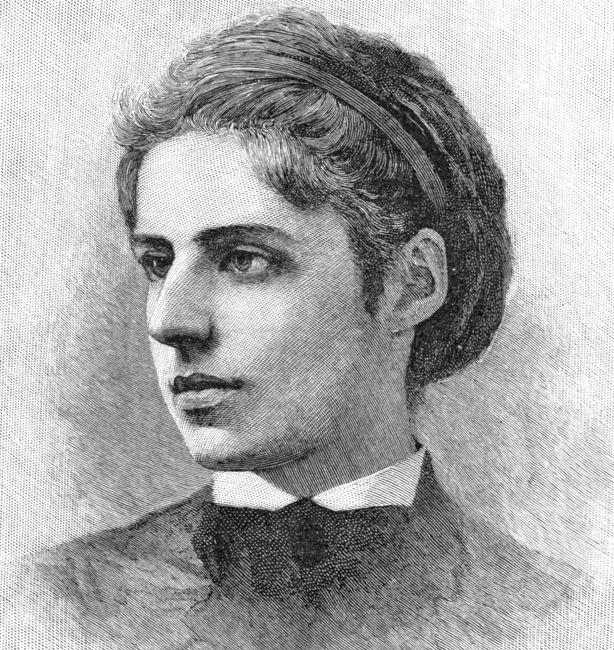
Emma Lazarus’ life reads like a parable of American Jewish identity. Born in 1849, Lazarus descended from at least three generations of Portuguese Jews who’d come to America prior to the mid-18th century. Raised in a rationalist, upperclass home, she was at ease in elite New York society, identifying with the values and aspirations of the literary circles in which she moved. She regarded the transcendentalist author and philosopher Ralph Waldo Emerson (1803–1882) as her mentor, submitting her published poetry for his appraisal.
Lazarus’ early career is framed by the emergence of a body of women’s prose and poetry made possible by the revolution in women’s education and status that spanned the 19th century. She herself was privately tutored, however, mastering German and Italian and (much later) studying Hebrew. Her first publications are the work of an accomplished young poetess ambitious enough to feel slighted when these compositions weren’t included alongside those of Shakespeare, Wordsworth, and Thoreau in Emerson’s Parnassus anthology.
Outside the Synagogue
The Lazaruses belonged to Shearith Israel, the oldest Sephardic congregation in New York. Although Emma’s greatuncle officiated there as rabbi, her parents weren’t the synagogue’s most engaged members. She, however, was approached by Gustav Gottheil, rabbi of the Reform Temple Emanu-El, to contribute to a hymnal he was editing by rendering Reform founder Abraham Geiger’s German translations of medieval piyyutim (liturgical poems) into English. Impressed by her published translations of Heinrich Heine’s poetry, Rabbi Gottheil also suggested she compose some hymns of her own. Lazarus was skeptical. As she replied to him in a letter dated February 6, 1877:
As for writing hymns myself, the flesh is willing but the spirit is weak. I should be most happy to serve you in your difficult and patriotic undertaking, but the more I see of these religious poems, the more I feel that the fervor and enthusiasm requisite to their production are altogether lacking in me. (Richard J. W. Gottheil, The Life of Gustav Gottheil: Memoir of a Priest in Israel [Bayard Press, 1936], pp. 62–3)
Nonetheless she did provide him with the requested translations.

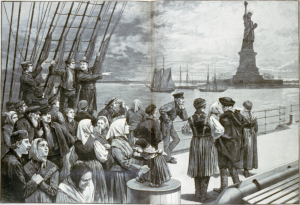
Lazarus was clearly more than a little involved in Jewish culture and community when Gottheil invited her to accompany him to Ward Island on October 14, 1882, to witness the mass immigration of Jews from eastern Europe.
For Emma, now thirty-three and presumably an established spinster, this was an awakening to Jewish history and continuity. What shape, what direction, what principles would define American Jewry? Lazarus was among the first to ask these questions, which remain ongoing challenges. She stood at the intersection of three key strands of American Jewish life: the migration from Europe to the U.S., which consequently became a major Jewish center; the emergence of a hyphenated, “Jewish-American” identity; and the rise of Zionism. Lazarus, as we will see, embodied the frictions as well as the confluences between these strands.
Americans in the Holy Land
In both America and England, Palestine had been emerging as a topic since the early 19th century, initially in the context of Christian missions. As new travel and communication technologies brought the Middle East within western reach, and the decline of the Ottoman Empire roused diplomatic and imperialist interests there, the Holy Land became a focus of debate.

Meanwhile, the U.S. was expanding: manifest destiny propelled the country’s growing white population westward to build its own promised land. This movement echoed the Puritans’ Mayflower voyage – which they perceived as a reenactment of the Hebrew slaves’ Exodus from Egypt to the Holy Land – that had led to the first American colonies. The Second Great Awakening raging in 19th-century America, a religious revival expressed in the rapid spread of the Baptist, Methodist, and Presbyterian churches, unleashed a missionary energy extending all the way to the land of Israel. Palestine thus became a magnet for pilgrims, tourists, artists, and scholars of archaeology and geography, followed by merchants eager to supply their needs.
Lazarus’ own awakening to Palestine can be attributed to such philosemitic writers as the British female novelist George Eliot (Mary Ann Evans, 1819– 1880), to whom she dedicated a play, and Sir Laurence Oliphant (1829–1888). The reverberations of their works in America (where Oliphant spent several years living in a commune) seem to have impressed her more than the efforts of Moses Montefiore and other Jewish proponents of a return to Zion.
Turnabout
Lazarus’ outing with Gottheil resembles nothing so much as a conversion experience. The stark encounter with the Jewish masses swept ashore at Ward Island (where thousands were packed into temporary housing) came to her as a prophetic call. She promptly penned a series of powerful polemics and poems, addressed to both Jews and Christians, exploring and extending the meaning of membership in the Jewish people in various directions. These remained pertinent not only for her own time but until today.

Lazarus was incensed by the publication of an article by one Madame Ragozin in The Century (an illustrated monthly) in defense of Russian pogroms. Ragozin’s essay, “Russian Jews and Gentiles,” presented Russian Jewry as an alien, subversive, heretical presence deserving persecution. Lazarus responded with “Russian Christianity vs. Modern Judaism,” which set out from its very title to alter the historiographic map by which Ragozin had divided all Jews into “those who followed Jesus, and those who crucified him” (“Russian Jews and Gentiles,” The Century 23, no. 1 [April 1882], p. 909). Lazarus countered that Jewish history continued to flourish in its own right and was “the oldest among civilized nations” (“Russian Christianity vs. Modern Judaism,” ibid. 24, no. 2 [May 1882], p. 49).
Emma followed up with “The Jewish Problem” (ibid. 25, no. 5 [February 1883]), reaffirming Jewish history from a Jewish point of view as apposed to the Christian one prevalent in American culture. As the author wryly reminded subscribers, she aimed to “review briefly [the Jews’] history since the scriptural age, where ordinary readers are content to close it” (ibid., p. 602).
The very notion of an independent Jewish history was a departure. As a broadly Christian tradition, American religious culture had referred to the Jewish people as either a mere prelude to Jesus or the discarded refuse of history following the Jews’ rejection of the Christian messiah. Lazarus’ treatment of Jewish history owed much to the revolutionary works of Heinrich Graetz (History of the Jews [1853–70]) and Leopold Zunz, which she read in German.
Framing Words: Hebrews
The Bible rarely refers to Hebrews, but many modern European languages use the term interchangeably with “Jews” and even “Israelis.” In Russia, home to roughly half the world’s Jews as the 18th century drew to a close, the word zhyd (Jew) is derogatory, whereas yevrey (Hebrew) is more neutral, alluding to the biblical origins of an otherwise despised people. Perhaps for this reason, the largely Russian Jewish population of Ottoman and Mandate Palestine preferred the descriptor “Hebrew” – as in the Hebrew University, the Hebrew Brigade (as opposed to the Jewish Brigade, as it was known in English), “Hebrew labor,” etc.
When Emma Lazarus called her series of articles An Epistle to the Hebrews, however, she was taking quite a different tack, adopting the title of a New Testament work attributed to the apostle Paul. His message there – that Christian believers need no Jewish rituals to achieve salvation – essentially delineated where Christianity parted company with Judaism and became a new religion. Similarly, Lazarus’ “The Jewish Problem” characterized America’s Jews as being neither Jewish nor gentile, echoing Paul’s description in Galatians 3:28, “There is neither Jew nor Greek, there is neither slave nor free, there is neither male nor female.” At the crossroads then confronting American Jewry, her titling of An Epistle to the Hebrews – a work advocating a new Jewish identity – surely resounded deeply.
Armchair Zionist
When she published An Epistle to the Hebrews in American Hebrew magazine between November 1882 and May 1883, Lazarus was among the very first Zionists on her side of the Atlantic. These fifteen open letters were printed ten months after Leon Pinsker’s Auto-Emancipation came out in German and four months after the founding of the first Zionist colony in Ottoman Palestine, Rishon Lezion.
Lazarus presented the Palestinian homeland as a solution, but only for persecuted Jews, not American ones. “There is not,” she assured her readers, “the slightest necessity for an American Jew, the free citizen of a republic, to rest his hopes upon the foundation of any other nationality soever” (An Epistle to the Hebrews [Philadelphia: Jewish Publication Society, 1987], p. 41). Zionism served eastern European Jews alone, since “their colonization en masse in the United States is impracticable” (ibid., p. 44). Her “plea for the establishment of a free Jewish State” had “not the remotest bearing upon the position of American Jews,” for “wherever we are free, we are at home” (ibid., p. 72). Here Lazarus was responding to criticism of her essay “The Jewish Problem” by Abram S. Isaacs, editor of the Jewish Messenger, who spoke for many in the American Jewish community in fearing that mass immigration of eastern European Jewry would endanger American Jewry’s hardwon status.
Isaacs also rightly pointed out, in an article he called “Will the Jews Return to Palestine?” that Lazarus hadn’t defined such basic terms as “Jewish.” In “The Jewish Problem,” she’d delicately avoided a religious definition, quoting a Russian Jew’s assessment that “the religious mission of the Jews belongs to the past.” This claim incited Isaacs: “If it be true that the racial tie […] binds Jews together even though they discard all religion, why form a separate nationality unless to establish a free religious and atheistic commune under the Jewish name?” (“Will the Jews Return to Palestine?” The Century 26, no. 1 [May 1883], p. 156).
Isaacs pinpointed key conundrums of Jewish identity: as Lazarus herself pondered in An Epistle to the Hebrews, how to “emancipate and fortify our reason to keep pace with the intellectual advance of our age” while “nourishing the sacred fires of historic memory” (Epistle, p. 15). How much heritage can be relinquished without losing one’s identity altogether? No less urgent, how to balance, as Lazarus formulates it, universal equality with Jewish particularity? Since America was “a society where all differences of race and faith were fused in a refined cosmopolitanism” (ibid., p. 73), why seek national restoration? She hastens to add that from such national restoration “I exclude American Jews, who have lost color and individuality, and are neither Jew nor Gentile” (“Jewish Problem,” p. 611).
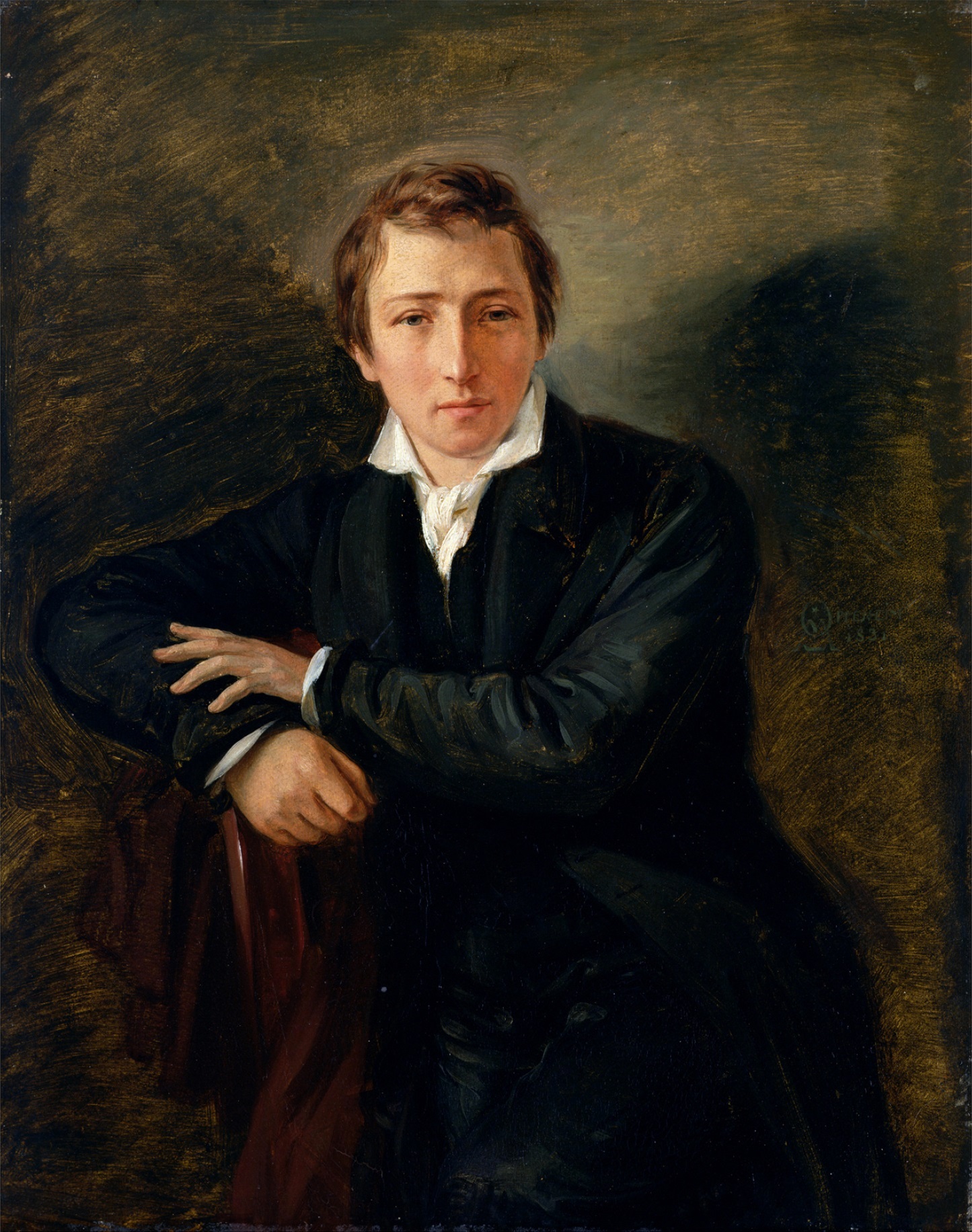
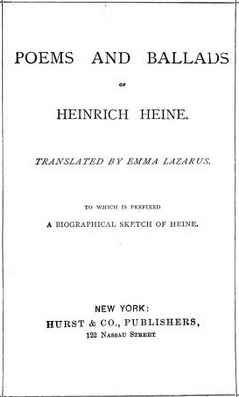
Lazarus first won recognition for her published translations of Heinrich Heine’s poetry. Flyleaf of a collection of Heine’s works in English, and the poet’s portrait by Moritz Daniel Oppenheim, 1831 | Hamburg Museum of Art
Unanswered Questions
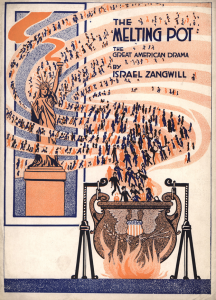
Lazarus has no answers to these questions of identity, which perplex American Jewry to this day. She excludes eastern Europe as a possible site of future Jewish life, as the vast majority of Jewish immigrants wouldn’t have dreamed of returning there (despite their moments of literary nostalgia). In Epistle to the Hebrews, Lazarus dismisses “the hackneyed question [of] whether Judaism be a race or a religion,” asserting simply that “it is both” (Epistle, p. 9). Easier said than done. Hers is a call to reawaken Jewish history, but which path is it to take? America, land of opportunity, religious and cultural freedom, and diversity, offered one form of Jewish evolution: immersion in a melting pot (whose results become clearer with each Pew report). Palestine resettled, in contrast, promised a renewed particularism.
These dual, far-from-integrated visions of identity and history shape Lazarus’ poetry. Her turn to Jewish public affairs transformed her poetic voice from lyrical wistfulness to a tone of historical immediacy and national destiny. With prophetic intensity, she linked ancient and contemporary Jewry in biblical images of redemptive promise. Take “The Banner of the Jew”:
Oh for Jerusalem’s trumpet now, To blow a blast of shattering power, To wake the sleepers high and low, And rouse them to the urgent hour! No band for vengeance – but to save, A million naked swords should wave. Oh, deem not dead that martial fire, Say not the mystic flame is spent! With Moses’ law and David’s lyre, Your ancient strength remains unbent Let but an Ezra rise anew, To Lift the Banner of the Jew! (Emma Lazarus, Selected Poems and Other Writings [Broadview Press, 2002], p. 183)
Recalling the return from the Babylonian exile under Ezra (as she does in her prose polemics, calling for a “new Ezra for their own people” [“Jewish Problem,” p. 611]), Lazarus imagines a renewed Jewish polity (“Moses’ law”) and culture (“David’s lyre”), perhaps casting herself as a contemporary psalmist. More historical than apocalyptic, “Jerusalem’s trumpet” reverberates at least culturally in a religious sense, as is clear from the reference to blowing “the sacred cornet” in Lazarus’ poem “The New Year,” dated Rosh Hashana 1882 (Lazarus, Selected Poems, p. 175).
On all these levels, this call to arms in verse joins past with future to create a new vision for the people of Israel.
Dangerous Particularism
Yet Lazarus recognized the dangers of nationalism. Two of her poems were devoted to Carmen Sylva, the pen name of Queen Elizabeth, wife of Carl I of Romania. This queen promoted the arts, notably by women, in a Romania attempting to define its national voice. This effort, however, included severe discrimination against Jews and even threats of expulsion. As Lazarus writes, the Jew in Romania remained “An alien in his land of birth / An outcast from his brethren’s earth” (“To Carmen Sylva,” in Standard Book of Jewish Verse, ed. Joseph Friedlander and George Alexander Kohut [New York: Dodd, Mead and Co., 1971, p. 683]). Another poem of hers also lamented Romanian Jewry’s plight:
Some little Jew is falling Clubbed in his narrow pale – The Queen is singing sweetly Songs of the nightingale. (“Lines on Carmen Sylva,” ibid., p. 684)
The illiberal nationalism Lazarus bemoaned in the 19th century is regrettably still very much with us. Consolidating one nationality all too often violates another. This is one of the harsher paradoxes permeating Lazarus’ prose and poetry: both are rife with tensions, inconsistencies, and contradictions, even as she attempts to resolve them. These include religion and race, particular and universal, past and future. Lazarus is caught in these conflicts – all integral to the faith of the Bible. She’s trapped within the very clashes she is trying to harmonize.
Jewish Mother at the Door
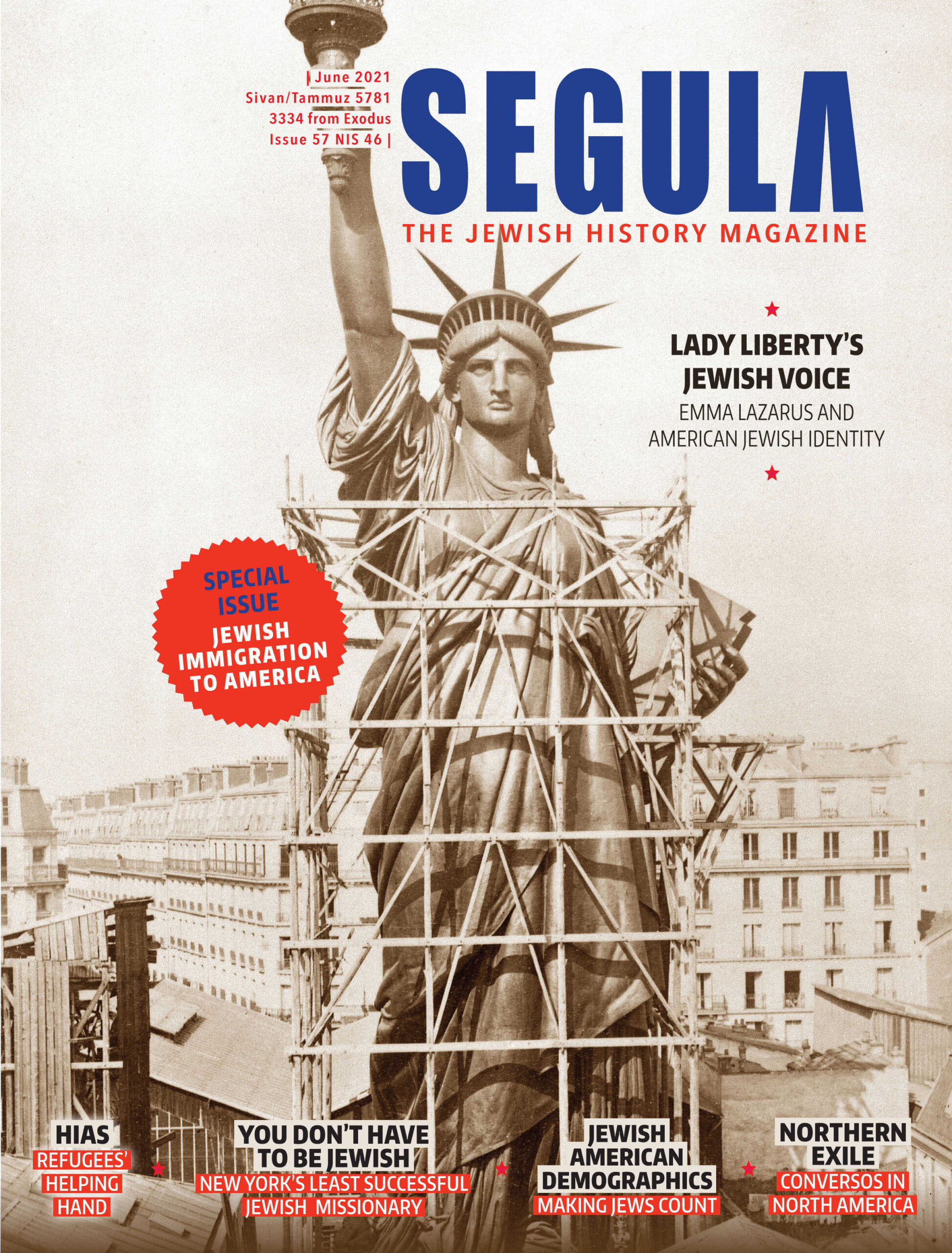
Lazarus’ most famous poem is of course “The New Colossus” (1883), written to help raise funds for a pedestal for the Statue of Liberty, France’s gift to America as a tribute to the two countries’ friendship. She actually wrote this work before the statue was assembled, and as historian John Higham has pointed out (in his Send These to Me: Jews and Other Immigrants in Urban America [New York: Atheneum, 1975], p. 78), its symbolic welcoming of refugees and other immigrants was her own invention.
Here at our sea-washed, sunset gates shall stand A mighty woman with a torch, whose flame Is the imprisoned lightning, and her name Mother of Exiles. From her beaconhand Glows world-wide welcome […]. (Lazarus, Selected Poems, p. 20)
The poem subtly alludes to the biblical Deborah, wife of “Lapidot” (Judges 4:4), meaning “torches” in Hebrew, who celebrates herself as “a mother in Israel” (ibid. 5:7). The lamp at the conclusion of the sonnet – “I lift my lamp beside the golden door” – appears elsewhere in Lazarus as the Chanuka menora.
The “Americanization” of this Jewish imagery recasts the statue, textually and politically, as an emblem of American pluralism. That this welcome is extended particularly to Jews becomes explicit in a sonnet Lazarus composed at the same time, entitled “1492”:
Thou two-faced year, Mother of Change and Fate, Didst weep when Spain cast forth with flaming sword, The children of the prophets of the Lord, Prince, priest, and people, spurned by zealot hate. Hounded from sea to sea, from state to state, The West refused them, and the East abhorred. No anchorage the known world could afford, Close-locked was every port, barred every gate. Then smiling, thou unveil’dst, O two-faced year, A virgin world where doors of sunset part, Saying, “Ho, all who weary, enter here! There falls each ancient barrier that the art Of race or creed or rank devised, to rear Grim bulwarked hatred between heart and heart!” (Lazarus, Selected Poems, p. 233)
Lazarus transforms the very discovery of America into a moment in Jewish history, a new door opening just as an old one slams shut. Like all of history as it unfolds, the significance of this moment was yet unknown: a “twofaced year” awaiting interpretation. For Lazarus, descendant of some of the first Jewish exiles to set foot in the New World, the Spanish expulsion of 1492 stands as the greatest Jewish trauma since the destruction of the Temple (surpassed only by the Holocaust, still to come). Yet that same year, Columbus discovered America, where Jews have lived a better life than the Old World ever offered.
The poet intertwines both Jewish and American events in the prophetic and biblical voice of the poem. To be “cast forth with flaming sword” recalls the expulsion from Eden, its entrance subsequently barred by “the flamelike blade of the revolving sword” (Genesis 3:24). In its golden age, Spain was just such a paradise, at least to Lazarus, who translated the country’s greatest Jewish poets into English. Jewry too is described here in national terms: “Prince, priest, and people.” Hounded in 1492 “from sea to sea, from state to state,” these exiles prefigure the refugees spoken for in “The New Colossus.”
Thus far, the sonnet looks back to the Jewish persecution, statelessness, and desperation of 1492, mirroring 1882 and the pogroms visited that year upon the Jews of imperial Russia. The poet then turns “West,” to the hidden face the year now “unveil’dst.”
The year 1492, “Mother of Change and Fate,” unlocks a “virgin world.” Like the Statue of Liberty, a feminized American continent beckons, “Ho, all who weary, enter here.” This is rescue indeed. Yet is it the culmination of Jewish history or its end, soon to be subsumed in American history? If in the New World “falls each ancient barrier that the art / Of race or creed or rank devised,” are these barriers to freedom or to particular identity as such? To erase “grim bulwarked hatred” is certainly a prophetic promise. But if, as Lazarus wrote in “The Jewish Problem,” American Jews “have lost color and individuality,” becoming “neither Jew nor Gentile,” what’s left of Jewish identity?
Emma Lazarus was among the first to celebrate but puzzle over how American Jewry could be both Jewish and American. Her early death in 1887 at age thirty-eight, possibly from cancer, perhaps prevented her from formulating a mature, integrated picture of such an identity. As it stands, her work lacks the moral language that can defend the benefits of distinctive identities coexisting with what Rabbi Jonathan Sacks called the “dignity of difference” in an interrelationship of ethnic communities. But then, a century and a half later, this language still eludes us.
Further reading:
Louis Harap, The Image of the Jew in American Literature from the Early Republic to Mass Immigration (Philadelphia: Jewish Publication Society, 1974), pp. 283–8; Esther Schor, Emma Lazarus (New York: Schocken, 2006); Shira Wolosky, Poetry and Public Discourse (New York: Palgrave Macmillan, 2013), pp. 139–52.
Feel free to share