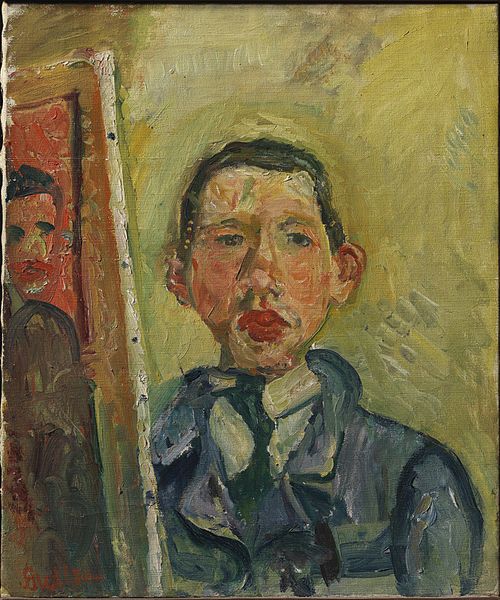
Like other Jewish artists drawn to the bright lights of prewar Paris, Chaim Soutine was seeking his destiny, not his fortune. Nevertheless, it was the everyday struggle to survive that marked both his work and his soul – in bold strokes that spoke of inner torment

August 11, 1943, Nazi-occupied Paris. A modest invitation is sent to a select group: “You are requested to attend the burial of Monsieur Ch. Soutine, painter, who passed away on August 9 at age forty-nine, which will take place this Wednesday, at 14:00 [2 pm] sharp.” The venue printed on the invitation, the well-known Père Lachaise Cemetery, has been crossed out and replaced with Montparnasse, written by hand. The invitation was sent by Marie-Berthe Aurenche, Soutine’s lover, with whom he had spent the last three years of his life. Among the handful who attended the funeral were Picasso and filmmaker Jean Cocteau.
All of France was by now occupied by the Nazis; even the so-called Free Zone under Marshall Petain was no longer “free” even in name. Some fifty-eight transports of Jews had left Drancy, a mere half-hour drive from Paris, with the vast majority headed for Auschwitz. Ultimately, some 77,000 Jews would be deported from France and murdered, one-third of them French citizens.
Pale of Settlement Artists
Chaim Soutine was one of a group of Yiddish-speaking Jewish artists who came to Paris before World War I and were part of the École de Paris – the “School of Paris.” The expatriate artists of this motley group (not all Jewish) were drawn to the City of Light as the center of the art world at that time. The group’s beginnings can be traced to 1905, when Pablo Picasso moved to the city, and it remained active until Paris was conquered by the Nazis in June 1940.
Not easily classified or unified by any one style, the artists in question were influenced by both Picasso and Matisse. All created and adopted styles and subject matter of their own. Aside from Amedeo Modigliani and Marc Chagall, Soutine was the most famous.
The artists of l’École de Paris were united not only by their desire to be at the hub of the European artistic scene, but by their “otherness” in xenophobic Paris, where art was either French or not. The Musée de Luxembourg exhibited only French artists, while the Jeu de Paume was for foreigners. Ironically, it was their thirst to be part of the artistic mainstream in Europe that sealed the fate of many of the Jews among these artists, who were deported from France by the Nazis and perished in the death camps. Soutine escaped Paris but was nevertheless a victim of the German conquest. This is his story.
Born in 1893 in the shtetl of Smilovichi (then in Russia, today in Belarus), Soutine was the tenth of eleven children; his father was a tailor. At least 40 percent of the village’s roughly four hundred inhabitants were Jewish. According to the myth disseminated by Soutine and repeated by Polish Jewish art critic Waldemar George in his 1928 monograph on the painter, Smilovichi was a primitive place. Chaim claimed to have been beaten in his youth for drawing, both by his older brothers and by the local rabbi’s sons. While the artist insisted that he’d broken away from a repressively Orthodox upbringing that had stifled his talents, recent research into Soutine’s life and family has revealed a much more complex and nuanced story.
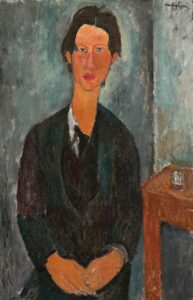
Soutine’s family sent him to Minsk as an apprentice to a tailor. Here he began studying art with the Jewish artist Iakov “Jankel” Kruger. In addition, Soutine learned photo retouching. He then moved on to the prestigious Vilna Art Academy. Dr. Jolanta Širkaité, a Lithuanian scholar, has evidence that the Soutines took pride in his art, hanging early works in their home and place of business.
In Vilna, Soutine studied alongside two other aspiring Jewish artists: Pinchus Krémègne and Michel Kikoine. Krémègne and Soutine hailed from the same shtetl, Kikoine from nearby, and all three eventually made their way to Paris in the second decade of the 20th century. All created dark still lifes and portraits, and all painted landscapes for a time in the south of France. Both Kikoine and Krémègne were supported, at least initially, by their families, while Soutine lived hand to mouth, yet he became by far the most famous.
A DIFFERENT SMILOVICHI
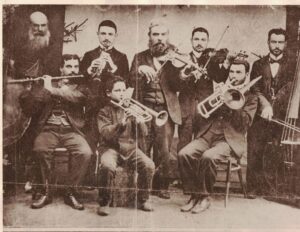
A late-19th-century photograph from Soutine’s birthplace casts doubt on the decrepit primitivity he ascribed to it
In 1928, art critic Waldemar George described the young artist who’d recently entered the Parisian limelight:
Imagine the small villages of Lithuania, roads rutted by rain and snow, leprous houses leaning on one another, like barracks, with asymmetrical windows […], and the Jews, with their Oriental nature, their crooked noses [and] long beards, their archaic dress, rituals and language […]. In this environment [Chaim] Soutine was born and raised […]. (Waldemar George, Soutine [Le Triangle, 1928], pp. 7–8)
This characterization of Soutine was part of the myth he and others cultivated regarding his background. Yet their dismal picture of shtetl life doesn’t match the backdrop of my husband’s family legends of Smilovichi, the birthplace they shared with Soutine.
A family photo taken in the 1890s and published in the Yiddish Forward in 1939 shows that Smilovichi, far from destitute, supported a large klezmer band. My husband’s great-grandfather, Mendel Fraiman, sits on the right with a trombone. His family had been living in Smilovichi for generations when they emigrated to the United States in 1906/7. We’re in contact with descendants of Abraham Zabitz, seated at left with a flute, who emigrated to the States in the 1920s and likely sent the photograph to the Forward. As for the other musicians pictured here, we’re still hoping to discover who they are and what became of them in World War II.
Not yet a Segula subscriber?
Access our full archive online, have print issues delivered to your door, and moreFeel free to share