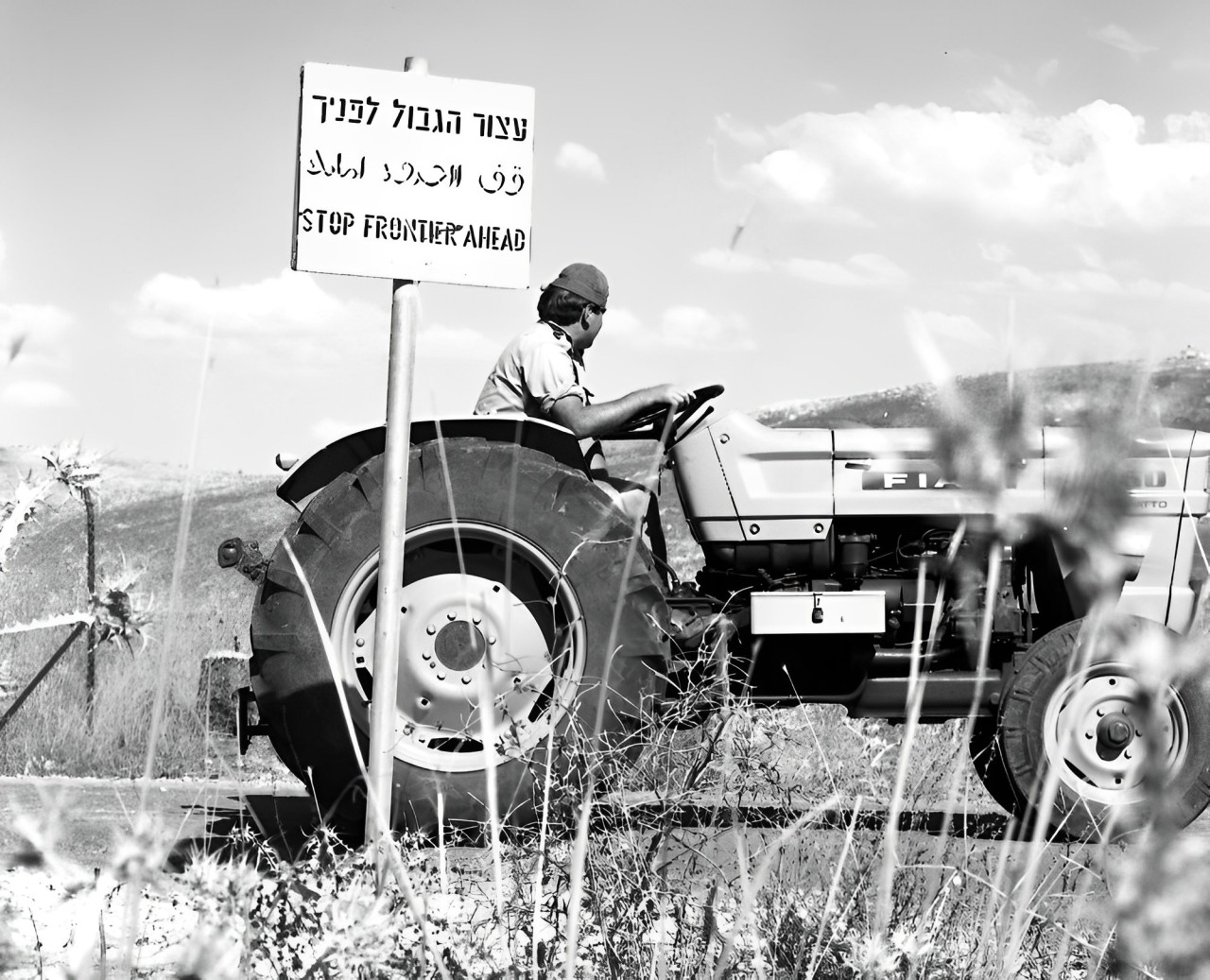
Though founded 130 years ago, Metula remains Israel’s northernmost settlement. How did most of its farmland end up in the Lebanese municipality of Marjayoun? And how did Metula’s residents fight back?

On March 23, 1949, Israel and Lebanon signed a ceasefire agreement that finally ended the War of Independence – on its northern front. Paragraph 5 specified:
The ceasefire line will run along the international border between Lebanon and Israel […]. Troop withdrawals up to the ceasefire line and reductions in the level of defensive forces [are] to be completed within ten days of signing this agreement.
The Israel Defense Forces relinquished eleven conquered Lebanese villages, and the Lebanese army withdrew from Rosh Ha-nikra. Although the two countries’ citizens were neatly aligned on each side of the border, their respective property wasn’t. Thus, by accepting the new border, Israel had effectively abandoned the farmland of Metula, its northernmost point.
Lookout
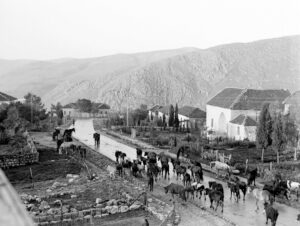
In 1870, while touring the Galilee, French intellectual Victor Guérin described a Druze village called Methelleh, Arabic for vantage point. Its inhabitants had come from Jabal al-Druze (Mountain of the Druze), in the Syrian Hauran region, to which they’d fled from Mount Lebanon in 1861, seeking shelter during civil conflict.
Baron Edmond de Rothschild’s agent Joshua Ossovetski had purchased real estate in El Mutallah – as the village name was recorded by the Palestine Exploration Society in 1881 – on behalf of the baron’s Jewish Colonization Association (JCA). The seller was Jabur Bey, a Christian from Sidon whose Druze farmers were constantly reneging on their tenancy agreement, withholding his percentage of produce and trespassing on his estate. After the sale, the Druze stayed put, only now their dues went to Rothschild.
When the Druze in the Lebanese Hauran rebelled against their corrupt Ottoman rulers in 1895, El Mutallah’s inhabitants joined the fray, abandoning the fields. So Ossovetski called on Jewish colonists from Rishon Lezion and Zikhron Yaakov to come save that season’s crop. Fifty-nine farmers and their families responded to the summons, founding the Jewish colony of Metula on the eve of Shavuot in 1896.
Ha-zvi, Eliezer Ben-Yehuda’s Jerusalem weekly, reported on the criteria by which candidates were selected and the terms of their contract with the JCA:
The village of Metula encompasses some thirteen thousand dunams of fertile and fruitful arable land. It has plenty of water, and its residents will be able to dig vegetable plots supplying their every need. It contains an adequate number of stone houses and a viable mill that should bring in some income. […]
The baron has consented to settle the fifty best farmworkers there […]. Each colonist will receive two hundred dunams of farmland, a house and a cowshed, and a horse and plow. […] Each will receive enough money to feed his family and horse for one year. […] Every unmarried worker must wed a girl from one of the baron’s colonies.
As this effort is an experiment that’s extremely valuable to the settlement [of the land of Israel], the [selection process] will be merciless, and only those best suited to bring it to fruition will be accepted. Therefore, only workers who’ve been employed in one of the colonies for a decade will be hired […]. They must have been graded as extremely good workers – or, at the very least, good ones – and be certified healthy by a qualified doctor […].
We are optimistic that this experiment will succeed, paving the way to settling the land. […] Fortunate are you, selected workers […]. Congratulations on being being chosen as the first pioneers in this new era of the Yishuv [the pre-state Jewish community in the land of Israel]. (“A Great Achievement – for the Yishuv,” Ha-zvi, 3 Iyar 5656/May 15, 1896, p. 2)
The bitter truth became apparent only over the next few years. Of the thirteen thousand dunams, over five thousand were basically rock. Thus, every farmer in fact received only 120 dunams instead of two hundred, and families were soon leaving in droves:
Despair has already stolen into their hearts, and any hopes they had of being simple farmers living off the fruit of their land without outside support have been dashed. (M. D. D., “From the Land of Israel,” Siloam 16, 9 Nisan 5658/April 1, 1898, p. 356)
By the turn of the century, the JCA had purchased more land for the thirty-nine farmers remaining in Metula. New homes were built, this time taking security considerations into account:
The dwellings were built in one area, so they could be surrounded by a wall and moat to protect them from Druze […]. (“JCA Annual Meeting,” Hashkafa, 25 Av 5663/August 21, 1903, p. 2)
Not yet a Segula subscriber?
Access our full archive online, have print issues delivered to your door, and moreFeel free to share